1876 G50C BG-950 (Regular Strike)
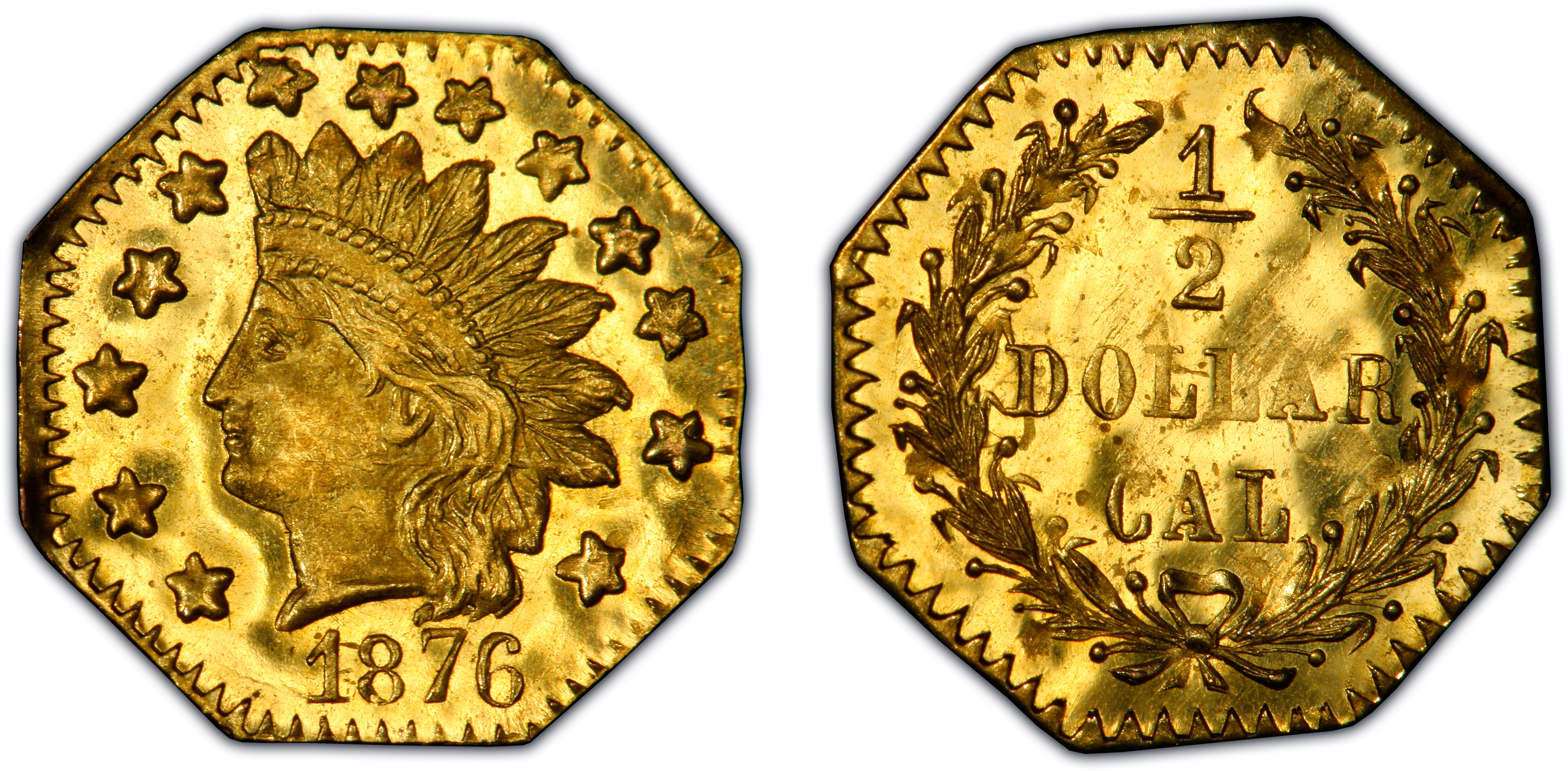
Obverse & Reverse
The 1876 BG-950 50-cent piece emerges from the second great period of California fractional gold production (1859-1882), a fascinating era that saw these miniature coins transition from urgent monetary necessity to cherished souvenirs and jeweler's novelties. The initial 'Period One' (1852-1856) issues were struck by private minters to alleviate a severe shortage of small change during the chaotic peak of the Gold Rush. However, by the 1870s, the monetary landscape had stabilized with the robust output of the San Francisco Mint. The Coinage Act of 1864 had officially outlawed private coinage, yet enforcement was lax, allowing a new generation of jewelers and artisans, many of them French immigrants in San Francisco, to continue striking these tiny gold pieces. The motivation had shifted; these 'Period Two' or 'Jeweler's Issues' were no longer primarily intended to facilitate commerce. Instead, they catered to a burgeoning tourist trade and a local appetite for keepsakes that embodied the romantic spirit of the Gold Rush. The Centennial Exposition in Philadelphia in 1876 created a nationwide fervor for historical souvenirs, and it is highly probable that issues like the BG-950 were produced to meet this demand. These later pieces were often underweight and of variable fineness compared to their Period One predecessors, as their value was derived more from their novelty than their intrinsic metal content. Struck crudely by hand using a hammer and anvil, the quality varied immensely. The BG-950, with its classic Indian Head design, is a quintessential example of this later period—a tangible link to the Centennial year and the enduring legacy of California's gold.
Associated EventPost-Gold Rush California / U.S. Centennial Year
Reason For MintingPrimarily struck as souvenirs and novelty items for the jewelry trade, rather than for general circulation, during the U.S. Centennial year.
Minter HistoryThe specific minter or jeweler who created the dies for BG-950 is unknown to history, a common trait for most 'Period Two' California Fractional Gold. Research by scholars like Walter Breen and Ronald J. Gillio, whose work is the basis for the 'BG' cataloging system, attributes these pieces to a group of anonymous, often French, jewelers operating in San Francisco. Unlike the earlier Period One minters who sometimes initialed their work, the makers of these later issues remain lost to time, their legacy being the varied and distinctive die pairings they produced.
Historical SignificanceThe BG-950 is significant not as a circulating coin but as a numismatic artifact representing the commercial evolution of private gold. It marks the transition from utilitarian coinage of necessity to souvenir tokens, reflecting California's maturation from a raw frontier to a place of romance and tourism. Its 1876 date explicitly ties it to the nation's Centennial, making it a memento of a pivotal year in American history, as viewed through the lens of the still-potent legend of the Gold Rush.
K-N/A
Denomination50 Cents
Minting Period1876
Assayer/MinterUnknown Private Minter
Geographic OriginSan Francisco, California
Obverse DescriptionFeatures a stylized Indian Head facing left, a popular motif for the era. The portrait is somewhat crude, typical of jeweler's issues. The date '1876' appears below the bust. Thirteen five-pointed stars encircle the central device along the octagonal border.
Obverse Inscription1876
Reverse DescriptionThe central device is the denomination '1/2' enclosed within a wreath. The wreath is composed of two branches tied with a bow at the bottom. The legend 'CALIFORNIA GOLD' follows the upper octagonal rim, outside of the wreath.
Reverse InscriptionCALIFORNIA GOLD 1/2
CompositionGold
Stated Fineness Actual FinenessVariable, often between .500 and .800 fine gold, typical for Period Two jeweler's issues.
Weight0.32 grams
Diameter10.00 mm
EdgePlain
Unknown
Survival EstimateFewer than 12 known. Based on combined NGC and PCGS population reports (as of late 2025), a total of approximately 9-10 examples have been certified, corroborating the R-7 rating.
Rarity ScaleR-7 (4-12 Known)
This coin is highly sought after due to its extreme rarity (R-7) and its specific date of 1876, the U.S. Centennial year. As an octagonal Indian Head type, it represents one of the most popular design combinations in the California Fractional Gold series. Its status as a 'Jeweler's Issue' adds a layer of historical intrigue.
Key VarietiesThe BG-950 is a specific die marriage and is considered a single variety. No major sub-varieties from the original striking period are known. Unlike some earlier territorial issues, there are no known later-date restrikes or pattern pieces associated with this specific die pair. Collectors should be aware of modern replicas, which are common for this series but are typically crude, often made of brass, and do not match the specific die characteristics of a genuine BG-950.
Authentication TipsGenuine BG-950 pieces have a distinctive die character. The lettering often shows weakness in spots, and the stars can be unevenly shaped, which are hallmarks of hand-striking. The surfaces should have the texture of genuine gold, not the soapy or pimpled feel of a cast counterfeit. Weight and size are key; fakes are often incorrect. The most definitive authentication is third-party grading by PCGS or NGC, who maintain databases of genuine die characteristics for comparison. Any piece not professionally certified should be regarded with extreme caution.
Shopping ConsiderationsFor a premium quality BG-950, a buyer should prioritize a sharp strike and clean surfaces. Look for examples where the date is fully legible and the details within the wreath are as clear as possible; these areas are often weakly struck. Original, lustrous surfaces command a significant premium, as many surviving examples have been cleaned, polished, or previously mounted in jewelry. Examine the rims and points of the octagon carefully for evidence of removal from a bezel. Given its R-7 rarity, any example is a major acquisition, but one with superior eye appeal, problem-free surfaces, and a strong strike would be a centerpiece of an advanced collection.
A coin's grade is its condition, rated on a 1-70 scale. For rare coins, this is the most critical factor in determining value, as a tiny difference in preservation can mean a huge difference in price.
Relevant Grade TypesOriginal period issues of BG-950 were business strikes. Due to their primary purpose as souvenirs, many entered collections immediately and survive in high grades, from Circulated (1-58) to Mint State (MS, 60-70). The majority of certified examples are Mint State. There is no evidence of Proof (PR/PF) examples being struck during the original period of issue, and no later-date Proof restrikes are known to exist for this variety.
Mint State CharacteristicsUncirculated examples of BG-950 are characterized by their often prooflike or semi-prooflike surfaces, a result of being struck from fresh, polished dies on polished planchets. Luster is typically bright and flashy rather than soft and satiny. The strike is a key differentiator; many are softly struck, particularly on the highest points of the Indian's hair and the leaves of the wreath. A specimen with a bold, complete strike is exceptionally rare and desirable. Small planchet flaws or adjustment marks are not uncommon given the crude manufacturing process.
Circulated Wear PatternsOn circulated examples, wear first appears on the high points of the Indian's cheek, hair, and the feathers of the headdress. On the reverse, the highest points of the wreath and the numerals '1/2' will show the first signs of friction. In lower grades (Fine and below), the date and the legend 'CALIFORNIA GOLD' will begin to weaken and merge with the fields.
Key Factors For ValueExtreme rarity is the primary value driver. Beyond that, the key factors are surface quality and strike. An example with original, undisturbed prooflike surfaces is far more valuable than one that has been cleaned or polished, even if both are technically 'uncirculated.' Strike sharpness is paramount; a coin with a fully struck date and wreath will command a substantial premium over a weakly struck counterpart. Eye appeal, encompassing attractive original toning and a lack of distracting marks, is also critical. A CAC sticker for this issue would be a significant value enhancer, confirming premium quality for the assigned grade.
PCGS Price Guide
| Grade | Price | Population |
|---|---|---|
| 61 | $900.00 | 1 |
| 62 | $1,000.00 | 3 |
| 62+ | $1,200.00 | N/A |
| 63 | $1,500.00 | 3 |
| 63+ | $1,750.00 | N/A |
| 64 | $2,500.00 | 4 |
| 64+ | $3,500.00 | N/A |
| 65 | $6,000.00 | 3 |