1869 G25C BG-827 (Regular Strike)
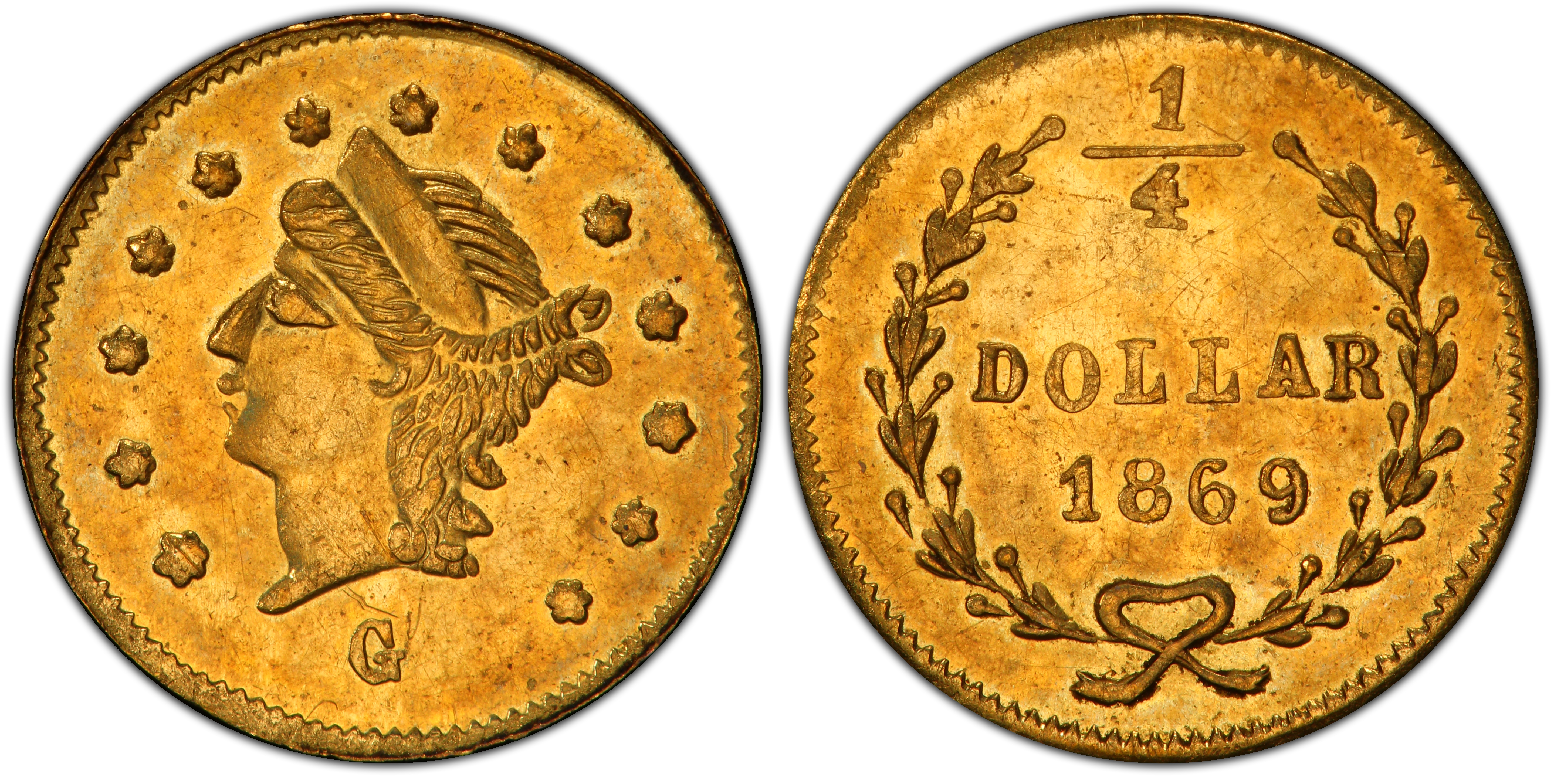
Obverse & Reverse
The 1869 BG-827 25 Cent piece emerges from the second great era of California Fractional Gold production, a period numismatically distinct from the initial wave of necessity-driven coinage. By 1869, the acute shortage of small change that plagued California in the early 1850s had been largely resolved by the output of the San Francisco Mint, which opened in 1854. Consequently, the purpose of these diminutive gold pieces shifted dramatically. They were no longer essential cogs in the machinery of commerce but had transformed into popular souvenirs and items of jewelry. This era, known to specialists as 'Period Two' (1858-1882), was characterized by pieces struck not to satisfy a monetary need, but to cater to a burgeoning tourist trade and a local appetite for keepsakes embodying the romance of the Gold Rush. Legally, the production of these denominated tokens existed in a gray area. The Coinage Act of April 22, 1864, had explicitly outlawed private coinage intended to pass as legal tender. However, enforcement of this law by the Secret Service was lax and inconsistent, not becoming truly stringent until 1883. This window of weak enforcement allowed dozens of jewelers and private minters, mostly in San Francisco, to continue producing denominated fractional gold pieces throughout the late 1860s and 1870s. These minters often used backdated dies to create an aura of historical authenticity, though the 1869 date on the BG-827 is considered contemporary to its striking. The intrinsic value of these 'Period Two' pieces was almost always significantly less than their face value; their gold content was often debased and weights were inconsistent, reinforcing their status as tokens rather than true coins. They were novelties, meant to be mailed back East in letters as a tangible piece of California's golden allure or mounted into rings, brooches, and stickpins. The BG-827, therefore, is not a relic of the chaotic, frontier economy of 1852, but rather a product of a more mature, post-Civil War California. It represents the commercialization of the Gold Rush mythos, a tangible piece of memorabilia from an era when the state was already beginning to capitalize on its legendary past. Its existence speaks to a continued fascination with gold and a market for affordable, portable symbols of the California dream.
Associated EventPost-Gold Rush California Souvenir Trade
Reason For MintingPrimarily produced to be sold as souvenirs, keepsakes, and for use in jewelry rather than for general circulation.
Minter HistoryThe specific minter of the BG-827 variety is unknown, a common trait for most 'Period Two' California Fractional Gold issues. The pieces were typically produced by various jewelers and artisans located in San Francisco who created their own dies. These small-scale operations rarely 'signed' their work, and records of their production are virtually nonexistent. Their legacy is the vast and complex series of die varieties cataloged by researchers like Breen and Gillio.
Historical SignificanceThis coin is significant not as a circulating medium of exchange, but as a historical artifact representing the transition of California Fractional Gold from necessity coinage to souvenir tokens. It exemplifies the post-1864 period of technically illegal but tolerated private minting and the commercialization of the Gold Rush narrative for a tourist and gift market.
N/A
DenominationG25C (Gold 25 Cents)
Minting Period1869
Assayer/MinterUnknown Private Minter
Geographic OriginSan Francisco, California
Obverse DescriptionA small, right-facing Liberty Head, stylistically similar to the contemporary U.S. gold coinage but of a cruder, simplified execution. The hair is tied in the back. The portrait is encircled by 13 five-pointed stars, often weakly struck, with the date '1869' positioned below the bust.
Obverse Inscription1869
Reverse DescriptionThe denomination '25 CENTS' is displayed across two lines within a delicate wreath. The wreath is composed of two branches tied together at the bottom with a bow. The design is simple and the elements are often softly defined.
Reverse Inscription25 CENTS
CompositionGold
Stated Fineness Actual FinenessVariable, often debased. Period Two pieces typically range from 14 to 22 karats (.583 to .917 fine).
Weight0.25 grams
Diameter9.80 mm
EdgePlain
Unknown
Survival Estimate31-75
Rarity ScaleR-5
The BG-827 is sought after for its direct connection to the romanticized post-Gold Rush era of California. As a 'Period Two' issue, it is more affordable than its earlier, circulating counterparts, making it an accessible entry point into this fascinating field. The small size and intricate (though often crude) detail offer a unique collecting challenge. Many specimens exhibit prooflike surfaces, adding to their aesthetic appeal.
Key VarietiesNo major die varieties are recognized for BG-827 itself, as the Breen-Gillio classification system already designates it as a specific die marriage. There are no known original proof strikes or official restrikes. All examples are considered business strikes, though many were produced with polished dies resulting in prooflike (PL) or deeply prooflike (DPL) surfaces, which are highly desirable and often noted by grading services.
Authentication TipsAuthentic 'Period Two' pieces like BG-827 are always denominated (e.g., '25 CENTS' or '1/4 DOLLAR'). Replicas made after 1883 or modern fakes often lack a denomination or use phrases like 'CAL GOLD CHARM'. Genuine examples are extremely thin and lightweight, often appearing fragile. Many common counterfeits are thicker, heavier, and made of brass or thinly plated base metal. Authentic pieces frequently exhibit a weak or uneven strike due to the crude hammer-striking process; a perfectly sharp, strong strike can be a sign of a modern replica. Lastly, no genuine pieces from this era feature a bear on the reverse; this is a hallmark of 20th-century fantasy pieces.
Shopping ConsiderationsA premium quality example for its grade will possess exceptionally clean surfaces with minimal distracting marks. Given their use in jewelry, carefully check the rims and surfaces under magnification for evidence of mounting, solder, or tooling. Strike is a critical factor; while perfect strikes are rare, seek examples with as much detail as possible in the center of Liberty's hair and the leaves of the wreath. Originality of the surface is paramount. Many specimens have been harshly cleaned over the years, leaving a dull or hairlined appearance. A coin with original, lustrous, or prooflike surfaces commands a significant premium. Attractive, reddish-gold toning that highlights the devices is also highly prized.
A coin's grade is its condition, rated on a 1-70 scale. For rare coins, this is the most critical factor in determining value, as a tiny difference in preservation can mean a huge difference in price.
Relevant Grade TypesAll original BG-827 issues were struck as business strikes, intended for sale as souvenirs. They are found in Circulated (1-58) and Mint State (MS, 60-70) grades. Many Mint State examples were struck using polished dies, resulting in Prooflike (PL) or Deep Prooflike (DPL) examples, which are not true Proofs but are highly sought-after. No true Proof (PR/PF) examples were struck during the original period of issue, and there are no known later-date collector restrikes.
Mint State CharacteristicsUncirculated examples of BG-827 often exhibit surprisingly vibrant, prooflike or mirror-like fields due to the use of polished dies by the jeweler-minters. However, the strike is often weak and uneven, a result of the manual hammer-striking process. It is common to see softness in the stars, the high points of Liberty's hair, and the details of the wreath's bow. Luster is typically bright and flashy, not soft and satiny. Small planchet flaws, fissures, or adjustment marks are not uncommon and should be evaluated for their impact on eye appeal.
Circulated Wear PatternsWear first appears on the highest points of the design. On the obverse, look for flattening on the hair above Liberty's eye and ear, and on her cheekbone. On the reverse, the bow of the wreath and the highest leaves are the first elements to show friction and lose detail. In lower circulated grades (VF and below), the stars on the obverse will begin to merge with the fields, and the letters and numbers of the denomination will become soft.
Key Factors For ValueThe primary drivers of value for this coin are surface preservation and strike quality. A high-grade example with pristine, original prooflike surfaces and minimal contact marks is far more valuable than a heavily abraded or cleaned piece. While some strike weakness is expected, specimens with an unusually sharp strike on both the central portrait and the wreath command a substantial premium. Eye appeal is crucial; a coin with attractive color and vibrant, flashy luster will be more desirable than a dull or lackluster example. A sticker from CAC (Certified Acceptance Corporation) indicating premium quality for the grade will also add a significant premium.
PCGS Price Guide
| Grade | Price | Population |
|---|---|---|
| 50 | $200.00 | 1 |
| 50+ | $210.00 | N/A |
| 53 | $215.00 | N/A |
| 53+ | $220.00 | N/A |
| 55 | $225.00 | 6 |
| 55+ | $230.00 | N/A |
| 58 | $250.00 | 5 |
| 58+ | $265.00 | N/A |
| 60 | $300.00 | 1 |
| 61 | $325.00 | 4 |
| 62 | $375.00 | 17 |
| 62+ | $400.00 | N/A |
| 63 | $475.00 | 7 |
| 63+ | $600.00 | N/A |
| 64 | $850.00 | 1 |