1881 G50C BG-952B (Regular Strike)
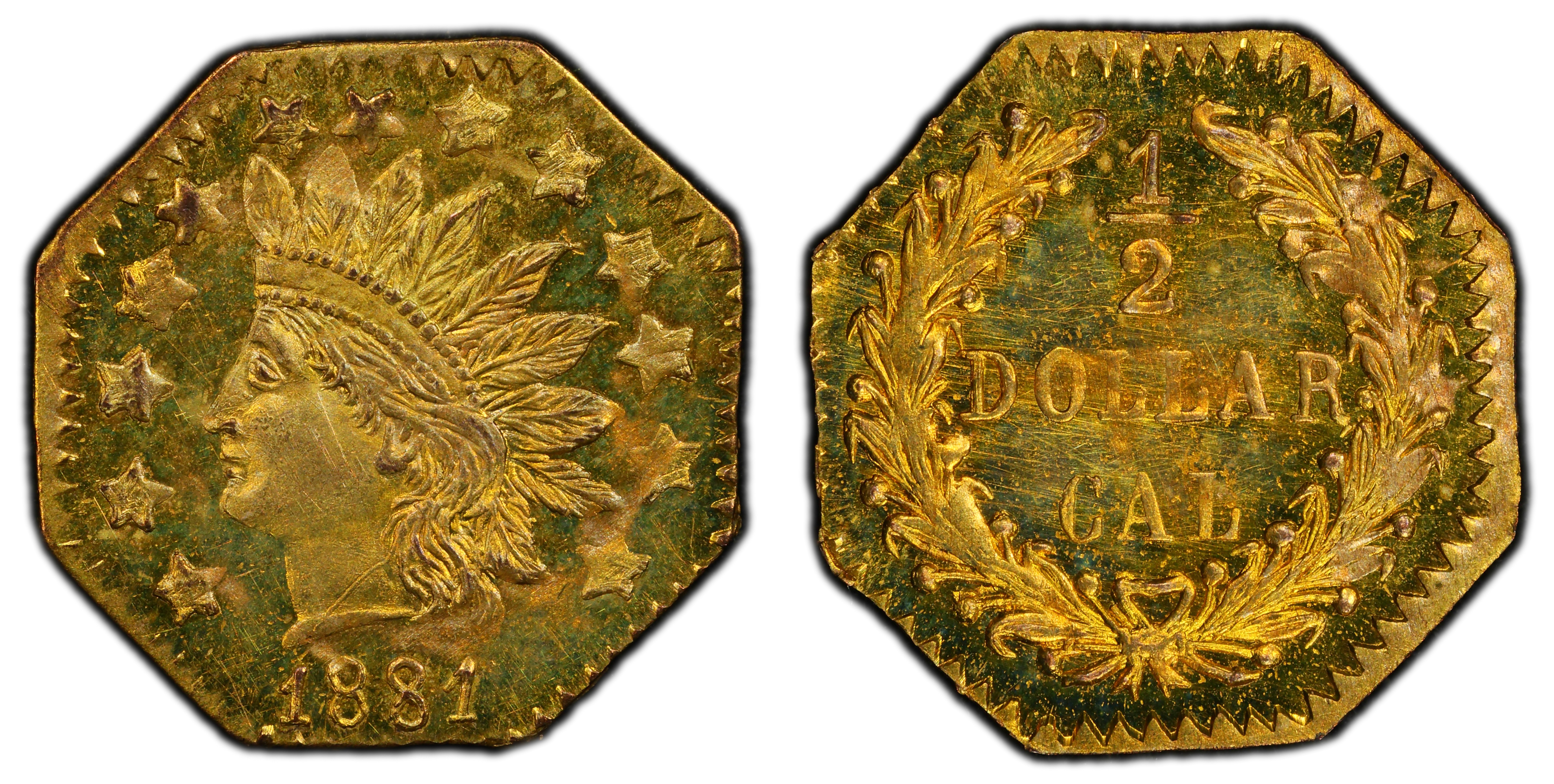
Obverse & Reverse
The 1881 BG-952B 50 Cents is a quintessential example of a 'Period Two' California Fractional Gold piece. The story of these fascinating miniature gold issues is bifurcated into two distinct eras. 'Period One' (1852-1857) consists of pieces struck out of commercial necessity to alleviate a severe shortage of small change during the initial chaos of the California Gold Rush. These early issues, though privately minted and often underweight, actively circulated and are considered true territorial coins. However, the establishment and efficiency of the San Francisco Mint in 1854 gradually satisfied the region's coinage needs, rendering the fractional gold pieces obsolete for commerce. Following a brief hiatus, jewelers recognized a new market for these items not as currency, but as souvenirs and keepsakes. This marked the beginning of 'Period Two' (1859-1882), during which a plethora of varieties were struck. The 1881 BG-952B falls squarely into this later period. These pieces were not intended to circulate but were sold to tourists, sent back East in letters as novelties, or mounted as jewelry. The designs often mimicked federal coinage, featuring Liberty or Indian heads, to enhance their appeal as miniature 'coins.' Production of denominated pieces ceased around 1882-1883 after the U.S. Secret Service began to enforce the Private Coinage Act of 1864 more strictly, viewing these items as illegal competition to official U.S. coinage. Thus, the BG-952B represents one of the final chapters in this uniquely American private minting tradition, a tangible link to the enduring mythology of the Gold Rush, produced decades after the initial frenzy had subsided but while its romantic allure was still a powerful commercial force.
Associated EventPost-Gold Rush California Commerce and Tourism
Reason For MintingProduced primarily as a souvenir or keepsake for the tourist trade, capitalizing on the romanticism of the California Gold Rush.
Minter HistoryThe specific minter for the BG-952B variety is unrecorded, a common trait for many 'Period Two' issues. Production was largely the domain of various San Francisco-based jewelers and private minters who created a wide array of dies. While some earlier minters are known (e.g., Deriberpe, Nouizillet, Routhier), many later producers operated anonymously. These craftsmen were skilled die sinkers and press operators, but their primary business was jewelry and novelty items, not large-scale monetary production. Their legacy is the immense variety of charming, if often crudely struck, souvenir gold pieces that characterize the later years of the series.
Historical SignificanceAs a 'Period Two' issue, its significance lies not in its use as circulating money, but as a cultural artifact. It demonstrates the commercialization of the Gold Rush legend and the demand for affordable souvenirs from the West. Numismatically, it is part of a complex and widely collected series that represents the last major chapter of legal, private precious metal coinage in the United States before federal laws were fully enforced.
BG-952B
Denomination50 Cents
Minting Period1881
Assayer/MinterUnknown Jeweler
Geographic OriginSan Francisco, California
Obverse DescriptionFeatures a stylized Indian Princess head facing left, adorned with a feathered headdress. The portrait is surrounded by 13 six-pointed stars, representing the original colonies. The date '1881' is positioned below the bust truncation.
Obverse Inscription1881
Reverse DescriptionThe central device is the denomination '1/2' which is contained within a laurel wreath. The wreath is composed of numerous leaves and berries and is tied with a bow at the bottom. The inscription 'DOLLAR' and 'CAL.' are typically found outside the wreath, though positioning varies by die state.
Reverse Inscription1/2 DOLLAR CAL.
CompositionGold
Stated Fineness Actual FinenessVaries, typically between .500 and .800 fine (12-19 Karat). Period Two pieces are known to have a lower and more inconsistent fineness than their Period One predecessors.
Weight0.25 grams
Diameter10.00 mm
EdgePlain
Unknown
Survival EstimateModerately Scarce. Based on a combined PCGS and NGC population of approximately 25-35 examples in all grades, a total survival estimate of 50-75 pieces is plausible.
Rarity ScaleR-5 (Very Scarce)
The BG-952B is popular as a representative of the late-period, octagonal Indian Head design type. Its appeal lies in its direct connection to the California Gold Rush story, affordability compared to 'Period One' issues, and the challenge of collecting the numerous Breen-Gillio varieties. The small size and tangible gold content make it a charming and historically rich collectible.
Key VarietiesThe primary variety is the regular business strike. No proof or special presentation strikings are known for BG-952B. The broader series contains hundreds of die marriage varieties cataloged by Breen-Gillio (BG), differing in design details, inscriptions, shape (round or octagonal), and date. No specific later-date restrikes of the BG-952B die marriage are recorded.
Authentication TipsAuthentic 'Period Two' pieces like BG-952B are very thin and light. Modern replicas are often thicker, heavier, and have a 'soapy' or cast-like appearance with mushy details. Genuine examples often show a somewhat crude, hand-struck quality, sometimes with slight off-center strikes or uneven impressions. The surfaces should exhibit original mint luster, not a uniform polished shine. Critically, genuine pieces must bear a denomination (e.g., '1/2 DOLLAR'); souvenir tokens made after 1883 are undenominated (e.g., '1/2 CAL GOLD') to comply with the law and are of little numismatic value.
Shopping ConsiderationsA premium quality example for this issue is defined by a sharp strike, especially on the fine details of the headdress feathers and the wreath leaves. Look for problem-free surfaces without evidence of cleaning, polishing, or mounting for jewelry (check rims for solder marks or smoothing). Luster is key; attractive, original satiny or prooflike surfaces command a significant premium. Given their souvenir nature, many survived in high grades, so collectors should seek out Mint State examples if possible. Weakness in the strike is common, but pieces with above-average definition and good eye appeal are highly desirable.
A coin's grade is its condition, rated on a 1-70 scale. For rare coins, this is the most critical factor in determining value, as a tiny difference in preservation can mean a huge difference in price.
Relevant Grade TypesAll original BG-952B coins are considered business strikes, as they were produced for commercial sale as souvenirs, not for monetary circulation. They are found in Circulated grades (About Uncirculated-50 to 58 are most common for pieces that were handled or kept as pocket pieces) and Mint State (MS, 60-70) grades. No true Proofs were struck during the original period of issue, and there are no known later-date Proof restrikes for this variety.
Mint State CharacteristicsUncirculated examples of BG-952B often exhibit a bright, slightly reflective luster. The quality of the strike can vary significantly; weakly struck pieces will show a lack of detail on the high points of the Indian's cheek and the feathers. Conversely, a well-struck example will have sharp, distinct feathers and a bold date. Small planchet flaws or adjustment marks are not uncommon and should be noted, but do not necessarily detract from the grade unless severe.
Circulated Wear PatternsWear first appears on the high points of the design: the Indian's cheekbone, the eyebrow, and the details of the feathers in the headdress. On the reverse, the highest points of the wreath leaves and the numerals of the fraction will show initial friction and flattening. In lower grades (VF and below), the stars on the obverse will begin to merge with the fields and the legend on the reverse will become soft.
Key Factors For ValueThe primary drivers of value for an 1881 BG-952B are grade and surface quality. A sharp, well-struck coin with brilliant, undisturbed mint luster will always sell for a substantial premium over a weakly struck or cleaned example of the same grade. Eye appeal is paramount; coins with rich, original reddish-gold toning are highly prized. A CAC sticker, indicating premium quality for the grade, adds a significant premium, as it confirms the coin's superior strike and surface preservation.
PCGS Price Guide
| Grade | Price | Population |
|---|---|---|
| 58 | $275.00 | 1 |
| 58+ | $285.00 | N/A |
| 60 | $300.00 | N/A |
| 61 | $325.00 | N/A |
| 62 | $350.00 | 4 |
| 62+ | $365.00 | N/A |
| 63 | $400.00 | 6 |
| 63+ | $420.00 | N/A |
| 64 | $500.00 | 10 |
| 64+ | $575.00 | N/A |
| 65 | $950.00 | 11 |
| 65+ | $1,250.00 | N/A |
| 66 | $2,500.00 | N/A |
| 66+ | $3,000.00 | N/A |
| 67 | $3,500.00 | N/A |