1873 G50C BG-915 (Regular Strike)
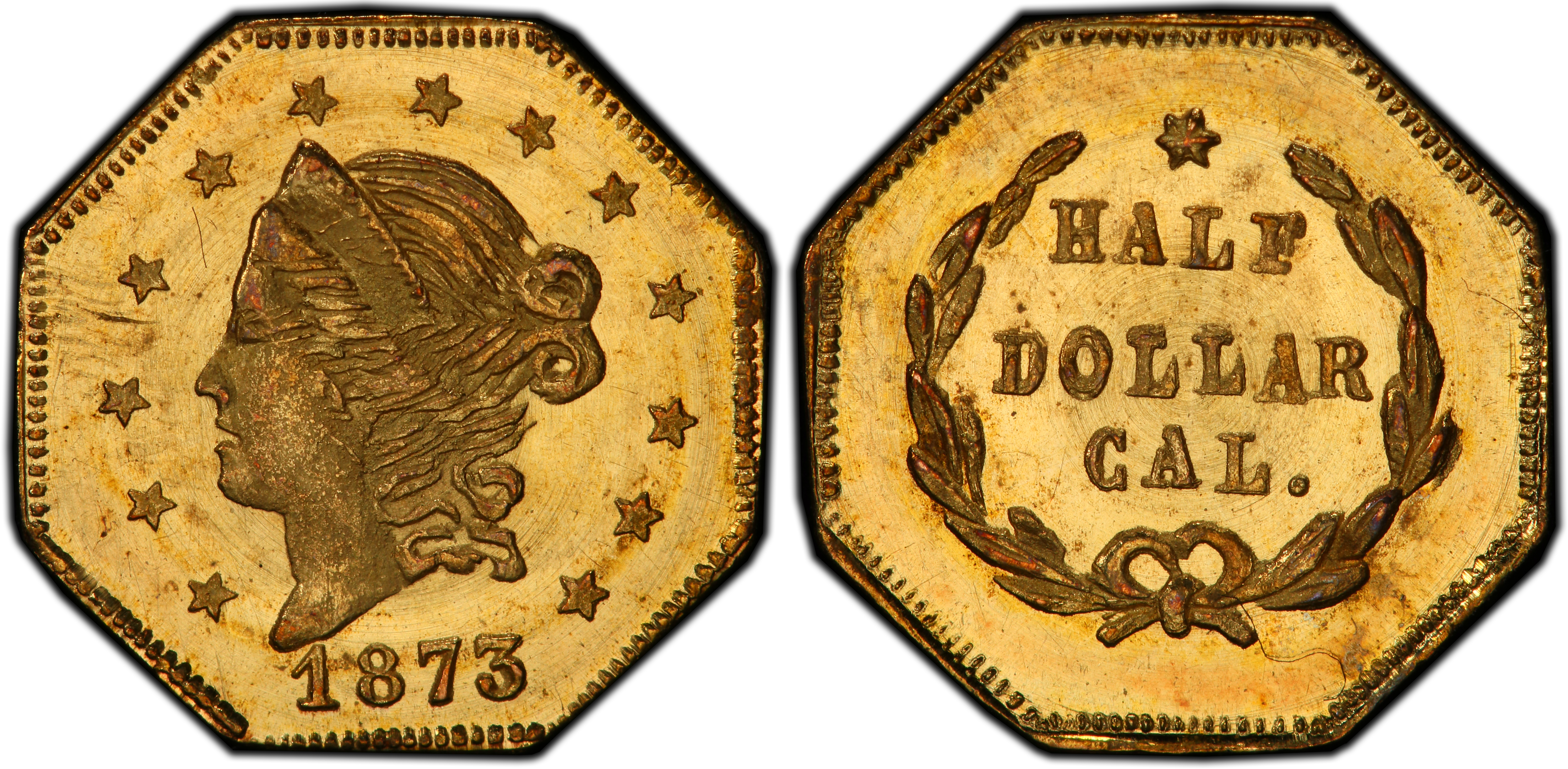
Obverse & Reverse
The 1873 Octagonal 50 Cents, cataloged as Breen-Gillio 915, is a quintessential example of a 'Period Two' California Fractional Gold piece. Unlike their 'Period One' (1852-1857) predecessors which were struck to alleviate a critical shortage of small change during the initial frenzy of the Gold Rush, the Period Two issues were created under vastly different circumstances. By the 1870s, the San Francisco Mint was in full operation, supplying the region with ample federal coinage. The acute need for privately minted currency had vanished. Instead, a thriving tourism and souvenir market had emerged. California, and particularly San Francisco, was a destination of immense romantic appeal to Easterners and Europeans, a land of gold and adventure. Enterprising jewelers, many of French origin, recognized this demand and began producing small, attractive gold tokens reminiscent of the earlier, functional issues. These 'jeweler's issues' were not intended for circulation but were sold as keepsakes, charms, and mementos of a visit to the Golden State. They were often intentionally underweight and of varying fineness, their value derived from their novelty rather than their intrinsic metal content. The Coinage Act of 1864 had made private coinage illegal, but the law was not strictly enforced by the Secret Service against these small souvenir pieces until the early 1880s. This legal gray area allowed for their production for over two decades. The BG-915, with its classic Liberty Head design, directly evoked the imagery of federal gold coinage, enhancing its appeal as a miniature treasure. It represents a fascinating transition in private minting: from a utilitarian response to economic necessity to a commercial enterprise catering to a burgeoning tourist trade and the public's fascination with the lingering mystique of the Gold Rush.
Associated EventCalifornia Gold Rush (Later Souvenir Period)
Reason For MintingPrimarily manufactured for sale to tourists and collectors as souvenirs of California, not for general circulation.
Minter HistoryThe specific minter or jeweler who produced the BG-915 variety is unknown. This is common for many 'Period Two' issues, which were often made anonymously to avoid potential scrutiny from federal authorities. Production was centered among the many jewelers in San Francisco who had the skills and equipment for die sinking and striking small gold pieces. Notable Period Two manufacturers included firms like Frontier & Deviercy and Robert B. Gray & Co., but a direct link to this specific variety has not been established.
Historical SignificanceThis coin is significant not as a circulating medium, but as a tangible artifact of California's post-Gold Rush economy and burgeoning tourism industry. It demonstrates the commercial adaptation of a numismatic concept—private gold coinage—from a practical necessity to a souvenir commodity, reflecting the romantic and mythologized perception of California in the American imagination during the late 19th century.
BG-915
Denomination50 Cents
Minting Period1873
Assayer/MinterUnknown Jeweler
Geographic OriginSan Francisco, California
Obverse DescriptionA classic Liberty Head design, facing left, similar in style to the contemporary federal gold coinage. The portrait is surrounded by 13 six-pointed stars representing the original colonies.
Obverse Inscription[None]
Reverse DescriptionThe denomination '50 CENTS' and date '1873' are contained within a continuous wreath of leaves and berries. The wreath is open at the top.
Reverse Inscription50 CENTS 1873
CompositionGold
Stated Fineness Actual FinenessVariable; Period Two issues were often less than the .900 standard of federal coins and were frequently underweight.
Weight0.75 grams
Diameter10.70 mm
EdgePlain
Unknown
Survival Estimate150-200
Rarity ScaleR-4
The BG-915 is popular among collectors for its classic Liberty Head design, attractive octagonal shape, and its status as a representative 'jeweler's issue.' It is one of the more available Period Two varieties, allowing collectors to acquire a genuine piece of this fascinating series without the extreme rarity and cost of many other Cal Gold issues. Its 1873 date places it firmly in the souvenir era, making it a key piece for telling the complete story of California's private gold.
Key VarietiesThe BG-915 is a specific die marriage. While there are no major varieties of the BG-915 itself from 1873, the broader series of California Fractional Gold is rich with hundreds of Breen-Gillio varieties, including different designs (Indian heads, Washington heads), shapes (round, octagonal), and denominations from the 1852-1882 period. No later-date restrikes or Proofs of the BG-915 variety are known to exist.
Authentication TipsAuthentic BG-915 examples exhibit specific die characteristics. The strike is often weak on some of the stars and the reverse lettering, particularly the 'F' in HALF and 'A' in DOLLAR. The surfaces should show the texture of a genuine strike, not the porous or tool-marked appearance of a cast counterfeit. The weight and diameter should conform closely to known standards (approx. 0.75g, 10.7mm). Many modern replicas exist; these are typically brassy in color, have a soapy or prooflike finish unlike originals, and often lack the denomination, instead reading 'CAL GOLD' to comply with modern laws. Comparing the coin to high-resolution images of certified examples is the best authentication method.
Shopping ConsiderationsA premium quality BG-915 will exhibit a sharp strike for the issue, with full details on Liberty's hair and the leaves of the wreath. Original, lustrous surfaces are highly desirable and command significant premiums; many surviving examples have been cleaned or polished over the years due to their use in jewelry. Look for coins with attractive, undisturbed reddish-gold or honey-gold toning. Check carefully for evidence of having been mounted in jewelry, such as rim damage or solder marks, which would drastically reduce the value. Given the often-uneven strikes, a coin that is well-centered and has strong details on the date and denomination is considered superior.
A coin's grade is its condition, rated on a 1-70 scale. For rare coins, this is the most critical factor in determining value, as a tiny difference in preservation can mean a huge difference in price.
Relevant Grade TypesOriginal examples of BG-915 were produced as business strikes, though not intended for circulation. They are found in Circulated grades (AU-50 to AU-58 are most common for pieces that saw light handling or jewelry use) and Mint State (MS, 60-70). No true Proofs were struck during the original period of issue, and there are no known later-date Proof restrikes. Any piece described as a 'Proof' is likely a modern replica or has been misattributed.
Mint State CharacteristicsIn uncirculated grades, the BG-915 typically displays a soft, satiny luster. The strike is a key differentiator; many are somewhat weakly struck in the centers. A premium MS example will have sharp details on Liberty's hair curls and the individual leaves on the reverse wreath. Because they were made as souvenirs and not handled like circulating coins, high-grade examples are more common than for Period One issues. However, they are susceptible to small, detracting contact marks due to the softness of the gold.
Circulated Wear PatternsFor examples that experienced light handling or wear, friction first appears on the highest points of the design. On the obverse, this includes Liberty's cheek, the hair above her eye, and the coronet. On the reverse, the highest points of the wreath's leaves and the bow at the bottom will show the first signs of smoothing and loss of detail.
Key Factors For ValueThe primary drivers of value for an 1873 BG-915 are grade and surface quality. An example with original, lustrous surfaces will be worth multiples of a cleaned or polished coin of the same technical grade. Strike quality is crucial; a sharply struck coin is always preferred. Eye appeal, which includes attractive toning and a lack of distracting marks, plays a major role. Certification by a top-tier service (PCGS or NGC) is standard for this series and essential for ensuring authenticity and liquidity. A CAC sticker on a certified coin indicates premium quality for the grade and will add a significant premium to its value.
PCGS Price Guide
| Grade | Price | Population |
|---|---|---|
| 53 | $230.00 | 1 |
| 53+ | $235.00 | N/A |
| 55 | $245.00 | 5 |
| 55+ | $250.00 | N/A |
| 58 | $260.00 | 5 |
| 58+ | $265.00 | N/A |
| 60 | $275.00 | N/A |
| 61 | $300.00 | 9 |
| 62 | $340.00 | 20 |
| 62+ | $350.00 | N/A |
| 63 | $400.00 | 37 |
| 63+ | $425.00 | N/A |
| 64 | $525.00 | 37 |
| 64+ | $625.00 | 1 |
| 65 | $950.00 | 25 |
| 65+ | $1,100.00 | N/A |
| 66 | $1,500.00 | 4 |
| 66+ | $2,000.00 | 2 |
| 67 | $2,750.00 | N/A |