1872 G50C BG-938, PL (Regular Strike)
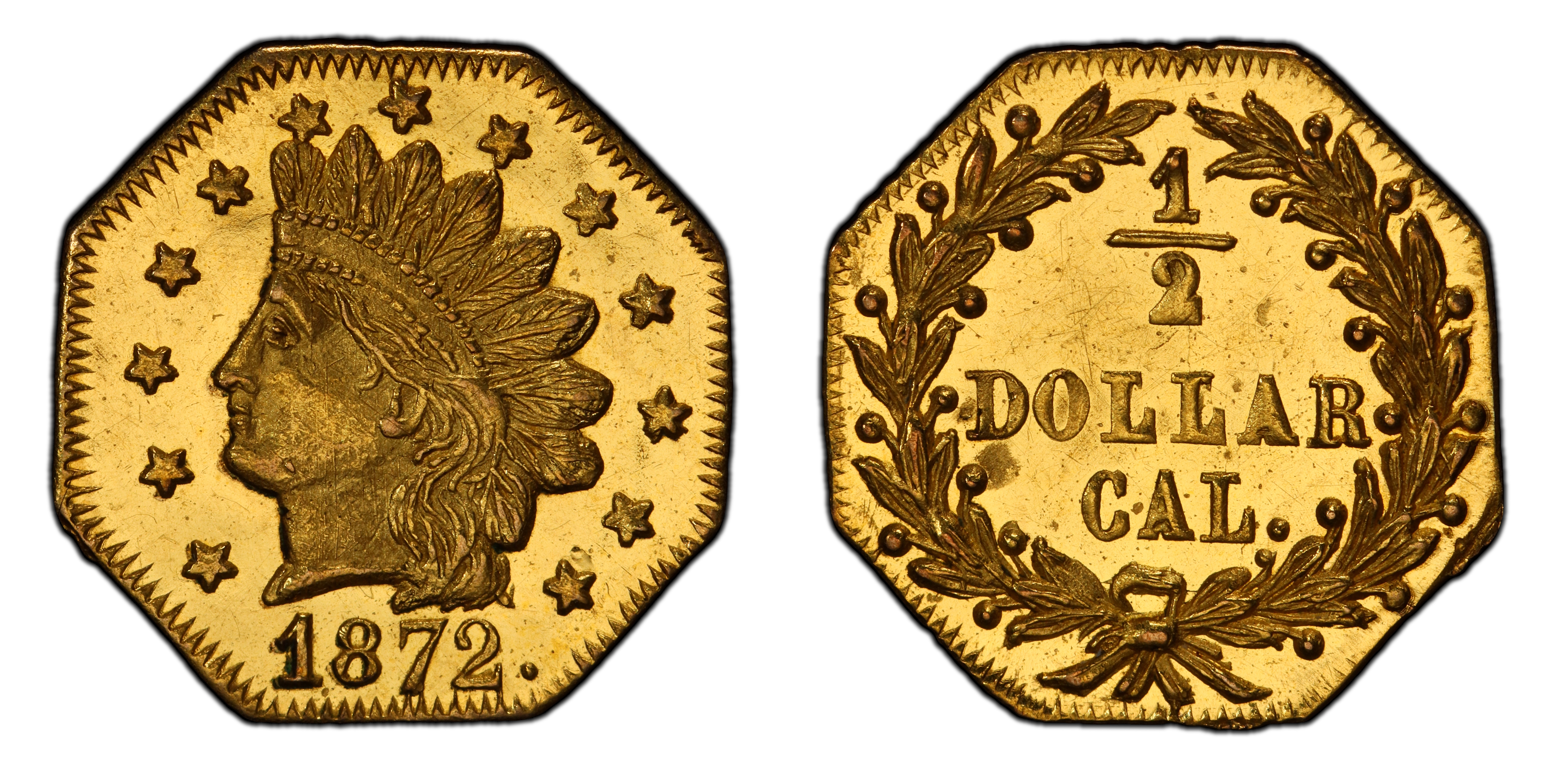
Obverse & Reverse
The 1872 G50C BG-938 is a product of the second period of California Fractional Gold production (1859-1882), a fascinating era that followed the initial gold rush frenzy. By the 1870s, the economic landscape of California had matured. The massive influx of federal coinage had largely obviated the need for private issues for commerce, as was the case in the early 1850s. Instead, these small-denomination gold pieces transitioned into a new role as souvenirs and keepsakes, popular with tourists and locals alike as mementos of California's golden heritage. Unlike their Period One predecessors, which were struck to alleviate a shortage of circulating small change, Period Two pieces were primarily novelties. Their production was spurred by the Act of April 21, 1864, which criminalized private coinage. Enterprising jewelers and mints found a loophole: so long as the coin did not mimic a federally-issued denomination, it could be legal. This led to the creation of 'Half Dollar' and 'Dollar' denominations in gold, which did not directly copy the designs of U.S. silver coinage. The BG-938 variety, with its 'Plain Liberty' head, is characteristic of this later period. These pieces were often sold in sets or individually and were manufactured by various San Francisco jewelers. Their production was a blend of machine and hand craftsmanship, resulting in numerous die varieties that captivate specialists today. The quality of engraving and striking varied, but the goal was to create an attractive, miniature gold coin that captured the spirit of the West. Their legality remained a gray area, and federal authorities eventually cracked down, leading to the cessation of their manufacture around 1882. Today, they are not just numismatic items, but tangible artifacts of post-Gold Rush California, representing a unique intersection of commerce, law, and tourism.
Associated EventPost-California Gold Rush economic stabilization and tourism boom.
Reason For MintingPrimarily created as souvenirs and novelty items for tourists and collectors, rather than for general circulation.
Minter HistoryThe specific minter for BG-938 is unknown, a common trait for many Period Two fractionals. Production was decentralized among various San Francisco jewelers and engravers. Firms like Robert B. Gray & Co. are known to have been major producers of similar items during this period. These artisans operated in a competitive environment, creating their own dies and striking small quantities of these gold tokens to satisfy the souvenir trade. They were skilled metalworkers but not official minters, leading to the wide variety of designs and sometimes crude workmanship seen across the series.
Historical SignificanceThe BG-938 represents the evolution of private gold coinage from a commercial necessity to a collectible souvenir. It showcases how private enterprise adapted to federal restrictions on coinage by creating quasi-numismatic items that skirted the law. The coin is a key artifact of California's cultural identity in the late 19th century, reflecting the romanticism of the Gold Rush era as it was packaged for a burgeoning tourist market.
N/A
Denomination50 Cents
Minting Period1872
Assayer/MinterUnknown, possibly private jewelers such as Robert B. Gray & Co.
Geographic OriginSan Francisco, California
Obverse DescriptionA head of Liberty facing left, with thirteen stars surrounding. The hair is tied back in a bun. This is known as the 'Plain Liberty' type, characterized by the lack of a coronet or headband. The date is below the bust.
Obverse Inscription1872
Reverse DescriptionThe denomination '1/2' is centered within a wreath of leaves and berries. The wreath is open at the top and tied with a bow at the bottom. The legend 'GOLD' appears at the top, and 'CHARM' at the bottom, outside the wreath.
Reverse InscriptionGOLD 1/2 CHARM
CompositionGold
Stated FinenessNot explicitly stated on the piece.
Actual FinenessVaries by specimen, but typically ranges from .500 to .800 fine (12 to 19 karat gold).
Weight0.25 grams
Diameter9.80 mm
EdgePlain
Unknown
Survival Estimate75-125
Rarity ScaleR-5
The BG-938 is sought after for its specific date, distinctive 'Plain Liberty' design, and its status as a representative of the 'souvenir' or 'charm' era of California Fractional Gold. Its R-5 rarity makes it a challenging but achievable acquisition for specialists. The inclusion of 'GOLD' and 'CHARM' on the reverse is a key feature that explicitly defines its non-monetary, keepsake purpose.
Key VarietiesThis is a regular business strike. No proof or presentation strikings are known for the original period of issue. The Breen-Gillio (BG) catalog system is built upon minute die differences, so BG-938 is itself a specific die marriage variety. Collectors should be aware of contemporary counterfeits and modern replicas, which are common for this series. There are no known major varieties such as overdates or dramatic die breaks for this specific BG number.
Authentication TipsAuthentic BG-938 specimens have a specific die crack that is a key diagnostic: a faint crack running from the rim through the top of the G in GOLD to the wreath. The lettering and stars, though small, should be relatively sharp and well-formed, not mushy or tool-marked as seen on many copies. The planchet should have the correct weight (around 0.25g) and diameter. Be wary of pieces with casting bubbles or a seam on the edge. The surfaces of genuine pieces often exhibit parallel striations from the rolling of the gold strip before blanking.
Shopping ConsiderationsWhen purchasing an BG-938, look for a sharp strike, especially on Liberty's hair details and the fine leaves of the wreath. Luster is a significant value determinant; a premium quality example will have frosty or semi-prooflike surfaces, as many were preserved as keepsakes and never circulated. Avoid coins that have been harshly cleaned, which strips the original surface and imparts a dull, lifeless appearance. Also, inspect carefully for evidence of having been mounted in jewelry, such as solder marks or rim damage, which drastically reduces the value. An example with original, undisturbed surfaces and strong eye appeal commands a significant premium.
A coin's grade is its condition, rated on a 1-70 scale. For rare coins, this is the most critical factor in determining value, as a tiny difference in preservation can mean a huge difference in price.
Relevant Grade TypesOriginal period issues were business strikes, technically intended as charms but produced like coins. They are found in Circulated (1-58) and Mint State (MS, 60-70) grades. Due to their nature as souvenirs, many were preserved in high grades. No true Proofs were struck during the original period of issue for this variety. The 'PL' in the input likely refers to 'Plain Liberty', not 'Prooflike', although some examples can be prooflike in appearance.
Mint State CharacteristicsAn uncirculated BG-938 is characterized by full, unbroken luster, which can range from satiny to semi-prooflike. The strike can be inconsistent; a top-quality piece will show sharp details in Liberty's hair and the wreath's leaves. Minor planchet flaws, such as small striations or laminations, are common due to the private manufacturing process and are not always considered major defects unless they are distracting. Bag marks are less common than on circulating coinage, but small contact marks from handling or storage with other pieces can be present.
Circulated Wear PatternsWear first appears on the highest points: Liberty's cheek, the hair above the ear, and the bun. On the reverse, the high points of the wreath leaves and the bow will show initial friction. In grades below AU-50, the finer details of the hair and leaves will merge, and the legends will begin to soften. As these were rarely circulated, heavy wear is uncommon and usually indicative of use in jewelry.
Key Factors For ValueThe primary value drivers for an BG-938 are grade and surface quality. An example in MS-64 with vibrant luster and clean surfaces can be worth multiples of one in MS-62 with distracting marks. Originality is paramount; coins with their original 'skin' and no signs of cleaning or polishing are highly prized by specialists. Strike sharpness is also key, with well-struck specimens commanding a premium. Eye appeal, encompassing toning (which can range from light yellow to deep orange-gold) and overall aesthetic quality, plays a major role. A CAC sticker for this issue provides third-party verification of quality for the grade and often results in a significant price increase.
PCGS Price Guide
| Grade | Price | Population |
|---|---|---|
| 63 | $1,050.00 | 1 |
| 63+ | $1,250.00 | N/A |
| 64 | $1,750.00 | 2 |
| 64+ | $2,100.00 | N/A |
| 65 | $2,500.00 | N/A |
| 65+ | $3,000.00 | N/A |
| 66 | $3,750.00 | N/A |