1874 G50C BG-958 (Regular Strike)
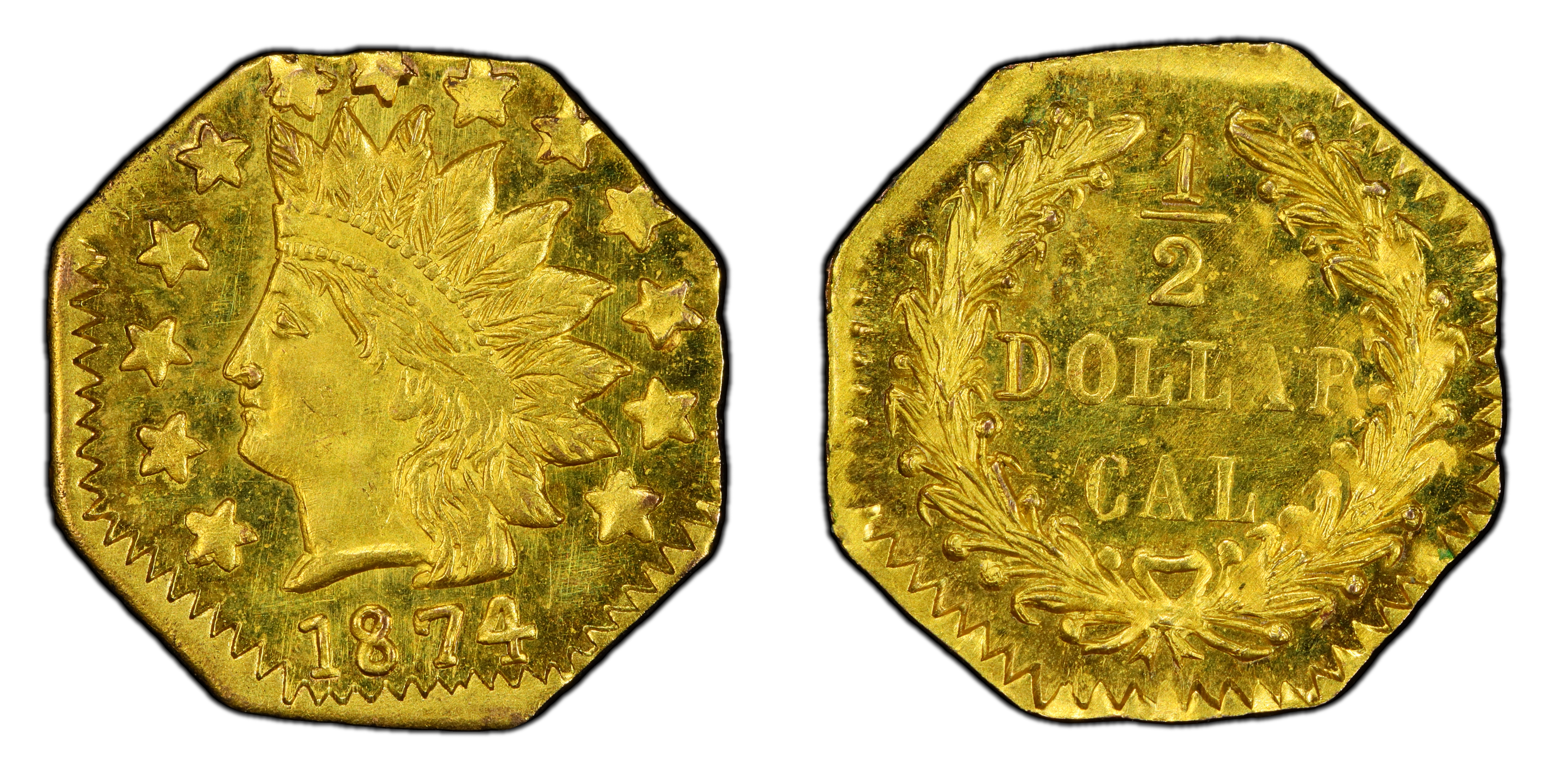
Obverse & Reverse
The 1874 BG-958 50 Cents represents a fascinating chapter in the long and complex story of California Fractional Gold. By 1874, the initial frenzy of the Gold Rush was a quarter-century in the past, but its economic consequences lingered. California, now a mature state, still operated in a commercial environment where small change was chronically scarce. Federal coinage, particularly in silver denominations, was often shipped east to settle accounts, leaving a vacuum for daily transactions. This void, which had existed since the late 1840s, was filled by a succession of private minters who produced diminutive gold coins in 25 cent, 50 cent, and dollar denominations. These pieces, while technically not legal tender, were indispensable for commerce, allowing citizens to buy a drink, a loaf of bread, or a newspaper without resorting to clumsy pinches of gold dust. The period in which the BG-958 was struck is often referred to by numismatists as 'Period Three' (1872-1882) of California Fractional Gold production. This era was characterized by more standardized manufacturing techniques and designs, often produced by jewelers and metallurgists like Robert B. Gray & Co. in San Francisco. Unlike the crude, necessity-driven issues of the early 1850s, these later pieces were well-made and intended to circulate widely, becoming an accepted part of the regional economy. However, their existence was a persistent annoyance to the U.S. government, which viewed private coinage as an infringement on its federal authority. The Coinage Act of 1864 had explicitly outlawed the private minting of coins, yet the practice continued in California due to lax enforcement and genuine local need. These 'tokens' or 'charms,' as they were sometimes defensively called by their makers, continued to be struck until Secret Service crackdowns in the early 1880s finally brought the era to a close. The BG-958, with its Indian Head motif—a popular design choice of the time, echoing federal coinage—is a tangible artifact of this lingering economic independence and the final chapter of a uniquely Western solution to a national currency shortage.
Associated EventPost-Gold Rush Economic Development
Reason For MintingTo alleviate a chronic shortage of small denomination circulating coinage for daily commercial transactions in California.
Minter HistoryRobert B. Gray & Co. was a prominent San Francisco jeweler and one of the most prolific producers of California Fractional Gold during the 1860s and 1870s. Successors to Antoine Nouizillet, the firm was known for its relatively high-quality strikes and consistent production. Gray and his contemporaries operated in a legal gray area, creating pieces that served a vital monetary function despite federal prohibitions. Their output was essential to the small-scale commerce of the region, and their surviving pieces are a testament to the persistent demand for a practical medium of exchange that the federal government was slow to supply to the West Coast.
Historical SignificanceThe BG-958 is significant as it represents the later, more refined period of a uniquely American currency phenomenon. It illustrates how regional economic needs could foster unofficial monetary systems that persisted for decades in defiance of federal law. These fractional gold pieces are a direct link to the everyday life of post-Gold Rush Californians and symbolize the West's continued economic autonomy and ingenuity long after the initial frontier period had passed.
N/A
Denomination50 Cents
Minting Period1874
Assayer/MinterRobert B. Gray & Co.
Geographic OriginSan Francisco, California
Obverse DescriptionA beaded border encloses a stylized female head facing left, often identified as an 'Indian Head,' though it bears resemblance to the contemporary Liberty Head motif. The portrait features hair tied in a bun at the back, adorned with a feathered headdress. Thirteen stars encircle the head.
Obverse Inscription[None]
Reverse DescriptionA beaded border surrounds the denomination '1/2' at the center, enclosed within a wreath of leaves and berries. The wreath is open at the top. The inscription 'CALIFORNIA GOLD' would typically be present, but is effaced on some varieties or states of the die.
Reverse Inscription1/2 DOLLAR
CompositionGold
Stated Fineness Actual FinenessVaries, but typically around .800 to .900 fine.
Weight0.25 grams
Diameter10.00 mm
EdgePlain
Unknown
Survival EstimateFewer than 30
Rarity ScaleR-6 to High R-6
The BG-958 is sought after for its rarity, its connection to the final years of California's pioneer gold era, and the charm of its miniature Indian Head design. As a dated 'Period Three' issue from a known maker, it offers a tangible link to San Francisco's commercial history. The octagonal shape adds to its distinctiveness and collector appeal.
Key VarietiesThe primary variety is the BG-958 as described. A significant related variety is the BG-958A, which was struck from the same dies after they were polished, effacing the 'CAL' from the reverse inscription. Some examples of BG-958 exhibit dramatic double striking, which is a desirable mint error. No special collector issues, such as proofs or restrikes from the original period or later, are known to exist for this specific variety; all are considered business strikes.
Authentication TipsAuthenticity is paramount with California Fractional Gold. Genuine BG-958 pieces exhibit a sharp, albeit sometimes uneven, strike from high-pressure dies. The details of the portrait's hair and feathers, as well as the wreath on the reverse, should be well-defined. The planchet's color should be a consistent gold alloy, not brassy or plated. Many contemporary counterfeits and later souvenir tokens exist; these often have a mushy or soapy appearance, incorrect weight, or design details that do not match known genuine examples. The presence of a die break or specific die polish lines can be a key diagnostic. Reference the Breen-Gillio and Mike Locke references and compare to high-quality images of certified examples. Third-party grading is highly recommended.
Shopping ConsiderationsWhen acquiring an 1874 BG-958, prioritize surface quality and strike. A premium quality example will exhibit minimal contact marks and retain some of its original mint luster, which can range from satiny to semi-prooflike. Check for sharp details on the high points: the feathers in the headdress and the numerals of the denomination. Avoid examples that have been harshly cleaned, which will appear unnaturally bright and have hairline scratches, or those that have been used in jewelry, evidenced by solder marks or rim damage. Some examples exhibit a slight rotation between the obverse and reverse dies, which is common and not considered a major flaw unless severe. Coins with attractive, original reddish-gold or rose toning command a significant premium. Given the rarity, any certified, problem-free example is a significant find.
A coin's grade is its condition, rated on a 1-70 scale. For rare coins, this is the most critical factor in determining value, as a tiny difference in preservation can mean a huge difference in price.
Relevant Grade TypesOriginal issues of BG-958 were business strikes intended for circulation and are graded on the standard 1-70 scale, found in Circulated grades (e.g., VF-20, AU-58) and, more commonly, in Mint State (MS, 60-70) as many were saved as keepsakes. The Proof (PR/PF) designation is not applicable, as no proofs were struck during the original minting period, nor are any later-date proof restrikes known for this variety.
Mint State CharacteristicsIn Mint State, the BG-958 typically exhibits a bright, satiny luster. The strike can be variable; some examples are sharply detailed, while others may show slight weakness on the highest points of the Indian's hair or the wreath. Due to the small size and minting process, it is common to see minor planchet flaws or striations. Contact marks, even small ones, can be distracting on such a tiny coin and will significantly impact the grade. High-grade examples often possess exceptionally clean, flashy fields which can appear prooflike.
Circulated Wear PatternsWear first appears on the highest points of the design. On the obverse, friction will dull the luster and show flatness on the cheek, the ear, and the highest feathers of the headdress. On the reverse, the high points of the wreath's leaves and the central '1/2' will show wear first. In lower grades (below VF), the stars and the finer details of the wreath will begin to merge with the fields.
Key Factors For ValueFor the BG-958, value is driven primarily by rarity and grade. A sharply struck coin with pristine, lustrous surfaces will command a substantial premium over a weakly struck or heavily marked example of the same numerical grade. 'Eye appeal' is critical; coins with attractive, original toning and mark-free surfaces are highly prized. Given the prevalence of counterfeits and imitations, certification by a top-tier service (PCGS or NGC) is nearly essential for market acceptance and realizing full value. A CAC sticker on an already certified coin indicates premium quality for the grade and often results in a significant price increase.
PCGS Price Guide
| Grade | Price | Population |
|---|---|---|
| 60 | $425.00 | N/A |
| 61 | $450.00 | 1 |
| 62 | $475.00 | 1 |
| 62+ | $525.00 | N/A |
| 63 | $850.00 | 5 |
| 63+ | $925.00 | N/A |
| 64 | $1,500.00 | 8 |
| 64+ | $1,600.00 | N/A |
| 65 | $1,750.00 | 1 |
| 65+ | $1,850.00 | N/A |
| 66 | $2,000.00 | 1 |
| 66+ | $2,250.00 | N/A |
| 67 | $2,750.00 | N/A |