1875 G50C BG-946, DMPL (Regular Strike)
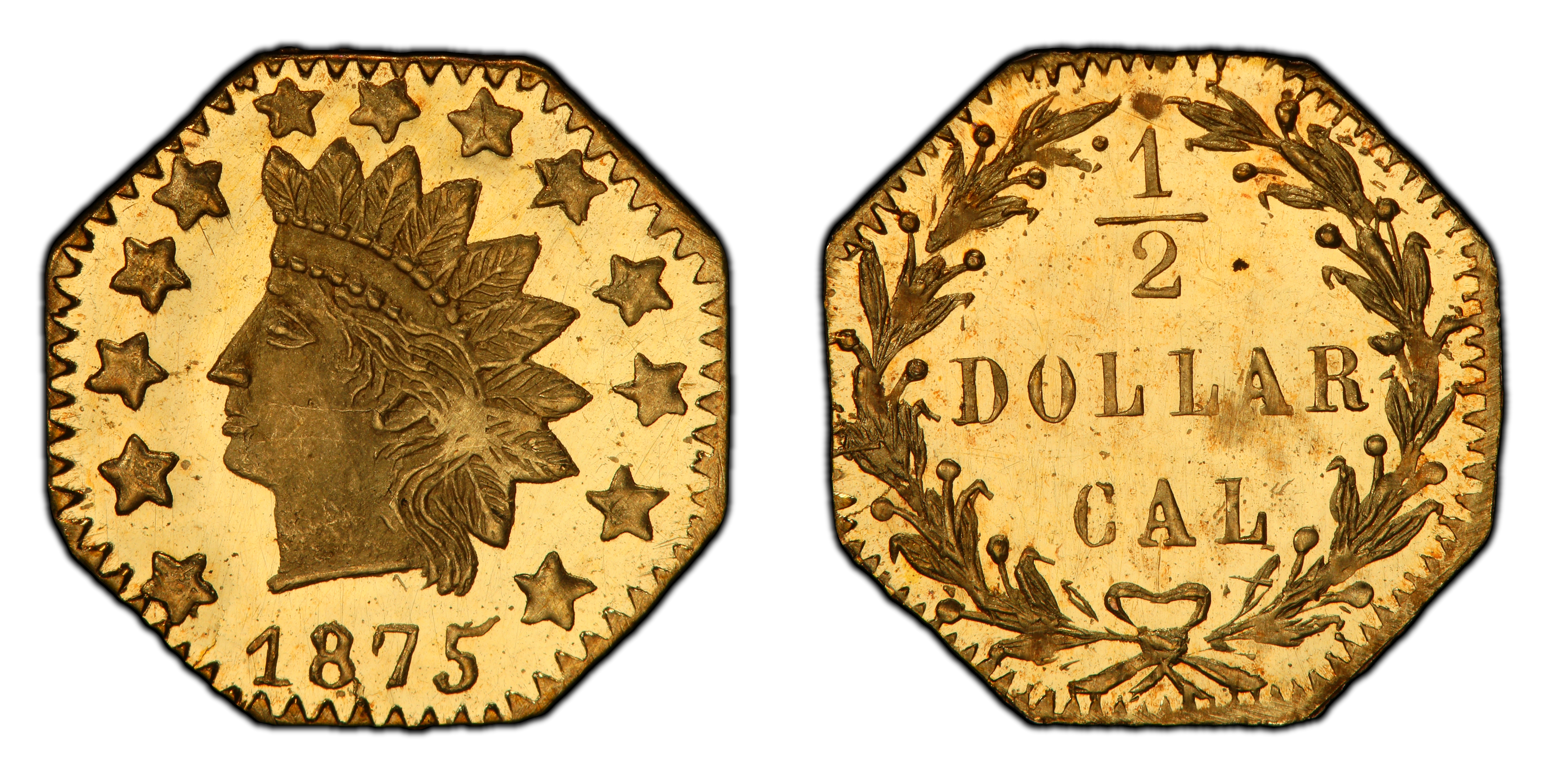
Obverse & Reverse
The 1875 G50C BG-946 is a quintessential example from 'Period Two' of California Fractional Gold production (1858-1882). Unlike the earlier 'Period One' issues (1852-1857), which were struck out of genuine commercial necessity to alleviate a severe shortage of small change during the initial Gold Rush, Period Two pieces were created primarily as souvenirs and novelties. By the mid-1870s, the United States Mint in San Francisco was in full operation, supplying the region with ample federal coinage and eliminating the need for private issues. However, the romance of the Gold Rush and the unique nature of the tiny gold coins had created a lasting demand from tourists, merchants, and collectors. San Francisco jewelers, leveraging their skills in working with precious metals, stepped in to fill this niche market. These later issues were often underweight for their stated denomination and were not intended to pass as legal tender in the same way their predecessors had. The Coinage Act of April 22, 1864, had already made the private issuance of coinage illegal, but lax enforcement, particularly in the West, allowed this souvenir trade to flourish. The makers of these pieces operated in a legal gray area, producing denominated items that were technically unlawful but widely tolerated as keepsakes. Production of denominated pieces finally ceased around 1883 when the Secret Service, concerned about the potential for fraud, began to strictly enforce the 1864 Act. The BG-946, with its popular Indian Head motif and octagonal shape, catered directly to the public's fascination with the 'Wild West' and is a tangible link to this fascinating post-Gold Rush era of numismatic history.
Associated EventPost-California Gold Rush Souvenir Trade
Reason For MintingTo satisfy the demand for souvenirs and collectible novelties related to the California Gold Rush, rather than for circulation.
Minter HistoryThe specific minter of BG-946 is not definitively known, a common trait for many Period Two fractional gold varieties. The pieces were produced by various skilled jewelers operating in San Francisco. Prominent makers of fractional gold during this era included figures like Robert B. Gray & Co. and Christopher Ferdinand Mohrig, but a direct attribution for this specific variety has been lost to time. These jewelers used techniques like hand-cut dies and manual presses, which resulted in the unique and often crude characteristics seen on the coins.
Historical SignificanceThe BG-946 represents the commercial evolution of private minting in California, from a utilitarian response to a coin shortage to a market-driven production of popular keepsakes. It highlights a period of weak federal oversight and the enduring romanticism of the Gold Rush that fueled a collectible market for decades after the initial rush had ended.
BG-946
DenominationG50C
Minting Period1875
Assayer/MinterUnknown San Francisco Jeweler
Geographic OriginSan Francisco, California
Obverse DescriptionThe obverse features a stylized Indian Head facing left, surrounded by thirteen stars. The portrait's details can be somewhat crude, a characteristic of many privately produced issues of the period. The date '1875' appears below the bust.
Obverse Inscription1875
Reverse DescriptionThe reverse design consists of the denomination '1/2' located centrally within an ornate wreath. The wreath is composed of two branches tied together at the bottom with a bow. The legend 'CALIFORNIA GOLD' encircles the wreath along the upper periphery, separated by the upper tips of the wreath's branches.
Reverse InscriptionCALIFORNIA GOLD 1/2
CompositionGold
Stated Fineness Actual FinenessVariable, but generally lower than federal coinage of the era.
Weight0.25 grams
Diameter10.00 mm
EdgePlain
Unknown
Survival EstimateFewer than 100 known
Rarity ScaleR-5 (Very Scarce)
This variety is highly sought after for its classic Indian Head design, octagonal shape, and its status as a historic souvenir from the post-Gold Rush era. Examples with the Deep Mirror Proof-Like (DMPL) designation are exceptionally rare and prized for their stunning visual contrast between mirrored fields and frosted devices, representing the pinnacle of quality for the issue.
Key VarietiesThe primary variety is the regular business strike. Collector designations of PL (Proof-Like) and DMPL (Deep Mirror Proof-Like) are recognized by grading services and represent coins struck from freshly polished dies, creating mirrored surfaces. These are not separate varieties in the die-making sense but are significant condition rarities. No proof issues were originally struck.
Authentication TipsA key diagnostic for genuine BG-946 is the crudeness of the date; the numerals often appear irregular, as if they were hand-engraved into the die. Genuine pieces are typically very thin and can have weak strikes in areas, whereas modern replicas are often thicker and more uniformly struck. Authentic pieces will not feature a bear on the reverse, a common motif on modern fantasy tokens. Consultation of the Breen-Gillio reference and comparison with certified examples is essential for authentication.
Shopping ConsiderationsFor a premium quality example, especially a DMPL specimen, look for deeply reflective, clear fields with at least 4-6 inches of reflectivity. The contrast with frosted devices should be sharp and distinct. The strike is a critical factor; seek examples with sharp details on the high points of the Indian's headdress and the leaves of the reverse wreath. As these coins were made from soft gold, even high-grade examples will often show minor planchet imperfections or small contact marks; a coin with minimal, non-distracting marks commands a significant premium. Avoid examples that have been cleaned, as this strips the original surface and luster, drastically reducing value and eye appeal. Evidence of jewelry mounting is also a significant impairment to be avoided.
A coin's grade is its condition, rated on a 1-70 scale. For rare coins, this is the most critical factor in determining value, as a tiny difference in preservation can mean a huge difference in price.
Relevant Grade TypesOriginal period issues of BG-946 were business strikes, although produced for souvenir purposes, and are found in Circulated (1-58) and Mint State (MS, 60-70) grades. No true Proofs were struck during the original period. The Proof-Like (PL) and Deep Mirror Proof-Like (DMPL or DPL) designations are applied to business strikes that exhibit exceptional surface reflectivity from being struck with newly polished dies. These are not a different type of coin but rather a special surface characteristic that makes them a distinct and more valuable collecting category.
Mint State CharacteristicsIn Mint State, the BG-946 should exhibit some degree of original mint luster. The strike is often somewhat weak in the center, particularly on the Indian's cheek and the '1/2' on the reverse. A key characteristic is the crude, 'hand-written' appearance of the date numerals, which is diagnostic to the variety. High-end DMPL examples display a dramatic cameo effect, with watery, reflective fields contrasting sharply with frosted design elements. Due to the soft gold composition, even Gem examples may display minuscule planchet flaws or contact marks from handling as souvenirs.
Circulated Wear PatternsWear first appears on the high points of the design. On the obverse, check the cheekbone, the eyebrow, and the feathers of the headdress. On the reverse, the highest points of the wreath's leaves and the bow will show the first signs of friction. In lower grades (VF and below), the stars on the obverse and the letters in the legends will begin to lose their sharpness and may merge with the fields.
Key Factors For ValueFor the 1875 G50C BG-946, the single most important value driver is the surface quality, specifically a DMPL designation, which can elevate the coin's value by a multiple over a standard MS example. Beyond that, a sharp, well-centered strike with full details is highly desirable. Eye appeal is paramount; coins with original, undisturbed surfaces and attractive, often reddish-gold toning are prized over cleaned or polished specimens. The presence of a CAC sticker indicates premium quality for the grade and will typically result in a higher market value.
PCGS Price Guide
| Grade | Price | Population |
|---|---|---|
| 64 | $1,500.00 | N/A |
| 64+ | $1,750.00 | N/A |
| 65 | $2,250.00 | N/A |
| 65+ | $2,500.00 | N/A |
| 66 | $3,500.00 | 1 |