1864 G50C BG-918 (Regular Strike)
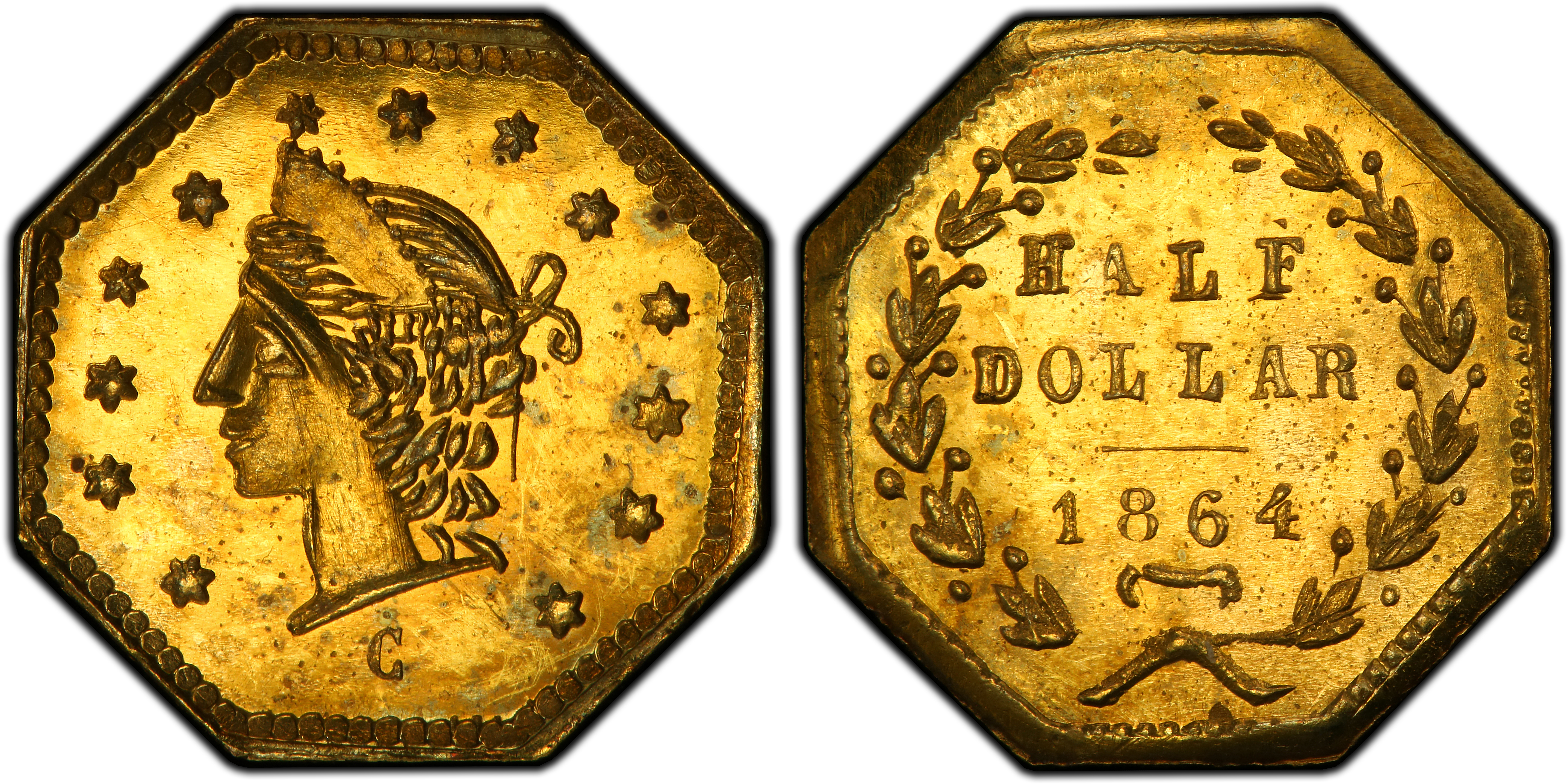
Obverse & Reverse
The 1864 Octagonal 50 Cents, cataloged as Breen-Gillio 918, is a quintessential artifact from the second phase of California's private gold coinage history. This period, designated by numismatists as 'Period Two' (1859-1882) or the 'Suppressed Jewelers' Issues,' saw a shift in the purpose and nature of these fascinating fractional gold pieces. The initial wave of 'Period One' issues (1852-1857) was born of pure necessity, created to alleviate a severe shortage of small-denomination coinage for daily commerce in the gold fields. However, by the late 1850s, the San Francisco Mint was in full operation, and the acute need for fractional currency had subsided. Entrepreneurs, primarily jewelers like Robert B. Gray, recognized a new market: the booming demand for souvenirs and keepsakes from the romanticized California Gold Rush. These later issues, while still potentially used in local transactions, were primarily intended for sale to tourists and for export to the East Coast and Europe as tangible mementos of the Golden State. The year 1864 is profoundly significant. Struck in the midst of the American Civil War, this piece represents a fascinating intersection of national crisis and regional economic evolution. While the nation was preoccupied with war, California's economy continued to thrive, and the allure of its gold was undiminished. Critically, 1864 also saw the passage of the Coinage Act of April 22, which expressly forbade the private minting of coinage. This federal action legally rendered pieces like the BG-918 unauthorized, transforming them from legitimate private tokens into illicit issues overnight. Despite this, production by jewelers continued for nearly two more decades, often with anachronistic dates to circumvent the law, a testament to their popularity and the lax enforcement on the distant West Coast. The manufacturing process was rudimentary; most fractional gold was produced by the 'hammer method,' where a planchet was placed on an anvil die and struck with a sledgehammer-wielded punch die. This crude technique resulted in inconsistent strike quality, often leaving coins with weakness in some areas and pronounced detail in others, a characteristic that defines the series.
Associated EventCalifornia Gold Rush / American Civil War
Reason For MintingTo serve a dual role as a circulating medium in a coin-scarce region and as a popular souvenir for the tourist trade, especially as federal legislation was enacted to prohibit private coinage.
Minter HistoryRobert B. Gray & Co. was a prominent San Francisco jewelry firm and a prolific producer of Period Two fractional gold. Active from approximately 1858 to 1871, the firm was established after Robert B. Gray purchased the business of another well-known jeweler and fractional gold maker, Antoine Louis Nouizillet. Gray not only used some of Nouizillet's old dies but also created his own, sometimes adding a small 'G' hallmark to his coinage, though BG-918 does not bear this mark. His issues are noted by researchers like Walter Breen and Ron Gillio for often having a higher intrinsic gold value compared to many of his contemporaries' more debased souvenir pieces. Gray eventually sold his interests to the California Jewelry Co. in 1871, ending his significant chapter in the fractional gold story.
Historical SignificanceThe BG-918 is historically significant as an example of private coinage struck during the final year of its legality. It embodies the transition of fractional gold from essential currency to commercial souvenir, reflects the robust and independent economy of Civil War-era California, and serves as a tangible link to the primitive but effective minting techniques employed by Gold Rush-era jewelers.
N/A
Denomination50 Cents
Minting Period1864
Assayer/MinterRobert B. Gray & Co.
Geographic OriginSan Francisco, California
Obverse DescriptionA stylized 'caricature' bust of Liberty facing left, her hair tied in a bun. She wears a beaded coronet. The field is encircled by thirteen six-pointed stars.
Obverse Inscription1864
Reverse DescriptionThe denomination '50 / CENTS' is displayed on two lines within a wreath composed of two olive branches tied with a bow at the bottom. The legend 'CALIFORNIA GOLD' encircles the wreath along the upper periphery.
Reverse InscriptionCALIFORNIA GOLD 50 CENTS
CompositionGold
Stated Fineness Actual FinenessThe fineness of Period Two issues is known to be variable, often lower than the .900 standard of federal coinage, but Gray's issues were generally of higher quality than many of his competitors.
Weight0.75 grams
Diameter11.10 mm
EdgePlain
Unknown
Survival EstimateFewer than 150 believed to exist.
Rarity ScaleR-4 (75-200 known) to R-6 (13-30 known). Numismatic sources and major auction houses have cited both ratings for this variety, reflecting the evolving census data and subjective nature of the scale. The R-4 rating is more commonly cited.
This coin is highly sought after for its specific Civil War date, octagonal shape, and connection to the romantic lore of the California Gold Rush. As a Period Two issue, it represents the fascinating 'jeweler's issue' era and the federal government's crackdown on private coinage. Its distinctive 'caricature' Liberty head adds to its unique visual appeal.
Key VarietiesThere are no major, recognized varieties of BG-918 struck during its period of issue. The Breen-Gillio classification system is built on minute die differences, so while different die states may exist (showing progressive wear or cracks), they are not typically collected as separate varieties by most collectors. No special collector restrikes of the BG-918 variety are known to exist.
Authentication TipsAuthentic examples were die-struck, not cast. Look for sharp, albeit sometimes uneven, details consistent with a hammer strike. The surfaces of genuine pieces often exhibit fine die polishing lines or a slightly irregular texture. Counterfeits are often cast, showing a porous or soapy surface, or may have incorrect details, weight, or a 'mushy' appearance. The lettering style and the specific shape of the Liberty head should be carefully compared to high-resolution images of certified examples.
Shopping ConsiderationsA premium quality example for this issue is defined by a bold, well-centered strike. Given the hammer-striking process, many examples are weakly struck, so coins with sharp details on the high points of Liberty's hair, coronet beads, and the wreath leaves command a significant premium. Look for original, uncleaned surfaces; many have been harshly cleaned or polished over the years, which drastically reduces value. High-end specimens are often described as having 'prooflike' or 'watery' fields, which are highly desirable. Check carefully for any hidden damage, such as bends, repairs, or evidence of having been mounted in jewelry.
A coin's grade is its condition, rated on a 1-70 scale. For rare coins, this is the most critical factor in determining value, as a tiny difference in preservation can mean a huge difference in price.
Relevant Grade TypesOriginal 1864 BG-918 pieces were all business strikes intended for commerce or sale as souvenirs. They are found in Circulated grades (AG-3 to AU-58) and Mint State grades (MS-60 to MS-70). No true Proofs were struck during the original minting period. The term 'Prooflike' (PL) is often used to describe high-grade business strikes that have exceptionally reflective, mirror-like surfaces from being struck with freshly polished dies, but these are not a separate striking method.
Mint State CharacteristicsAn uncirculated BG-918 is defined by the absence of wear and the presence of original mint luster. Top-tier examples exhibit a sharp, full strike, which is rare for the issue. The luster is often vibrant and satiny. A key characteristic of choice specimens is the presence of prooflike or 'watery' fields, which create a beautiful contrast with the frosted devices. Due to the softness of the gold and crude handling at the time of manufacture, even Mint State coins will typically show scattered contact marks or planchet flaws; a coin with exceptionally clean surfaces is a major rarity.
Circulated Wear PatternsWear first appears on the highest points of the design. On the obverse, look for flattening on the beads of the coronet and the highest strands of Liberty's hair above her ear and eye. On the reverse, the highest leaves and berries of the wreath will show initial friction and loss of detail. On lower-grade examples, the legends will begin to weaken, particularly the date and the word 'CENTS'.
Key Factors For ValueBeyond the numerical grade, value is driven by three key factors: strike, surface quality, and eye appeal. A sharply struck coin with full details will always be worth more than a weakly struck coin of the same grade. Original, lustrous surfaces free of harsh cleaning, scratches, or other damage are paramount. Finally, eye appeal—a subjective but critical measure—encompasses attractive toning (often a subtle reddish-gold hue), the presence of prooflike fields, and a generally pleasing appearance. For this issue, a CAC sticker, indicating premium quality for the grade, adds a significant price premium.
PCGS Price Guide
| Grade | Price | Population |
|---|---|---|
| 45 | $190.00 | 1 |
| 45+ | $195.00 | N/A |
| 50 | $200.00 | N/A |
| 50+ | $205.00 | N/A |
| 53 | $210.00 | 2 |
| 53+ | $225.00 | N/A |
| 55 | $250.00 | 10 |
| 55+ | $275.00 | N/A |
| 58 | $325.00 | 6 |
| 58+ | $350.00 | N/A |
| 60 | $385.00 | 2 |
| 61 | $415.00 | 7 |
| 62 | $450.00 | 29 |
| 62+ | $485.00 | N/A |
| 63 | $600.00 | 16 |
| 63+ | $750.00 | N/A |
| 64 | $975.00 | 7 |
| 64+ | $1,150.00 | N/A |
| 65 | $1,650.00 | 1 |