1872/1 G25C BG-869, PL (Regular Strike)
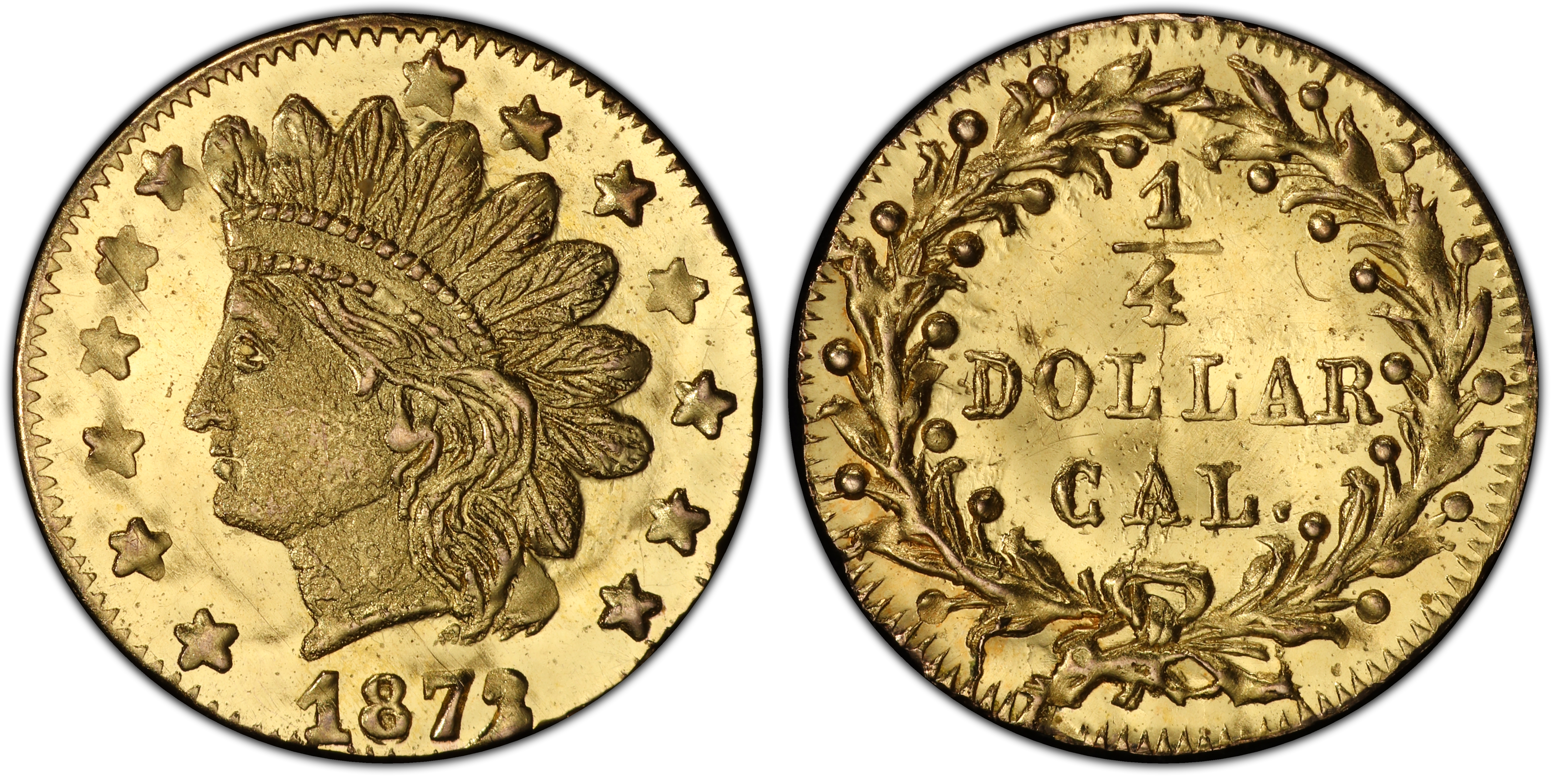
Obverse & Reverse
The 1872/1 Gold 25 Cents, cataloged as Breen-Gillio 869, is a quintessential example of a 'Period Two' California Fractional Gold piece. These small-denomination coins arose from the unique economic conditions of post-Gold Rush California. While the initial wave of the rush had subsided, the region still suffered from a chronic shortage of small change for daily transactions. The first fractional gold pieces, struck from 1852-1857 ('Period One'), were earnestly intended to fill this commercial void. However, by the late 1850s, the San Francisco Mint was producing sufficient federal silver coinage, rendering the tiny, easily lost gold pieces impractical for circulation. Rather than disappearing, they found a new purpose. Enterprising jewelers, primarily in San Francisco, recognized a burgeoning market for these miniature gold coins as souvenirs, keepsakes, and jewelry items. From 1858 to 1882, a prolific number of varieties were struck, not as legal tender, but as commercial tokens catering to tourists, locals sending mementos back East, and a general fascination with the 'Golden State.' The BG-869 falls squarely into this 'jeweler's issue' era. Its existence was technically in defiance of the Private Coinage Act of 1864, which prohibited private entities from issuing coins. However, federal enforcement was lax, particularly for items not clearly intended to circulate as money. Many producers backdated their coins to pre-1864 dates to circumvent the law, a practice evident in the 1872/1 overdate of this piece. These coins were typically produced via the hammer method: a gold planchet was placed on a lower die (anvil), and an upper die was struck with a sledgehammer, resulting in inconsistent strike quality. The gold content was also unregulated and often significantly less than the face value would imply, further cementing their status as tokens rather than true coinage. Production of these charming pieces finally ceased around 1883 when the Secret Service, concerned about potential for fraud, cracked down on the remaining manufacturers.
Associated EventPost-California Gold Rush Economic Development
Reason For MintingPrimarily created to satisfy the large demand for souvenirs and novelty jewelry items related to the California Gold Rush.
Minter HistoryThe specific minter for BG-869 is unrecorded, a common characteristic for many 'Period Two' issues. They were produced by numerous, often competing, jewelers in San Francisco who created their own dies. While some makers, like Robert B. Gray & Co., hallmarked their pieces with an initial, many, including the producer of BG-869, remain anonymous. These artisans were skilled metalworkers but not official minters, operating in a legally gray area to profit from the public's appetite for gold souvenirs.
Historical SignificanceThe BG-869 is significant not as a circulating coin, but as a tangible artifact of California's cultural and economic transition in the 1870s. It represents a shift from the utilitarian coinage of the Gold Rush to a commercial souvenir market, reflecting the state's growing tourism and its romanticized national image. Numismatically, it is a key representative of the diverse and complex series of 'jeweler's issues' that challenge the strict definition of what constitutes a coin.
N/A
Denomination25 Cents
Minting Period1872
Assayer/MinterAnonymous San Francisco Jeweler
Geographic OriginSan Francisco, California
Obverse DescriptionFeatures a right-facing Indian Head, likely modeled after the contemporary U.S. Indian Head cents. The portrait is surrounded by 13 stars, representing the original colonies. The date, 1872, is below the bust, with a clear repunching of the 2 over a 1.
Obverse Inscription1872/1
Reverse DescriptionA wreath of two olive branches, open at the top and tied with a bow at the bottom, encircles the denomination. A characteristic and important diagnostic for this variety is a vertical die crack often visible through the center of the reverse.
Reverse Inscription1/4 DOLLAR CAL.
CompositionGold
Stated Fineness Actual FinenessVariable, typically lower than federal standards, often in the 14-20 Karat range.
Weight0.25 grams
Diameter10.00 mm
EdgePlain
Unknown, but very small.
Survival Estimate76-150 known examples, with a high concentration in Mint State grades, reflecting their status as souvenirs rather than circulating coins.
Rarity ScaleR-4 (Low R.4)
Sought after for its clear 1872/1 overdate, Indian Head design, and status as a popular, collectible variety within the extensive California Fractional Gold series. The high frequency of Proof-Like (PL) specimens adds to its appeal, as these coins often possess flashy, mirrored surfaces.
Key VarietiesThe primary variety is the BG-869 itself, defined by its specific die pairing. A crucial diagnostic is the consistent presence of a vertical die crack through the center of the reverse wreath. While there are no major sub-varieties, the die state (early vs. late, with the crack more or less prominent) can be a point of interest for specialists. No known patterns, trial pieces, or later restrikes are associated with this specific Breen-Gillio number.
Authentication TipsGenuine examples are very thin and lightweight. Counterfeits and modern replicas are often thicker, heavier, and have a 'soapy' or cast-like appearance. Look for sharp, albeit sometimes unevenly impressed, details consistent with a hammer strike. The reverse die crack is a strong indicator of authenticity for this variety. Any piece featuring a bear on the reverse is a modern token, not a genuine fractional gold piece. Be wary of pieces that are perfectly struck, as weakness in some areas is common on genuine examples.
Shopping ConsiderationsA premium quality example for this issue is defined by its surfaces. Seek out coins designated 'PL' (Proof-Like) or 'DMPL' (Deep Mirror Proof-Like) by grading services, as these possess the most eye appeal. The strike can be variable; a well-struck example will show clear details in the headdress feathers and the lettering. Luster should be bright and reflective, not dull or subdued from cleaning. Avoid specimens with scratches, rim bumps, or evidence of having been mounted in jewelry, as was common. The natural gold color should be a bright yellow-gold, sometimes with subtle reddish toning.
A coin's grade is its condition, rated on a 1-70 scale. For rare coins, this is the most critical factor in determining value, as a tiny difference in preservation can mean a huge difference in price.
Relevant Grade TypesOriginal period issues were business strikes, although not intended for widespread circulation. They are found in both Circulated (1-58) and, more commonly, Mint State (MS, 60-70) grades. No true Proofs were struck during the original minting period. However, due to the nature of their production with polished dies, a significant portion of surviving BG-869 specimens are Proof-Like (PL), exhibiting mirrored fields. These are not a different type of strike but rather a desirable surface characteristic of a business strike.
Mint State CharacteristicsAn uncirculated BG-869 is defined by its luster. High-quality examples have bright, flashy, mirrored fields that contrast with lightly frosted devices. The strike is often sharp on the central devices (Indian head, wreath) but may show some softness at the periphery (stars, legends). Due to the softness of the gold and the hammer-striking process, it is common to see minor planchet irregularities or small, scattered contact marks, even on high-grade specimens. The presence of the reverse die crack is characteristic and not considered a flaw.
Circulated Wear PatternsFor the few examples that saw handling, wear first appears on the highest points of the design. On the obverse, this includes the cheek, the eyebrow, and the tips of the feathers in the headdress. On the reverse, the highest points of the wreath's leaves and the bow ribbon will show the first signs of friction and flattening of details.
Key Factors For ValueSurface quality is paramount for BG-869. A strong 'PL' or 'DMPL' designation commands a significant premium. Eye appeal, driven by clean, reflective fields and a sharp strike, is the most important value driver. Coins with original, lustrous, undisturbed surfaces are prized over those that have been cleaned or polished. While the reverse die crack is expected, examples from an earlier die state with a less prominent crack may be preferred by some specialists. A CAC sticker for this issue confirms premium quality for the grade and adds a strong premium.
PCGS Price Guide
| Grade | Price | Population |
|---|---|---|
| 64 | N/A | N/A |
| 65 | N/A | N/A |
| 66 | $1,600.00 | 1 |
| 66+ | $1,850.00 | N/A |
| 67 | $2,250.00 | 1 |