1852 25C BG-799V, DMPL (Regular Strike)
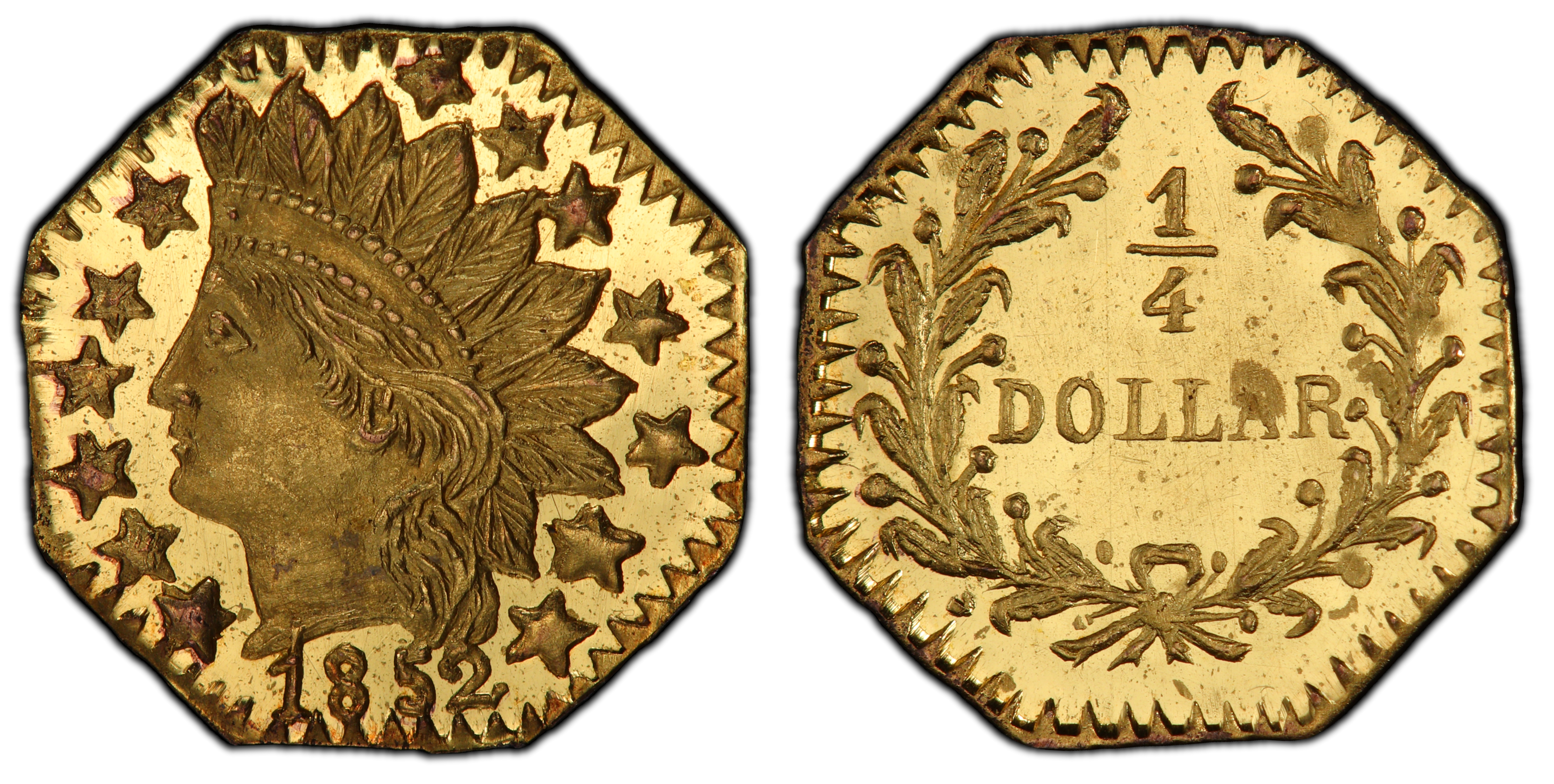
Obverse & Reverse
The 1852 25 Cents struck by Antoine Louis Nouizillet represents a fascinating and chaotic chapter in American economic history. In the immediate aftermath of the 1848 discovery of gold at Sutter's Mill, California was flooded with prospectors and entrepreneurs, but the region was starved for circulating coinage. Gold dust and nuggets served as a medium of exchange, but this was inefficient, inconsistent, and prone to theft and fraud. The U.S. Mint in Philadelphia was too distant to solve the problem, and the establishment of a branch mint in San Francisco was still years away. This monetary vacuum created a fertile ground for private minters. Jewelers, metallurgists, and businessmen saw an opportunity to convert raw gold into standardized, convenient coins. Antoine Louis Nouizillet, a French jeweler and watchmaker who arrived in San Francisco in 1851, was one such entrepreneur. His small denomination pieces—25 cents, 50 cents, and one dollar—were intended to facilitate everyday transactions, meeting a desperate need for small change. These 'fractional' gold pieces were technically tokens, as they lacked federal sanction, but they circulated out of sheer necessity. However, their production was controversial. Many private issues were underweight or of debased fineness, profiting the minter at the public's expense. While Nouizillet's pieces were generally better regarded than some, the entire industry came under scrutiny. The United States Assay Office opened in San Francisco in 1851, and federal legislation in 1864 effectively ended the private minting of gold coins. Nouizillet's operation was short-lived, likely ceasing by 1853, and he returned to his primary trade. His coins, once utilitarian objects, are now treasured as tangible relics of the California Gold Rush's tumultuous and entrepreneurial spirit, a time when private citizens literally made their own money.
Associated EventCalifornia Gold Rush
Reason For MintingTo provide a convenient medium of exchange for small, everyday transactions due to a severe shortage of official United States coinage in California.
Minter HistoryAntoine Louis Nouizillet was a French immigrant, likely from Paris, trained as a jeweler and watchmaker. He arrived in San Francisco around 1851, drawn by the economic opportunities of the Gold Rush. Rather than mining, he applied his metallurgical skills to the production of private gold coins from a workshop on Clay Street. He produced twenty-five cent, fifty cent, and one-dollar pieces bearing a distinctive Liberty head design, likely engraved by a local German craftsman. His minting activities were brief, lasting only from 1852 to 1853. After ceasing coin production, he continued his work as a jeweler in San Francisco for several more years before his historical trail goes cold. His operation was small-scale, but his coins are among the most professionally executed of the Period One (1852-1857) California fractionals.
Historical SignificanceThis coin is a direct artifact of the monetary chaos of the Gold Rush, demonstrating the private sector's response to the failure of the federal government to supply adequate coinage to the booming California economy. It represents the crucial role of private minters in creating a functional, albeit unregulated, local currency.
N/A
Denomination25 Cents
Minting Period1852-1853
Assayer/MinterAntoine Louis Nouizillet
Geographic OriginSan Francisco, California
Obverse DescriptionA fairly crude but appealing Liberty Head facing left, her hair tied in a bun at the back. She is surrounded by thirteen six-pointed stars, representing the original colonies. The date '1852' is below the bust.
Obverse Inscription1852
Reverse DescriptionThe denomination '1/4 DOLLAR' is arranged in two lines within a simple wreath of two laurel branches tied at the bottom with a bow.
Reverse Inscription1/4 DOLLAR
CompositionGold
Stated Fineness Actual FinenessApproximately .850 to .900, though this could vary.
Weight0.64 grams
Diameter11.50 mm
EdgePlain
Unknown
Survival Estimate50-75
Rarity ScaleR-6 (Very Rare)
This piece is highly sought after as a representative issue of the very first year of California fractional gold production. Its crude, handmade charm, direct connection to the Gold Rush, and overall rarity make it a cornerstone for specialists. The DMPL (Deep Mirror Prooflike) designation adds another layer of desirability, as these examples possess a reflectivity and sharpness approaching that of a true Proof coin, making them visually stunning.
Key VarietiesThe BG-799 is a specific die marriage cataloged in the Breen-Gillio reference work. The 'V' in BG-799V typically denotes a minor variety, often related to die state or a subtle repunching. No official patterns, restrikes, or collector-oriented proofs were made during the period of issue. All known examples are business strikes intended for circulation.
Authentication TipsGenuine examples have a characteristic soft, slightly yellowish-gold luster. The details, while not sharp by modern standards, should be consistent with known genuine pieces; the stars are often weakly struck and somewhat indistinct. Look for a 'soft' appearance to the devices, without the hard, sharp edges seen on modern fakes. Many crude cast and die-struck counterfeits exist. Authentication by a major grading service (PCGS or NGC) is virtually essential for a purchase of this magnitude, as they have extensive databases of genuine examples for comparison.
Shopping ConsiderationsA premium quality example for this issue, especially one designated DMPL, will exhibit strong reflectivity in the fields on both the obverse and reverse. Look for a bold strike on the central devices, particularly on Liberty's portrait and the '1/4 DOLLAR' on the reverse, which are often weak. Original, uncleaned surfaces are paramount; many have been harshly cleaned or polished over the years, which drastically reduces value. Seek out a coin with minimal distracting marks in the primary focal areas. An example with a CAC sticker would command a significant premium, as it indicates superior quality and eye appeal for the assigned grade.
A coin's grade is its condition, rated on a 1-70 scale. For rare coins, this is the most critical factor in determining value, as a tiny difference in preservation can mean a huge difference in price.
Relevant Grade TypesAll original 1852 25C pieces were struck as business strikes for circulation and are graded on the Circulated (AU-58 and below) and Mint State (MS-60 to 70) scales. No Proof (PR/PF) examples were struck by Nouizillet during the original period of issue. The DMPL (Deep Mirror Prooflike) designation is an attribute applied to a business strike (MS) coin that has deeply reflective, mirror-like surfaces from being struck with freshly polished dies, but it is not a true Proof striking.
Mint State CharacteristicsIn Mint State, this coin will exhibit full, unbroken luster. DMPL examples will have pronounced reflectivity in the fields. However, the strike is almost never perfect. Expect some softness on the highest points, such as the stars and the hair above Liberty's ear. The planchets were often imperfect, so minor original flaws or adjustment marks may be present and should not be heavily penalized if they are not distracting. The soft, 22-karat gold is highly susceptible to contact marks, so even a high-grade MS example will likely show some light ticks.
Circulated Wear PatternsThe first signs of wear will appear on the highest points of the design. On the obverse, this is Liberty's cheek, the hair bun, and the eyebrow. On the reverse, the high points of the wreath's leaves and the numerals '1/4' will show friction first. As wear progresses, the stars will become flatter and begin to merge with the fields, and the fine details of the wreath will disappear.
Key Factors For ValueFor an 1852 BG-799V, the primary value drivers are grade and surface quality. An original, uncleaned coin with minimal marks will always be prized. The DMPL designation carries a significant premium. Strike quality is also critical; a coin with a sharp strike on the central Liberty portrait and the reverse denomination is far more desirable than a weakly struck example in the same grade. Finally, eye appeal, which encompasses the color of the gold and the overall visual harmony of the coin, plays a major role. A CAC sticker confirms the coin is a premium example for its grade and adds substantial value.
PCGS Price Guide
| Grade | Price | Population |
|---|---|---|
| 66+ | $6,000.00 | 1 |