1871 G25C BG-860, PL (Regular Strike)
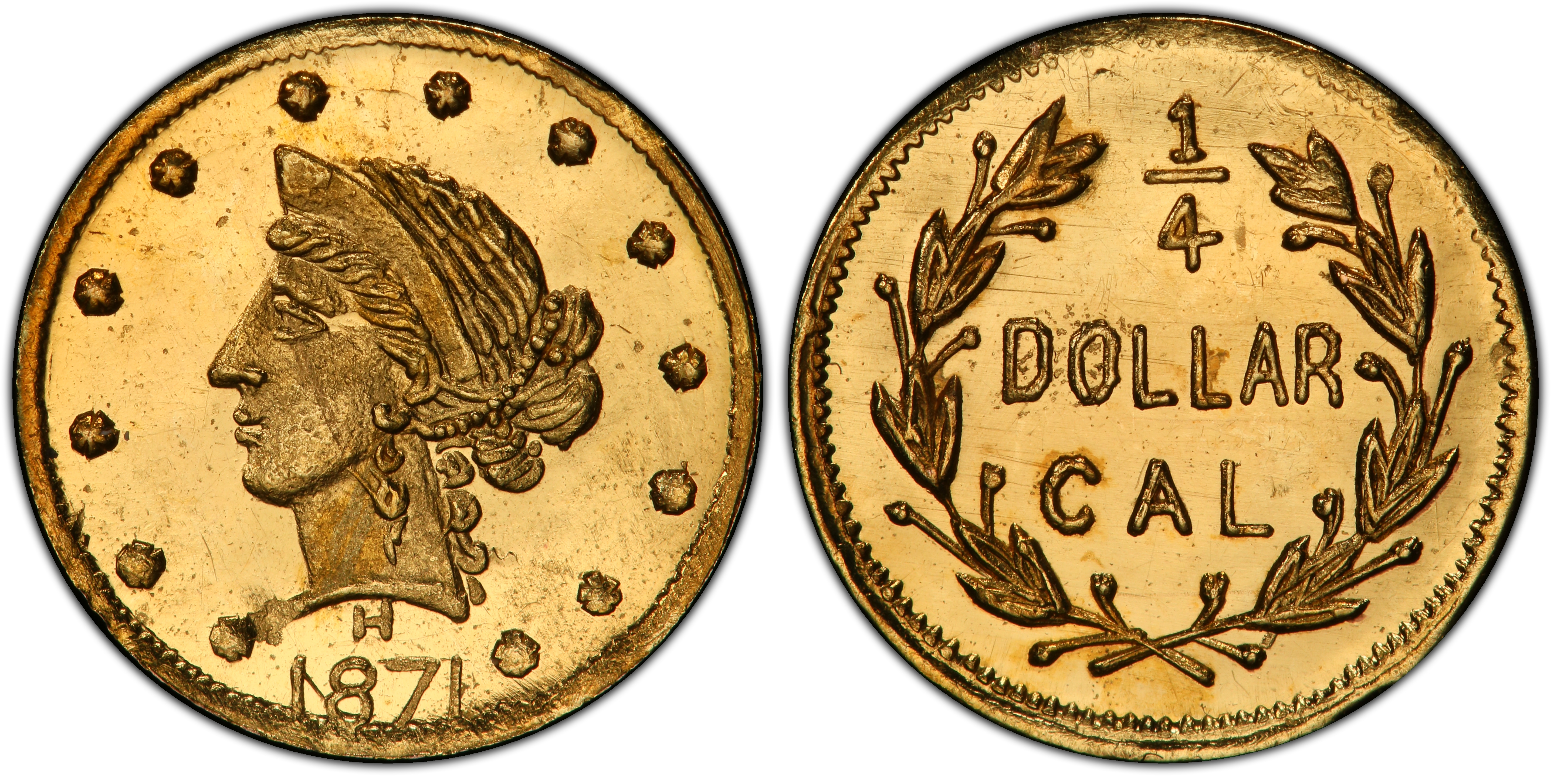
Obverse & Reverse
The 1871-H 25 Cents, cataloged as Breen-Gillio 860, is a quintessential example of a 'Period Two' California Fractional Gold piece. Unlike their 'Period One' predecessors (1852-1857), which were struck to alleviate a severe shortage of small-denomination coinage and are believed to have circulated, the Period Two issues were created primarily as souvenirs and for use in jewelry. By the 1870s, the San Francisco Mint was producing ample federal coinage, rendering private issues unnecessary for commerce. However, the romance of the Gold Rush, still fresh in the public's memory, created a robust market for miniature gold tokens that recalled the heady days of '49. Jewelers and private minters like Hermann Hammer, identified by the 'H' mintmark on this variety, stepped in to meet this demand. These pieces were produced in a legally ambiguous environment. The Coinage Act of 1864 had made private coinage illegal, but federal enforcement by the Secret Service was lax in California until the early 1880s. This allowed minters to continue striking denominated pieces ('25 CENTS') without immediate legal consequence. The BG-860 was struck on a thin, round gold planchet, typical of these later issues, which contained significantly less than their face value in gold. Their purpose was not monetary but sentimental; they were sold to tourists, given as gifts, and mounted into rings, cufflinks, and watch fobs. The craftsmanship, while often charming, was secondary to the novelty. The fact that this variety is designated R-6 indicates a very small original production, likely numbering in the mere hundreds, with only a tiny fraction surviving today. Its numismatic significance lies not in its economic impact, but in its role as a tangible artifact of California's post-Gold Rush cultural identity, representing the commercialization of the state's mythic origins.
Associated EventPost-Gold Rush California Souvenir Market
Reason For MintingTo satisfy tourist and local demand for souvenir 'pioneer gold' pieces for use in jewelry and as keepsakes.
Minter HistoryHermann Hammer was one of several San Francisco-based jewelers and die-sinkers who produced California Fractional Gold pieces during the 'Period Two' era (1859-1882). While detailed biographical records are scarce, numismatic scholarship identifies him through the 'H' mintmark present on several Breen-Gillio varieties from the early 1870s. Like his contemporaries, such as Robert B. Gray & Co., Hammer capitalized on the nostalgia for the Gold Rush by creating these miniature, denominated gold tokens. His operations were characteristic of the time: small-scale, utilizing hand-operated presses, and producing coins that were not intended for circulation but rather to be sold as novelties. The rarity of his known issues suggests his production was limited compared to some other makers.
Historical SignificanceThe BG-860 is historically significant as a representative of the transition of California Fractional Gold from a necessary medium of exchange to a commercialized souvenir. It embodies the Victorian-era fascination with the Gold Rush and the desire for miniature keepsakes. Its existence highlights a period of lax federal enforcement of coinage laws and the entrepreneurial spirit of San Francisco's jewelers.
N/A
Denomination25 Cents
Minting Period1871
Assayer/MinterHermann Hammer
Geographic OriginSan Francisco, California
Obverse DescriptionA classic Liberty Head portrait, facing left, in the style of contemporary federal gold coinage. The portrait is somewhat crudely rendered, a common feature of these private issues. It is encircled by thirteen five-pointed stars, representing the original colonies. The date '1871' is positioned below the bust truncation.
Obverse Inscription1871
Reverse DescriptionThe central device is the denomination '25 CENTS' contained within a simple, continuous wreath composed of two olive branches. The wreath is tied with a bow at the bottom. A small letter 'H', for the minter Hermann Hammer, is sometimes associated with this die pairing, though it may not be visible or present on all examples.
Reverse Inscription25 CENTS
CompositionGold
Stated Fineness Actual FinenessTypically of lower fineness than federal issues, often ranging from 14 to 21 karats (.583 to .875 fine).
Weight0.25 grams
Diameter9.50 mm
EdgePlain
Unknown, but presumed to be very low, likely a few hundred pieces at most.
Survival Estimate13-30 pieces known
Rarity ScaleR-6
The BG-860 appeals to specialists in the extensive California Fractional Gold series. Its high rarity (R-6), association with a specific known minter (Hammer), and classic Liberty Head design make it a desirable, albeit challenging, acquisition. As a 'Period Two' issue, it tells a different story than the circulation-era pieces, attracting collectors interested in the full history of California's private coinage.
Key VarietiesNo major die varieties, patterns, or official restrikes of BG-860 are widely recognized. The primary distinction is the presence of the 'H' mintmark. The entire category of 'Period Two' issues is distinct from 'Period Three' tokens, which were often backdated, undenominated 'charms' made after 1883 to circumvent renewed enforcement of coinage laws.
Authentication TipsAuthentic Period Two pieces must have a denomination (e.g., 'CENTS' or 'DOLLAR'). Replicas often feature a bear on the reverse or are undenominated, stating 'CALIFORNIA GOLD' instead of a value. Genuine examples are struck in gold, though of varying fineness; modern fakes are typically gold-plated brass and have a different weight, feel, and surface characteristic. The strike is often weak in areas, particularly on the stars or the highest points of Liberty's hair, whereas many modern fakes have an unnaturally sharp, uniform strike. Look for a 'seam' on the edge, a tell-tale sign of a cast counterfeit.
Shopping ConsiderationsFor a premium quality BG-860, a potential buyer should seek an example with a sharp strike on the central devices, particularly Liberty's portrait and the numbers of the date. Due to the manufacturing process, many are weakly struck, so a bold example commands a significant premium. Original, lustrous surfaces are highly prized; many surviving examples have been cleaned, polished, or previously mounted in jewelry, which severely impacts the value. Look for any signs of circular scratches, solder, or tooling on the rim or fields. Attractive, original reddish-gold or orange-gold toning is a plus. Given the coin's rarity, even a problem-free, high-grade circulated example (e.g., AU-58) is a significant prize. For Mint State coins, prooflike (PL) or deep mirror prooflike (DMPL) surfaces are exceptionally rare and desirable.
A coin's grade is its condition, rated on a 1-70 scale. For rare coins, this is the most critical factor in determining value, as a tiny difference in preservation can mean a huge difference in price.
Relevant Grade TypesAll original 1871-H BG-860 pieces were struck as business strikes, though many were made with polished dies to enhance their appeal as souvenirs, resulting in prooflike surfaces. They are found in Circulated grades (AU-58 and below) and Mint State (MS, 60-70). No true Proofs were struck in the traditional sense during this period. The 'PL' or 'DMPL' designations from grading services are applied to business strikes with mirrored fields and are highly desirable.
Mint State CharacteristicsIn uncirculated condition, the BG-860 often exhibits a soft, satiny luster, though prooflike examples with reflective fields are known and command premiums. The strike is a key determinant of quality; many are softly struck, with weakness on the stars closest to the rim and on the finer details of Liberty's hair. A well-struck MS example will show clear definition in these areas. Being small and made of soft gold, contact marks are common, even on high-grade pieces; a coin with minimal, well-hidden marks will have superior eye appeal.
Circulated Wear PatternsWear first appears on the highest points of the design. On the obverse, friction will dull the luster and show first on Liberty's cheek, the hair above the ear, and the coronet. On the reverse, the high points of the wreath's leaves and the numerals of the denomination will show initial wear. In lower grades (VF and below), the legends and stars will begin to lose their sharpness and merge towards the fields.
Key Factors For ValueThe primary drivers of value for an 1871-H BG-860 are rarity and grade. Surface quality is paramount; an example with original, undisturbed luster will always be worth multiples of a cleaned or polished coin of the same technical grade. Sharpness of strike is the next key factor, as well-defined examples are much rarer than weakly struck ones. Eye appeal, driven by attractive toning and minimal distracting marks, is crucial. Finally, certification by a top-tier grading service (PCGS or NGC) is essential for market acceptance, and a CAC sticker indicating premium quality for the grade would add a significant further premium.
PCGS Price Guide
| Grade | Price | Population |
|---|---|---|
| 63 | $900.00 | 1 |
| 63+ | $1,000.00 | N/A |
| 64 | $1,100.00 | 1 |
| 64+ | $1,250.00 | N/A |
| 65 | $1,750.00 | 1 |