1870 G25C BG-836 (Regular Strike)
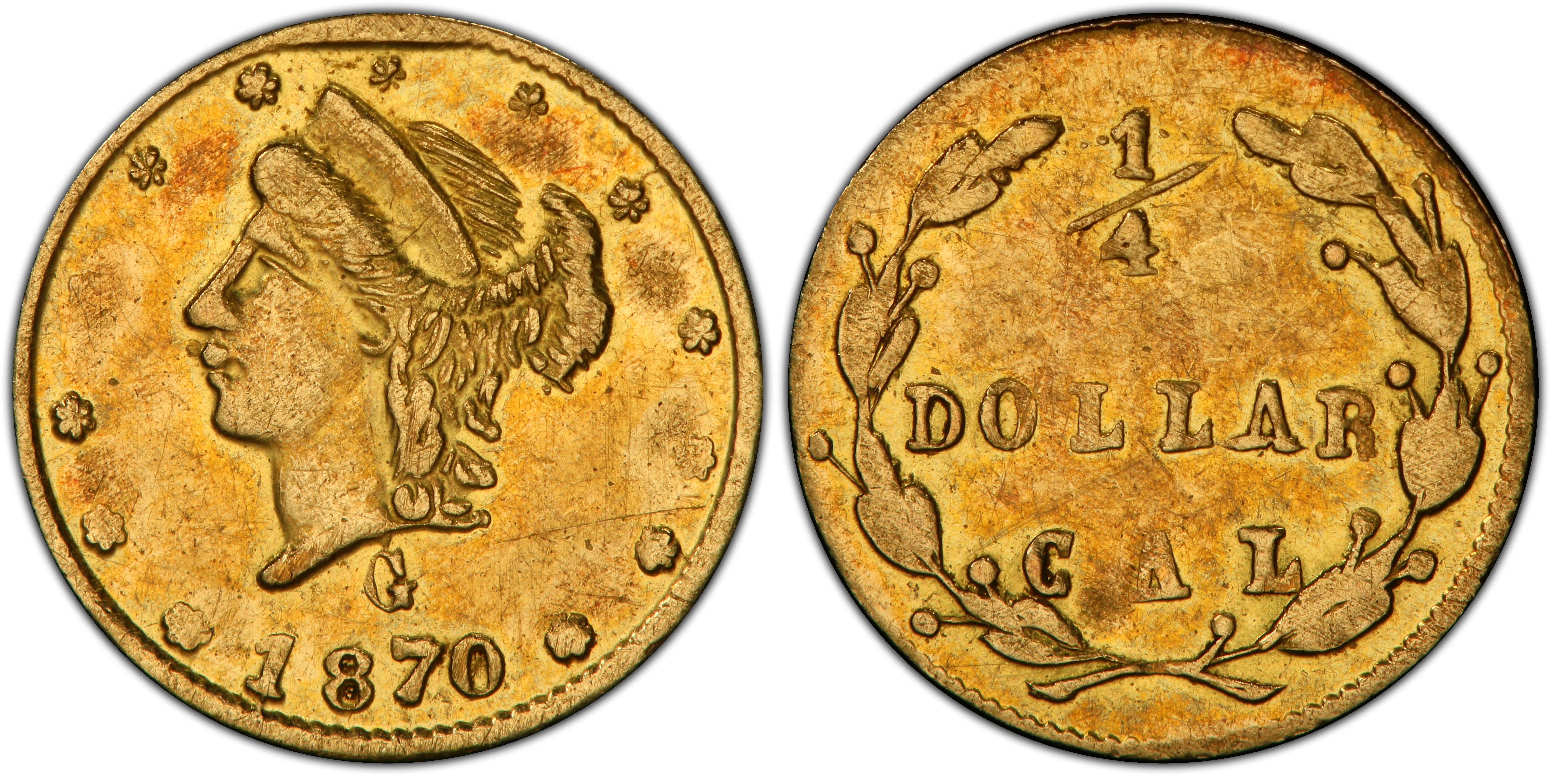
Obverse & Reverse
The 1870 G25C BG-836 is a classic exemplar of 'Period Two' California Fractional Gold. By 1870, the acute shortage of small change that characterized the initial Gold Rush boom had been largely ameliorated by the output of the United States Mint in San Francisco, which began operations in 1854. The rationale for producing these minuscule gold pieces had thus shifted from necessity to novelty. They were no longer essential cogs in the machinery of commerce but had evolved into popular souvenirs, keepsakes, and jewelry items for tourists and locals captivated by the romance of the Golden State. The Coinage Act of 1864 had officially prohibited the private issuance of coinage, but the law was not aggressively enforced until the Secret Service crackdown of 1883. This legal gray area allowed a number of San Francisco jewelers and metalworkers to continue their craft. Robert B. Gray & Co. was one such prominent firm, having acquired the business of an earlier fractional gold pioneer, Antoine Louis Nouzillet. These 'jeweler's issues' were typically struck with a lower intrinsic gold value relative to their face value, a fact well understood by the public who accepted them not as money, but as charming mementos. The 1870s marked a significant economic transition for California; the easily accessible placer gold deposits were long exhausted, and the state's economy was diversifying into large-scale agriculture, railroad expansion, and manufacturing. San Francisco, however, remained the undisputed financial and cultural hub of the West Coast. It was in this environment of prosperity and nostalgia for the 'Days of '49' that the BG-836 was born. Struck using the crude but effective 'hammer method'—where dies were struck by hand with a sledgehammer—the quality of these pieces could vary dramatically. The BG-836 is a variety of immense rarity, suggesting an exceptionally small production run, perhaps as a trial or special order. Its journey since 1870 has been one of quiet survival, with only a handful of examples known to modern numismatics, making each a direct and precious link to the post-Gold Rush era of Californian enterprise.
Associated EventCalifornia Economic Transition (Post-Gold Rush)
Reason For MintingPrimarily created as a souvenir or 'jeweler's issue' for the novelty trade rather than for circulation as currency.
Minter HistoryRobert B. Gray & Co. was a San Francisco jewelry firm active in the production of California fractional gold during the 'Period Two' era. Around 1859, Gray purchased the business and equipment of Antoine Louis Nouzillet, one of the earliest fractional minters. The firm continued to use some of Nouzillet's dies while also creating their own, some of which feature a distinctive 'G' hallmark. According to research by Breen and Gillio, Gray's issues are often of higher weight and intrinsic value than those of his contemporaries. The firm was ultimately sold to the California Jewelry Co. (Levison Bros.) in 1871.
Historical SignificanceThe BG-836 is significant as it represents the mature phase of the fractional gold phenomenon, when the pieces were made as commercial keepsakes rather than circulating currency. Its extreme rarity makes it a key variety for advanced specialists and a testament to the diverse and unofficial minting activities that persisted in San Francisco long after the Gold Rush's peak.
N/A
Denomination25 Cents
Minting Period1870
Assayer/MinterRobert B. Gray & Co.
Geographic OriginSan Francisco, California
Obverse DescriptionA Liberty Head, facing left, with hair tied in a bun. The portrait is surrounded by 13 six-pointed stars, representing the original colonies. The date, 1870, is positioned below the bust truncation.
Obverse Inscription1870
Reverse DescriptionThe denomination '25 CENTS' is displayed across two lines in the center, enclosed within a continuous wreath. The wreath is composed of two olive branches, tied with a bow at the bottom, and features prominent berries.
Reverse Inscription25 CENTS
CompositionGold
Stated Fineness Actual Fineness EdgePlain
Extremely low, likely fewer than 20 pieces.
Survival EstimateFewer than 5 known; Breen-Gillio (2003) lists just four examples.
Rarity ScaleHigh R-7
This is a landmark rarity in the California Fractional Gold series. Its appeal is immense for the advanced specialist due to its near-unobtainable status, its connection to a known San Francisco jeweler, and the challenge of acquiring one of the few known specimens.
Key VarietiesThe primary known variety relates to the die state. 'Die State I' or the 'Fresh Reverse' state, is from the dies before they were polished. This polishing subsequently removed the stems from the berries on the reverse wreath, creating a 'floating berries' appearance on later strikes. The earlier, 'Fresh Reverse' state is considered more desirable by specialists. No later-date Proof restrikes or patterns of this specific variety are known to exist.
Authentication TipsGenuine California Fractional Gold pieces of this era are characteristically very thin, almost like a business card. Authenticity is supported by the presence of a clear denomination (e.g., '25 CENTS' or '1/4 DOLLAR'). Replicas are often thicker, have a soapy or cast-like appearance, and frequently feature a bear on the reverse, a design element never used on genuine 19th-century issues. The strike can be uneven, a hallmark of the hammer-striking process, which is often a positive indicator unlike modern, perfectly struck fakes.
Shopping ConsiderationsFor a coin of this rarity, any available example is a major acquisition. A 'premium quality' specimen would be one that is well-centered and exhibits a relatively sharp strike for the issue, particularly on the central Liberty Head details and the reverse denomination. As noted in auction records, stars 4 and 11 are often bluntly struck, which is characteristic and not a flaw. Look for original, undisturbed surfaces with some remaining luster; a satiny, honey-gold appearance is typical. Avoid examples that have been holed, used as jewelry, harshly cleaned, or show signs of tooling. Given the rarity, even a problem-free, circulated example in AU condition is a significant prize. Certification by a top-tier grading service (PCGS or NGC) is mandatory for a transaction of this magnitude.
A coin's grade is its condition, rated on a 1-70 scale. For rare coins, this is the most critical factor in determining value, as a tiny difference in preservation can mean a huge difference in price.
Relevant Grade TypesAll original examples of BG-836 were struck as business strikes, intended for sale as souvenirs, not circulation. They are found in Circulated (1-58) and, more commonly for survivors, Mint State (MS, 60-70) grades. No proofs were struck during the original period of issue, and no later-date Proof restrikes are known to exist for this variety.
Mint State CharacteristicsUncirculated examples of BG-836 typically exhibit a soft, satiny luster rather than a deeply prooflike or frosty one. The strike is often somewhat weak in peripheral areas due to the crude hammer-striking process; the stars nearest the rim (specifically stars 4 and 11) are noted as being characteristically blunt. The central devices, however, can be sharp. Due to the softness of the gold and the manufacturing process, small planchet flaws or faint adjustment marks may be present and should be considered characteristic rather than disqualifying.
Circulated Wear PatternsOn circulated examples, wear first appears on the highest points of the design: the hair above Liberty's eye and ear, her cheekbone, and the leaves and berries in the wreath. On moderately worn pieces, the finer details of the hair will merge and the individual letters of the denomination will begin to lose their sharpness. In lower grades, the stars and date will become faint.
Key Factors For ValueWith only a few specimens known, rarity is the primary value driver. Beyond that, the grade and surface quality are paramount. An example with original, uncleaned surfaces and minimal distracting marks will command a significant premium. Eye appeal is crucial; a specimen with a sharp strike for the issue and attractive original color will be prized above a dull or weakly struck counterpart. The die state (e.g., the 'Fresh Reverse') is a key factor for specialists. A CAC sticker would provide a strong endorsement of quality for the assigned grade and add a substantial premium.
PCGS Price Guide
| Grade | Price | Population |
|---|---|---|
| 50 | $1,500.00 | N/A |
| 50+ | $1,550.00 | N/A |
| 53 | $1,650.00 | N/A |
| 53+ | $1,700.00 | N/A |
| 55 | $1,800.00 | N/A |
| 55+ | $2,000.00 | N/A |
| 58 | $2,250.00 | 2 |
| 58+ | $2,750.00 | N/A |
| 60 | $3,500.00 | N/A |
| 61 | $4,500.00 | 2 |