1872/1 G50C BG-937, PL (Regular Strike)
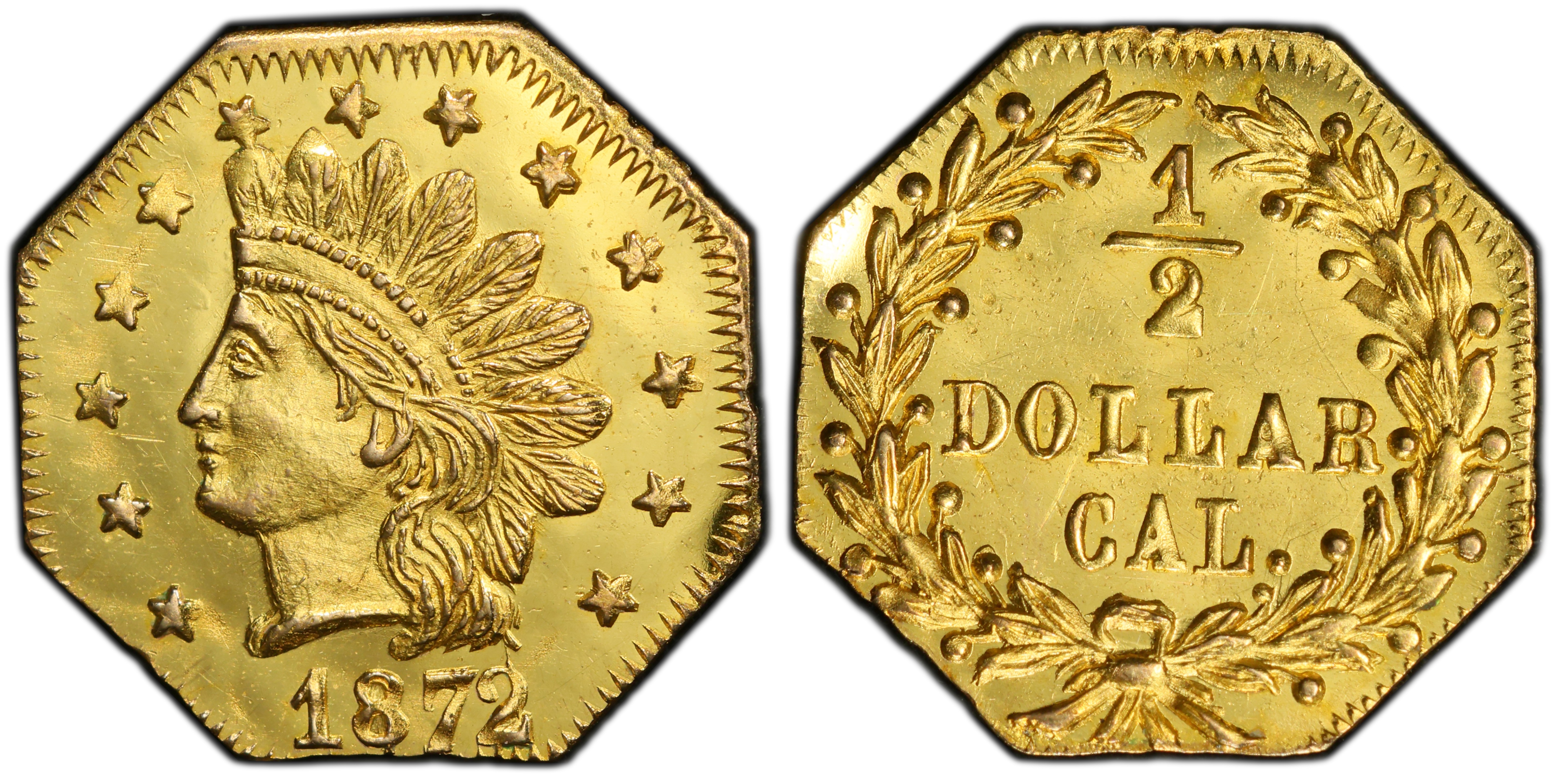
Obverse & Reverse
The BG-937 is a quintessential example of a 'Period Two' California Fractional Gold piece, a fascinating and complex series born from the California Gold Rush. The initial period of fractional gold (1852-1857) saw the striking of tiny coins to alleviate a severe shortage of small change in the booming Western economy. These 'Period One' pieces, though often underweight, were intended for and saw actual circulation. By the late 1850s, the new San Francisco Mint was producing enough federal silver and gold coinage to satisfy commercial needs, rendering the fractional gold pieces obsolete as circulating currency. However, a robust market for them had developed among tourists, settlers, and those back East who desired a tangible, golden souvenir of the romanticized Gold Rush. This demand gave rise to 'Period Two' (circa 1858-1882), during which numerous jewelers and private minters in San Francisco produced fractional gold pieces almost exclusively as keepsakes. These later issues, including the 1872/1 BG-937, were not intended for circulation and were often sold at a premium over their metallic value. The Coinage Act of 1864 technically outlawed private coinage, but it wasn't strictly enforced by the Secret Service until 1883, allowing this souvenir trade to flourish for two decades. The BG-937 is notable for its clear 1872/1 overdate, a diagnostic created when a die for an 1871 coin was re-punched with the new date for use in 1872. This variety, with its Indian Head motif—a popular and distinctly American design—would have been an attractive memento. The production methods were often crude, with dies being hand-cut and coins struck by the hammer method, leading to variations in strike quality. While the specific minter is unrecorded, numismatic scholarship, notably the work of Walter Breen and Ronald J. Gillio, often attributes the elegant engraving style of this period to jewelers like Gaetano Franceso. After 1883, the production of denominated pieces ceased, leading to a third period of non-denominated 'charms' and tokens that mimicked the earlier issues. The BG-937 remains a popular collectible, representing the transition of fractional gold from a circulating medium of necessity to a cherished souvenir of a pivotal era in American history.
Associated EventCalifornia Gold Rush Aftermath & Souvenir Trade
Reason For MintingPrimarily minted to be sold as souvenirs and keepsakes for tourists and collectors, not for general circulation.
Minter HistoryThe specific minter of BG-937 is unknown, a common trait for Period Two fractionals. Many were produced by jewelers in San Francisco. Stylistic analysis suggests the die-sinker may have been Gaetano Franceso, an Italian jeweler and engraver active in San Francisco during this period, known for his refined and artistic work on other fractional gold pieces. However, this attribution remains speculative, as records from these private operations are virtually nonexistent.
Historical SignificanceThis coin is significant as it exemplifies the 'Period Two' souvenir phase of California Fractional Gold production. It demonstrates the continued romantic appeal of the Gold Rush long after the initial fever had subsided and federal coinage became plentiful. The 1872/1 overdate provides a direct link to the annual production practices of these private minters and serves as a key diagnostic for numismatists.
BG-937
DenominationG50C (Gold 50 Cents)
Minting Period1872
Assayer/MinterUnknown, possibly Gaetano Franceso
Geographic OriginSan Francisco, California
Obverse DescriptionA stylized head of Liberty facing left, wearing a feathered headdress. The portrait is surrounded by thirteen stars representing the original colonies. The most prominent feature is the clear overdate, where the '2' in the date is punched over an underlying '1'.
Obverse Inscription1872/1
Reverse DescriptionThe denomination '1/2' is enclosed within a wreath of leaves and berries. The wreath is open at the top.
Reverse Inscription1/2
CompositionGold
Stated Fineness Actual FinenessVaries, but typically lower than federal coinage, consistent with souvenir issues.
Weight0.25 grams
Diameter10.00 mm
EdgePlain
Unknown
Survival Estimate75-125
Rarity ScaleR-4+
BG-937 is highly sought after due to its distinct 1872/1 overdate, a feature that is easily visible and adds historical intrigue. As an octagonal Indian Head type from Period Two, it captures the classic aesthetic of the series. The existence of Prooflike (PL) and Deep Mirror Prooflike (DMPL) examples adds a further layer of desirability for registry set collectors and those who appreciate exceptional surface quality.
Key VarietiesThe primary variety is the 1872/1 overdate itself. Within the BG-937 issue, there are different die states, with later states showing a prominent cud or die break on the reverse near the 3 o'clock position. No major restrikes from the original dies are known, but the entire field of California fractionals is plagued by later imitations and charms. Notably, collector Robert Bashlow was famous for restriking various historical coins in the 1960s, but there is no evidence he possessed or used the BG-937 dies. Any 'restrike' would almost certainly be a modern replica or fantasy piece, not a numismatically significant issue.
Authentication TipsGenuine BG-937s have a specific die marker: the '1' of '1/2' on the reverse is high and leans to the right. The overdate on the obverse should show a clear remnant of the '1' beneath the '2'. Counterfeits are common in the fractional gold series. Fakes often have a soapy, indistinct look, incorrect weight, or a brassy color. They may also lack a denomination or use the phrase 'CALIFORNIA GOLD' instead of a proper denomination like '1/2 DOLLAR' (though BG-937 itself only has '1/2'). Weakly struck areas are common on genuine pieces, while fakes are sometimes suspiciously sharp and uniform. Third-party grading is highly recommended.
Shopping ConsiderationsA premium quality BG-937 is defined by a sharp strike on the central devices (Indian's portrait and the '1/2'), which is often lacking. Look for examples where the feathers and facial details are clear. Surface quality is paramount; many have been cleaned or used as jewelry. A coin with original, undisturbed satiny or prooflike luster commands a significant premium. For PL or DMPL designated coins, the mirrored fields should be deep and clear, with frosted devices providing strong cameo contrast. Check carefully for hidden tooling in the fields or repairs on the delicate octagonal rim. The visibility and completeness of the underlying '1' in the overdate can also influence value among specialists.
A coin's grade is its condition, rated on a 1-70 scale. For rare coins, this is the most critical factor in determining value, as a tiny difference in preservation can mean a huge difference in price.
Relevant Grade TypesOriginal period issues were business strikes, although produced for souvenir purposes, and are found in both Circulated (1-58) and Mint State (MS, 60-70) grades. Due to their status as keepsakes, many survive in high grades. No true Proofs were struck during the original minting period. However, some were struck using highly polished dies on polished planchets, resulting in coins with reflective surfaces. These are designated as Prooflike (PL) or Deep Mirror Prooflike (DMPL/DPL) by grading services, which are business strikes with special characteristics, not a separate issue type like true Proofs. These PL and DMPL examples are highly prized and trade at significant premiums.
Mint State CharacteristicsUncirculated examples of BG-937 are characterized by their luster, which can range from a soft, satiny glow to deeply mirrored fields on PL/DMPL specimens. Strike is a key issue; many are weakly struck on the stars, the lower part of the date, and the denomination. A well-struck example with full central details is rare and desirable. As these were privately made from relatively soft gold, even high-grade examples will typically show small, scattered contact marks from handling and storage over the past 150 years.
Circulated Wear PatternsOn circulated examples, wear first appears on the high points of the design. For the obverse, this includes the cheek, brow, and the tips of the feathers in the headdress. On the reverse, the highest points of the wreath's leaves and the fraction '1/2' will show the first signs of friction and flattening. In lower grades (VF and below), the stars will begin to merge with the fields and the date becomes less distinct.
Key Factors For ValueBeyond the numerical grade, value is driven by several key factors. First is surface quality: an example with original, uncleaned surfaces and strong luster is worth far more than a cleaned or polished coin of the same grade. Second is the strike: a sharply struck coin with full details, especially on the portrait and date, is a premium piece. Third is eye appeal, which includes attractive toning (often a reddish-gold hue) and the absence of distracting marks. Finally, the PL or DMPL designation adds a massive premium, with DMPL coins being the most coveted. A CAC sticker for this issue confirms premium quality for the grade and will add to its market value.
PCGS Price Guide
| Grade | Price | Population |
|---|---|---|
| 64 | $950.00 | 4 |
| 65 | N/A | N/A |