1868 G50C BG-961, PL (Regular Strike)
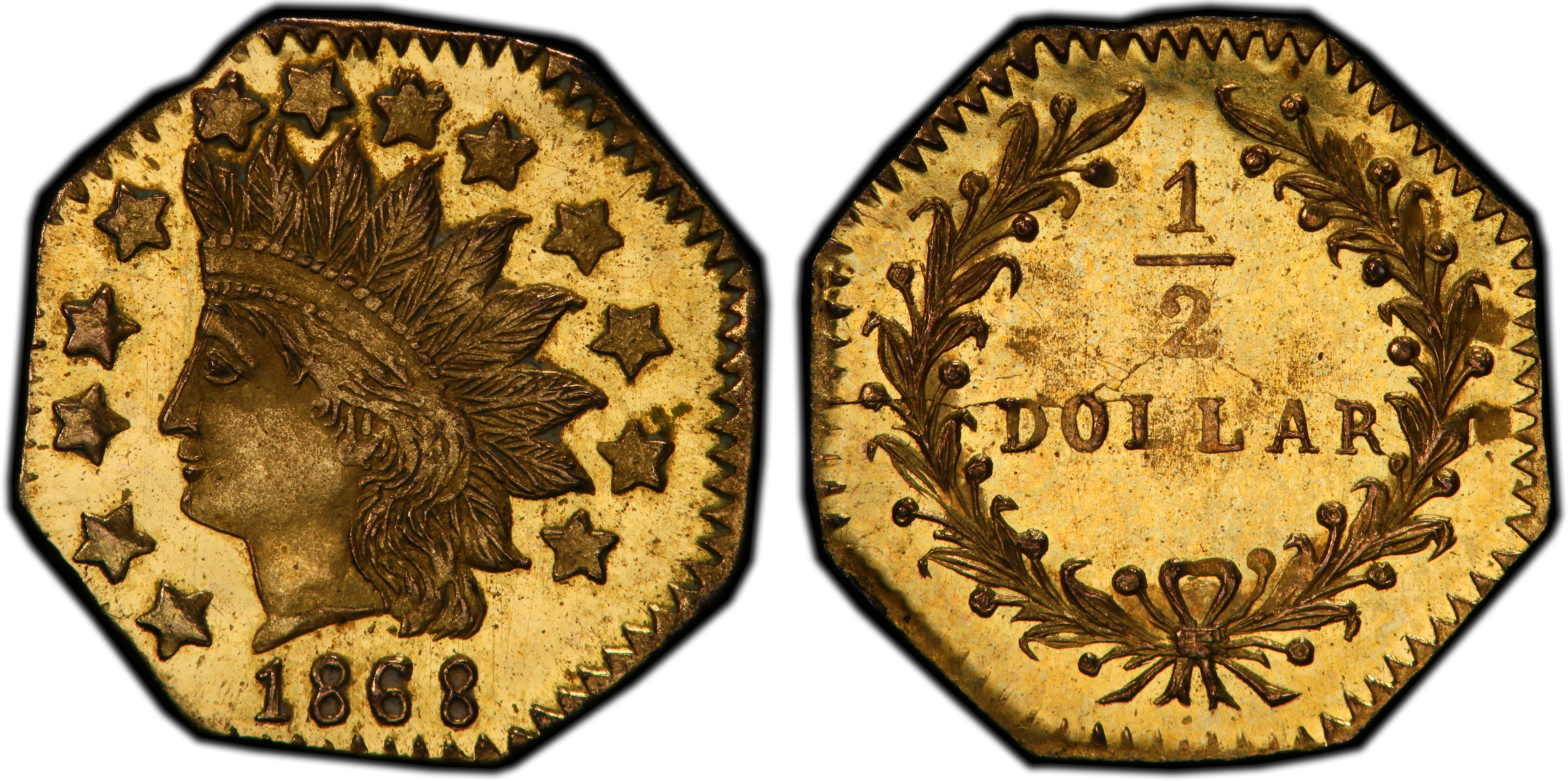
Obverse & Reverse
The 1868 BG-961 50 Cents is a product of what numismatists classify as 'Period Two' (1859-1882) of California Fractional Gold production. Unlike the 'Period One' issues (1852-1857), which were struck out of a genuine commercial need to alleviate a severe shortage of small change during the initial Gold Rush, the Period Two pieces emerged in a different economic landscape. By the late 1850s and into the 1860s, the San Francisco Mint was in full operation, producing ample quantities of federal silver and gold coinage, effectively satisfying the region's transactional needs. The rationale for striking private fractional gold had thus shifted dramatically. The continued production by various jewelers and private minters in San Francisco was no longer for circulation but to cater to a burgeoning souvenir and novelty market. These miniature gold pieces became popular keepsakes for tourists, mementos of the Gold Rush, and items to be mounted into jewelry. The Act of 1864 had prohibited private coinage, but enforcement was lax, allowing these 'jeweler's issues' to be produced for years, often with pre-dated dies to circumvent the law. The BG-961, dated 1868, is a quintessential example of this era. It was not intended to pass from hand to hand in saloons or general stores; rather, it was a finely crafted miniature sold as a charming curiosity. Its high rarity today (R-7) suggests an extremely small original production run, typical of these specialized, non-circulating issues. Their gold content was often less than their face value would imply, further cementing their status as tokens rather than true coinage. Today, these pieces are highly prized by collectors not for their role in commerce, but as rare artifacts representing the transition of California from a frontier economy to a place of myth, tourism, and remembrance.
Associated EventPost-Gold Rush California Tourism
Reason For MintingPrimarily minted as a souvenir or for use in jewelry, rather than to alleviate a currency shortage.
Minter HistoryThe specific minter or jeweler who produced the BG-961 die pair is unrecorded. During 'Period Two,' numerous San Francisco jewelers, such as Robert B. Gray & Co., Antoine Nouizillet, and others, were active in producing fractional gold. However, the dies for BG-961 have not been definitively attributed to any known maker, reflecting the often-anonymous nature of these souvenir operations.
Historical SignificanceThe BG-961 is significant not as a circulating coin but as a numismatic artifact representing the commercialization of the Gold Rush legacy. It marks a shift from utilitarian private coinage to souvenir tokens, reflecting California's changing economy and its emerging identity as a tourist destination. Its extreme rarity makes it a key piece for advanced collectors of the series.
N/A
Denomination50 Cents
Minting Period1868
Assayer/MinterUnknown Private Minter
Geographic OriginSan Francisco, California
Obverse DescriptionAn Indian Head, facing left, with a feathered headdress. The portrait is encircled by 13 five-pointed stars. The date, 1868, is positioned below the bust.
Obverse Inscription1868
Reverse DescriptionAn ornamental wreath, open at the top, encircles the denomination '50 CENTS'. The legend 'CALIFORNIA GOLD' is inscribed around the wreath at the periphery. The octagonal planchet has a plain, raised border on both sides.
Reverse InscriptionCALIFORNIA GOLD 50 CENTS
CompositionGold
Stated Fineness Actual FinenessVariable, but typically lower than Period One issues.
EdgePlain
Extremely Low
Survival Estimate7 to 9 known
Rarity ScaleR-7
The BG-961 is a major rarity in the California Fractional Gold series, appealing to advanced specialists. Its allure lies in its extreme scarcity (R-7), octagonal shape, and the challenge of acquiring one of the very few known examples. The 'PL' (Proof-Like) designation adds another layer of desirability for those seeking exceptional surface quality.
Key VarietiesNo major die varieties from the original minting period are widely recognized for BG-961. Unlike some other territorial issues, there are no known special collector restrikes (such as Chapman restrikes) for California Fractional Gold. The primary variations for collectors to note are die states, though on such a rare issue, any example is a major acquisition. The 'PL' (Proof-Like) and 'DPL' (Deep Proof-Like) designations by grading services are not varieties but denote exceptional surface quality from the original strike.
Authentication TipsGenuine Period Two fractionals like BG-961 are typically very thin and crisply struck, though sometimes with areas of central weakness. Suspect any example that appears thick, cast, or has a soft, soapy appearance. The details of the Indian's feathers and the leaves of the wreath should be sharp. A key rule for fractional gold is 'Beware the Bear'—no genuine denominated pieces from this era feature a bear. Edges should be plain and well-formed. Due to its high rarity and value, authentication by a top-tier grading service (PCGS or NGC) is essential for this variety.
Shopping ConsiderationsFor a 'premium quality' BG-961, look for a specimen with sharply struck central details, particularly on the Indian's cheek and the '50 CENTS' on the reverse. Given the 'PL' designation, mirrored fields are a primary consideration; the reflectivity should be consistent and not the result of polishing (look for cartwheel luster within the mirrors). Avoid examples that have been cleaned, which will appear hazy or show hairline scratches. Any mounting traces from jewelry use, however faint, will drastically reduce the value. Given the minuscule population, any example without significant impairments is a prize, but one with clean, reflective surfaces and a strong strike commands a significant premium.
A coin's grade is its condition, rated on a 1-70 scale. For rare coins, this is the most critical factor in determining value, as a tiny difference in preservation can mean a huge difference in price.
Relevant Grade TypesOriginal period issues were business strikes. Despite being sold as souvenirs, they are not considered Proofs in the traditional sense and are graded on the Mint State (MS, 60-70) scale if uncirculated. Due to their non-circulating nature, most known examples are in high grades (AU or MS). The 'PL' (Proof-Like) designation is a modifier for a business strike (MS) coin that exhibits reflective, mirror-like fields, likely resulting from freshly polished dies used to create a flashy product for sale. No true Proofs were struck, and no authorized restrikes exist.
Mint State CharacteristicsAn uncirculated BG-961 is defined by its luster and absence of wear. The luster is typically flashy and reflective, especially on PL designated pieces. The strike can be inconsistent; while some are sharp, many Period Two fractionals show some softness in the center of the obverse or reverse. The high points of the design are extremely susceptible to contact marks due to the softness of the gold. A superior MS example will have minimal marks, strong underlying luster, and the best possible strike for the variety.
Circulated Wear PatternsWhile most examples are uncirculated, if wear is present, it will first appear on the highest points: the Indian's cheekbone, brow, and the upper feathers of the headdress. On the reverse, the highest points of the wreath's leaves and the numerals in '50' would show the first signs of friction. In lower grades, the stars and peripheral legends would begin to lose their sharpness.
Key Factors For ValueFor the BG-961, value is driven first by its sheer existence due to its R-7 rarity. Beyond that, the primary factors are surface quality and eye appeal. A specimen with deep, clean, original proof-like surfaces will command a massive premium over a standard MS example or one that has been cleaned or polished. Strike sharpness is also key; a coin with fully struck-up central details is highly desirable. Finally, a CAC sticker on a PCGS or NGC holder provides third-party verification of quality for the grade and adds a significant premium for this elite-level rarity.
PCGS Price Guide
| Grade | Price | Population |
|---|---|---|
| 63 | $1,750.00 | 1 |
| 63+ | $2,000.00 | N/A |
| 64 | $2,250.00 | N/A |
| 66 | N/A | N/A |