1871 G25C BG-861 (Regular Strike)
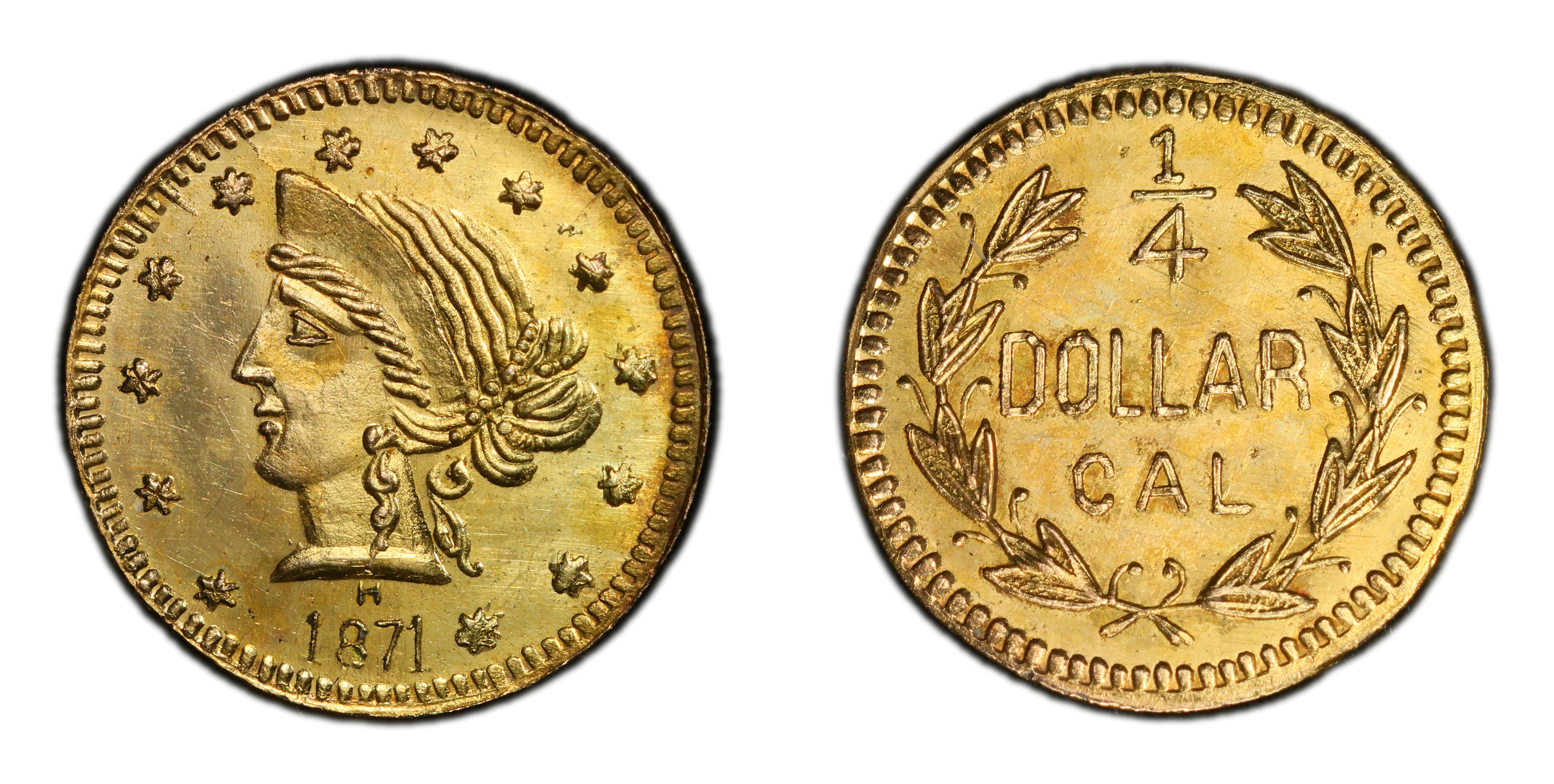
Obverse & Reverse
The 1871 25 Cents, cataloged as Breen-Gillio 861, is a fascinating anomaly within the California Fractional Gold series, notable for its origin far from the California gold fields. This piece belongs to 'Period Two' (1859-1882) of the series, a time when these small gold coins transitioned from being a necessary supplement to circulating currency to primarily serving as souvenirs, keepsakes, and jewelry items. Unlike the earlier 'Period One' issues born from a severe shortage of small change during the Gold Rush, the Period Two 'jeweler's issues' were lighter, often less pure, and struck for a public fascinated with the romanticism of the West. The story of BG-861, however, takes a unique turn. Research has identified the 'H' mintmark found on this and related varieties with the firm of Reuben N. Hershfield and Noah Mitchell. In a bold and ultimately ill-fated venture, they established their minting operation not in San Francisco, but in Leavenworth, Kansas. They produced a variety of denominated gold pieces dated 1871, intending to capitalize on the souvenir market. Their operation was short-lived. In August 1871, United States Secret Service agents raided their facility, arresting the minters and seizing their equipment and stock. Hershfield and Mitchell were charged with violating the Coinage Act of April 22, 1864, which prohibited the private minting of coinage. This swift federal action abruptly terminated their production, making all 'H' mintmark varieties one-year-only issues. The surviving examples of BG-861 are therefore relics of a brief, audacious, and illegal minting operation, whose story adds a dramatic chapter to the already colorful history of private coinage in America.
Associated EventPost-Gold Rush era souvenir coinage production
Reason For MintingProduced primarily as a commercial souvenir or keepsake to capitalize on the public's fascination with the California Gold Rush.
Minter HistoryReuben N. Hershfield and Noah Mitchell were jewelers who operated a private mint in Leavenworth, Kansas. In 1871, they began producing small denomination gold pieces, stylistically similar to those being made in California, marking them with an 'H'. Their enterprise was illegal under the federal Private Coinage Law of 1864, and their operation was shut down by the Secret Service in August 1871, making their coins scarce and historically significant.
Historical SignificanceThe BG-861 is significant not only as a representative of the 'jeweler's issue' period of California Fractional Gold but for its unusual Kansas origin and the dramatic story of its suppression by federal authorities. It serves as a prime example of the legal conflicts surrounding private coinage in the 19th century.
N/A
Denomination25 Cents
Minting Period1871
Assayer/MinterReuben N. Hershfield and Noah Mitchell
Geographic OriginLeavenworth, Kansas
Obverse DescriptionA head of Liberty facing left, her hair tied in a bun. She is surrounded by 13 six-pointed stars. The date '1871' is below the bust. A small letter 'H', the minter's mark, is located below the truncation of the neck and above the date.
Obverse Inscription1871
Reverse DescriptionThe denomination '25 CENTS' is displayed within a wreath composed of two branches tied together by a bow at the bottom. The legend 'CALIFORNIA GOLD' encircles the wreath along the upper periphery.
Reverse InscriptionCALIFORNIA GOLD / 25 CENTS
CompositionGold
Stated Fineness Actual FinenessVariable, typical for Period Two issues (often between .500 and .800 fine).
Weight0.25 grams
Diameter9.80 mm
EdgePlain
Unknown (part of the stock seized by the Secret Service in August 1871)
Survival Estimate31-75 coins known
Rarity ScaleR-5
This coin is highly sought after for its compelling backstory, being an illegal issue struck in Kansas rather than California. Its one-year-only status, the 'H' mintmark, and verified rarity make it a prized possession for specialists in the series.
Key VarietiesThe BG-861 is a single, specific die marriage. There are no major varieties from the original minting period. No restrikes, patterns, or trial pieces are known to exist, as the operation was shut down abruptly by law enforcement, precluding any later collector-oriented issues.
Authentication TipsGenuine examples must have the small 'H' for Hershfield below the bust. The strike is often somewhat soft, particularly on the highest points of Liberty's hair and the wreath. The lettering style and star shapes should be compared to known genuine examples. Modern counterfeits or replicas often have a soapy, cast-like appearance, incorrect weight, or may omit the denomination 'CENTS' to avoid legal issues. Be wary of pieces with an unusually sharp, uniform strike, which can be a red flag.
Shopping ConsiderationsA premium quality example for its grade will show minimal distracting marks, particularly on Liberty's cheek and the fields. Look for a well-centered strike, though perfect centering is not always the norm. Original, undisturbed luster is paramount; many of these tiny coins have been cleaned or used as jewelry, so evidence of polishing, solder, or rim damage should be carefully checked for. A sharp strike on the date and the 'H' mintmark is highly desirable. Even wear is preferable to a weakly struck but technically uncirculated piece.
A coin's grade is its condition, rated on a 1-70 scale. For rare coins, this is the most critical factor in determining value, as a tiny difference in preservation can mean a huge difference in price.
Relevant Grade TypesOriginal period issues of BG-861 were business strikes, likely intended as souvenirs. They are found in Circulated (1-58) and, more commonly, Mint State (MS, 60-70) grades due to their non-circulating purpose. No Proof (PR/PF) examples were struck during the original period of issue, and no later-date restrikes of any kind are known.
Mint State CharacteristicsUncirculated examples of BG-861 typically exhibit a soft, satiny luster rather than a deeply prooflike or frosty one. The strike is characteristically weak in the center, so some softness on the high points of Liberty's hair and the wreath leaves is expected even on high-grade MS specimens. The planchets were often imperfect, so minor original flaws may be present. Contact marks are common due to the softness of the gold and their method of production and storage.
Circulated Wear PatternsOn circulated examples, wear first appears on the highest points of the design: the hair bun and the strands of hair over Liberty's ear, as well as her cheek. On the reverse, the high points of the wreath leaves and the bow will show initial flatness. In lower grades (VF and below), the stars on the obverse and the letters in the legends will begin to lose their sharpness and merge towards the rim.
Key Factors For ValueFor the BG-861, value is driven by rarity and grade. A coin with original, uncleaned surfaces commands a significant premium. Strike quality is a major consideration; a well-struck example with sharp details on the central devices is more desirable than a weakly struck piece of the same numerical grade. Eye appeal is crucial; coins with a pleasing, original reddish-gold toning are prized. A CAC sticker for this issue provides a strong endorsement of surface quality and strike for the grade, often resulting in a substantial price premium.
PCGS Price Guide
| Grade | Price | Population |
|---|---|---|
| 53 | $250.00 | 1 |
| 53+ | $260.00 | N/A |
| 55 | $275.00 | 1 |
| 55+ | $285.00 | N/A |
| 58 | $300.00 | 2 |
| 58+ | $310.00 | N/A |
| 60 | $325.00 | 1 |
| 61 | $350.00 | 8 |
| 62 | $400.00 | 16 |
| 62+ | $450.00 | N/A |
| 63 | $575.00 | 13 |
| 63+ | $650.00 | N/A |
| 64 | $875.00 | 14 |
| 64+ | $1,000.00 | N/A |
| 65 | $1,750.00 | 1 |