1867 G25C BG-805 (Regular Strike)
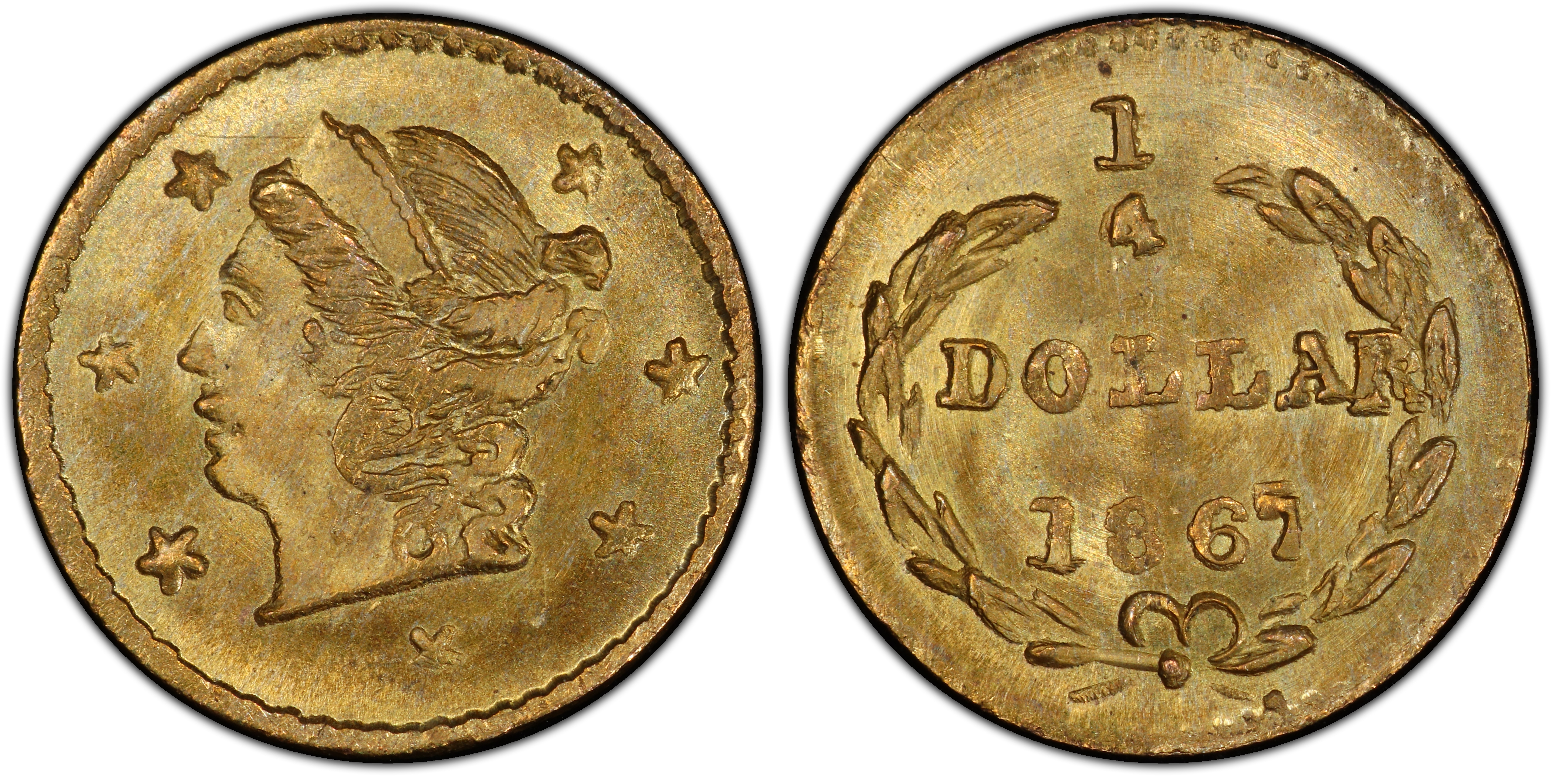
Obverse & Reverse
The 1867 25 Cents, cataloged as Breen-Gillio 805, is a quintessential example of a 'Period Two' California Fractional Gold piece. By the time of its striking, the acute shortage of small change that had plagued California in the early 1850s had largely been resolved by the output of the official United States Branch Mint in San Francisco, which opened in 1854. The impetus for producing these miniature gold coins had therefore shifted dramatically. The 'Period One' (1852-1857) issues were created out of commercial necessity, intended to circulate and facilitate daily transactions in a gold-dust-based economy. In contrast, Period Two issues, struck from 1858 to 1882, were primarily manufactured by jewelers and novelty makers to be sold as souvenirs, keepsakes, and jewelry items. They catered to a burgeoning tourist trade and a national fascination with the romance of the California Gold Rush. Technically, the Private Coinage Act of April 22, 1864, had made the issuance of private coinage illegal. However, this federal law was not aggressively enforced against these small, low-value tokens until the Secret Service finally cracked down in 1883. This legal gray area allowed numerous San Francisco jewelers to continue production throughout the 1860s and 1870s. The BG-805 is a product of this era. Unlike pieces struck by more prominent makers like Robert B. Gray & Co. (who often hallmarked their coins with a 'G'), the BG-805 is anonymous, its creator lost to history. This is common for Period Two issues, many of which were produced with cruder dies and less care than their Period One predecessors. The gold content was also not standardized and was typically well below the coin's nominal face value, making them profitable trinkets rather than legitimate currency. Their survival in high grades is more common than for Period One coins, as they were not subjected to the rigors of circulation, but were instead often kept in drawers or mounted in jewelry, which resulted in its own set of characteristic impairments.
Associated EventPost-Gold Rush California Souvenir Trade
Reason For MintingTo be sold as a souvenir or jewelry charm capitalizing on the fame of the California Gold Rush, rather than to circulate as money.
Minter HistoryThe specific minter for BG-805 is unknown. 'Period Two' California Fractional Gold pieces were struck by numerous jewelers and artisans in San Francisco and, to a lesser extent, other cities. These makers were typically small-scale operators who created dies and struck coins using simple hand-presses or hammer-striking methods. Unlike their 'Period One' counterparts who were filling a crucial monetary void, these minters were entrepreneurs in the souvenir market. Their work is characterized by a wide variety of designs and often cruder engraving, reflecting their primary purpose as decorative items rather than coinage meant to inspire public confidence.
Historical SignificanceThe BG-805 is historically significant not as a coin used in commerce, but as a tangible artifact of how the California Gold Rush was mythologized and commercialized. It represents a shift from the utilitarian private coinage of necessity to the nostalgic and commercial production of souvenirs, illustrating a later chapter in the region's economic and cultural history. As an anonymous piece, it speaks to the cottage industry of jewelers who participated in this trade.
Not Applicable
Denomination25 Cents
Minting Period1867
Assayer/MinterUnknown Private Minter
Geographic OriginSan Francisco, California
Obverse DescriptionFeatures a small, somewhat crudely rendered Liberty Head facing left, modeled after the contemporary U.S. gold dollar. The portrait is surrounded by thirteen stars, representing the original colonies. The date, 1867, appears below the bust. The stars are often unevenly spaced and weakly struck.
Obverse Inscription1867
Reverse DescriptionA simple wreath, open at the top, encircles the denomination. The wreath is composed of two branches tied with a bow at the bottom. The style is typical for Period Two issues, often appearing somewhat less refined than the wreaths on federal coinage.
Reverse Inscription25 CENTS
CompositionGold
Stated Fineness Actual FinenessVariable, but typically less than face value. Fineness for Period Two issues can range from .500 to .800, though this specific variety is not individually assayed.
Weight0.24 grams
Diameter9.60 mm
EdgePlain
Unknown
Survival Estimate60-75 known
Rarity ScaleLow R-5
This variety appeals to specialists in the extensive California Fractional Gold series. Its status as a scarcer 'Period Two' issue, combined with the challenge of finding a well-struck, problem-free example, makes it a desirable target for completists. The historical connection to the post-Gold Rush souvenir trade adds to its allure.
Key VarietiesThere are no major varieties of the BG-805 itself, as it is a specific die marriage. No known patterns, trial pieces, or restrikes exist. The primary variation within the broader series is between the 'Period One' circulating issues and the 'Period Two' souvenir issues, with this coin belonging firmly to the latter.
Authentication TipsAuthentic examples are struck, not cast, so fields should exhibit some degree of luster, not a porous or granular texture. The details, while potentially crude, should be sharp in protected areas. Pay close attention to the style of the numerals in the date and the letters in the legend; compare them against certified examples. Many modern replicas exist, often made of brass or thinly gold-plated base metal. These fakes often have incorrect weights, a soapy or unnatural luster, and may feature designs (like bears) that never appeared on genuine fractional gold. Genuine pieces are tiny and very thin; fakes can sometimes feel disproportionately thick.
Shopping ConsiderationsA premium quality example for its grade will possess a sharp strike, especially on the stars and the word 'CENTS'. Many examples are weakly struck in portions of the periphery. Original, uncleaned surfaces are paramount; look for a warm, reddish-gold or mellow yellow-gold luster. Avoid examples that have been used as jewelry, which may show signs of solder, harsh cleaning, rim damage from a bezel, or circular scratches from being spun in a mounting. Since these were souvenirs, many survived in high grades, so the discerning collector should focus on Mint State examples with superior eye appeal and minimal distracting marks. A CAC sticker on this issue would indicate a premium quality piece with excellent surfaces and strike for the grade.
A coin's grade is its condition, rated on a 1-70 scale. For rare coins, this is the most critical factor in determining value, as a tiny difference in preservation can mean a huge difference in price.
Relevant Grade TypesOriginal issues of BG-805 were business strikes. As they were sold as souvenirs and not intended for circulation, they are most commonly encountered in Mint State (MS, 60-70) grades. It is unusual to find this variety in truly circulated grades (1-58), and any wear is more likely due to mishandling or jewelry use rather than commercial exchange. No Proof (PR/PF) examples were struck during the original minting period, and no later restrikes are known to exist.
Mint State CharacteristicsIn uncirculated grades, the BG-805 typically displays a slightly satiny, sometimes prooflike luster in the fields. The strike is a key determinant of quality; many are softly struck on the peripheral stars and the lower part of the wreath. A well-struck piece will show clear definition in Liberty's hair and the individual leaves of the wreath. Due to the softness of the gold and the crude production methods, even high-grade examples can exhibit minor planchet flaws or die polishing marks. Contact marks, even small ones, are highly visible on the tiny surfaces and will greatly influence the grade.
Circulated Wear PatternsOn the rare occasion that wear is present, it will first appear on the highest points: Liberty's cheek, hairline, and the top of her coronet. On the reverse, the highest points of the wreath's leaves and the bow knot will show the first signs of friction. In lower grades, the date and the denomination would begin to lose their sharpness.
Key Factors For ValueFor the 1867 BG-805, value is primarily driven by three factors: grade, surface quality, and strike. A high numerical grade (e.g., MS-65 vs. MS-63) creates a significant price jump. Within a grade, surface quality is key; an example with clean, original, lustrous surfaces will command a strong premium over one that is dull, has been cleaned, or is plagued by distracting marks. Finally, a sharp, well-centered strike is highly desirable and actively sought by advanced collectors. The presence of a CAC sticker, verifying the quality for the assigned grade, adds a substantial premium.
PCGS Price Guide
| Grade | Price | Population |
|---|---|---|
| 55 | $225.00 | 2 |
| 55+ | $235.00 | N/A |
| 58 | $260.00 | N/A |
| 58+ | $270.00 | N/A |
| 60 | $300.00 | N/A |
| 61 | $315.00 | N/A |
| 62 | $325.00 | 4 |
| 62+ | $355.00 | N/A |
| 63 | $400.00 | 14 |
| 63+ | $450.00 | N/A |
| 64 | $600.00 | 14 |
| 64+ | $725.00 | N/A |
| 65 | $800.00 | 9 |
| 65+ | $900.00 | N/A |
| 66 | $1,600.00 | 5 |
| 66+ | $2,150.00 | N/A |
| 67 | $3,250.00 | 1 |