1869 G50C BG-1009 (Regular Strike)
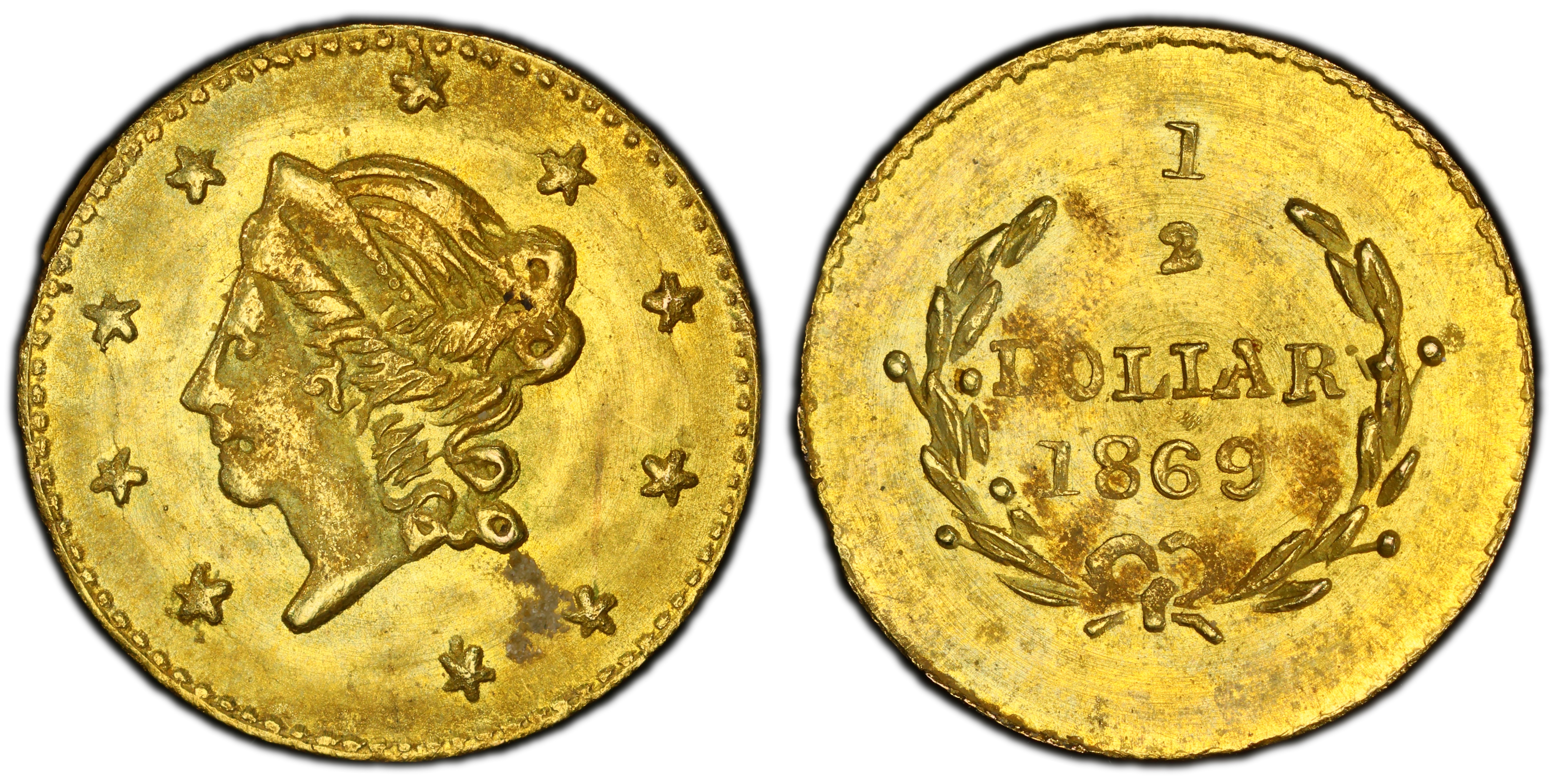
Obverse & Reverse
The 1869 G50C BG-1009 is a product of the second period (1859-1882) of California Fractional Gold production, a fascinating and complex chapter in American numismatics. Following the initial California Gold Rush boom, the state's explosive population growth created a chronic shortage of small denomination coinage for daily transactions. While the first period (1852-1856) saw private minters strike coins that were generally of good weight and intended to alleviate this shortage, the landscape had changed by the late 1860s. The Coinage Act of 1864 had officially prohibited private coinage, rendering new issues illegal. However, enforcement in the still-remote West was lax, and a demand for small gold pieces persisted, albeit for a different reason. The transcontinental railroad was completed in 1869, bringing a wave of tourists and settlers to California. This new audience, fascinated by the Gold Rush romance, created a robust market for souvenirs and keepsakes. Jewelers, many of French origin in San Francisco, stepped in to meet this demand, producing vast quantities of small, often underweight, gold tokens. These 'jeweler's issues' were not truly intended for circulation in the same way as their Period One predecessors. The BG-1009 is a quintessential example of this later period. Struck anonymously, its primary purpose was to be sold as a novelty or charm. Despite their semi-official status, they are avidly collected today as they represent the final evolution of a uniquely American response to localized economic conditions and the enduring allure of gold.
Associated EventPost-Gold Rush Economic Expansion & Tourism
Reason For MintingPrimarily produced to be sold as souvenirs and keepsakes to tourists and settlers in post-Gold Rush California.
Minter HistoryThe specific minter or jeweler who produced BG-1009 is unknown, a common characteristic of the Period Two issues. These coins were often made by various San Francisco-based jewelers who saw a commercial opportunity in creating gold souvenirs. Unlike the assayers of the Gold Rush's peak, these producers were less concerned with creating a circulating medium and more with manufacturing attractive, low-cost novelties, hence the frequent anonymity and lower gold content compared to face value.
Historical SignificanceThe BG-1009 and its contemporaries represent the commercialization of the Gold Rush myth. While not intended as a monetary necessity like earlier issues, their existence demonstrates the sustained economic impact of the gold discovery and the transition of California from a remote frontier to a destination. They are tangible artifacts of a developing tourist economy and the final chapter of America's private gold coinage era.
BG-1009
DenominationG50C
Minting Period1869
Assayer/MinterUnknown
Geographic OriginSan Francisco, California
Obverse DescriptionA beaded border encloses a Liberty Head motif, facing left. The portrait is styled after the contemporary U.S. gold coinage, with hair tied in a bun. Thirteen stars encircle the head.
Obverse Inscription[None, only stars]
Reverse DescriptionA beaded border surrounds a wreath of two branches tied with a ribbon at the bottom. Inside the wreath is the denomination '50 CENTS' and the date '1869'.
Reverse Inscription50 CENTS 1869
CompositionGold
Stated Fineness Actual FinenessVariable, but generally lower than monetary issues.
EdgePlain
Unknown
Survival EstimateFewer than 75; likely in the 31-75 range.
Rarity ScaleR-5
This variety appeals to collectors completing a Breen-Gillio set of California fractionals. Its status as a Period Two 'jeweler's issue' makes it an accessible example of this unique numismatic category, combining the allure of gold with a direct connection to California's post-Gold Rush history.
Key VarietiesThere are no known major varieties, patterns, or restrikes of the BG-1009 from the original minting period. The entire series of California Fractional Gold is defined by its vast number of distinct Breen-Gillio varieties, with each BG number representing a unique die pairing.
Authentication TipsAuthentic BG-1009 specimens often exhibit a characteristically soft strike, particularly on the highest points of Liberty's hair and the details within the wreath. Look for known die characteristics such as granularity or faint die rust, especially in the center of the reverse. Counterfeits are common in this series; many are brass or gold-plated. Be wary of pieces that are unusually sharp or have fields that appear too perfect. Comparison with high-resolution images of certified examples is essential. Any piece featuring a bear is a 20th-century fantasy piece, not a genuine fractional gold coin.
Shopping ConsiderationsWhen acquiring an example of BG-1009, prioritize originality of the surfaces. A 'premium quality' example will have minimal distracting marks and retain some of its original satiny or semi-prooflike luster. Due to the typically soft strike, a coin that shows unusual sharpness in the central details is highly desirable. Conversely, be prepared for some inherent weakness. Carefully check for evidence of cleaning, which will manifest as hairlines, or tooling. Some examples are noted to have natural planchet porosity; distinguish this from post-strike damage. Given the small size, third-party certification by PCGS or NGC is highly recommended to guarantee authenticity and grade.
A coin's grade is its condition, rated on a 1-70 scale. For rare coins, this is the most critical factor in determining value, as a tiny difference in preservation can mean a huge difference in price.
Relevant Grade TypesOriginal examples of BG-1009 were business strikes, technically intended as novelties but made with the same methods as circulating coinage. They are found in Circulated (1-58) and, more commonly, Mint State (MS, 60-70) grades. No true Proofs were struck during the original period of issue for this variety. Any coin described as 'Prooflike' (PL) is a business strike with reflective surfaces, not a specially prepared Proof striking.
Mint State CharacteristicsUncirculated examples are defined by their luster, which can range from frosty to semi-prooflike. The strike is a key differentiator; most examples are softly struck, especially on the central devices. High-end Mint State coins will display the best possible strike for the variety combined with clean, mark-free surfaces. Minor planchet porosity or die granularity, particularly on the reverse, is characteristic of the issue and should not be confused with damage.
Circulated Wear PatternsOn circulated examples, wear first appears on the highest points of Liberty's hair, particularly the strands above the ear and the bun. The cheek and the eyebrow are also susceptible. On the reverse, the high points of the wreath's leaves and the bow will show the first signs of friction, becoming flat in lower grades. The digits of the date and the letters in 'CENTS' will lose their sharpness with progressive wear.
Key Factors For ValueFor the BG-1009, the primary value drivers are grade and surface quality. An example with minimal contact marks and original, unimpaired luster commands a significant premium. Strike sharpness is a major factor; a well-struck specimen is far more desirable than a typically weak one in the same grade. Eye appeal is crucial; coins with a pleasing, original reddish-gold color are preferred over those that are bright yellow or have been cleaned or dipped. Certification by a top-tier service (PCGS, NGC) is nearly essential for market acceptance, with a CAC sticker adding a further premium for exceptional quality within the assigned grade.
PCGS Price Guide
| Grade | Price | Population |
|---|---|---|
| 53 | $200.00 | 1 |
| 53+ | $205.00 | N/A |
| 55 | $220.00 | 3 |
| 55+ | $225.00 | N/A |
| 58 | $245.00 | 6 |
| 58+ | $255.00 | N/A |
| 60 | $290.00 | N/A |
| 61 | $325.00 | 1 |
| 62 | $360.00 | 8 |
| 62+ | $375.00 | N/A |
| 63 | $475.00 | 7 |
| 63+ | $520.00 | N/A |
| 64 | $625.00 | 10 |
| 64+ | $750.00 | N/A |
| 65 | $1,075.00 | 3 |
| 65+ | $1,250.00 | N/A |
| 66 | $1,800.00 | 2 |