1875 G50C BG-946 (Regular Strike)
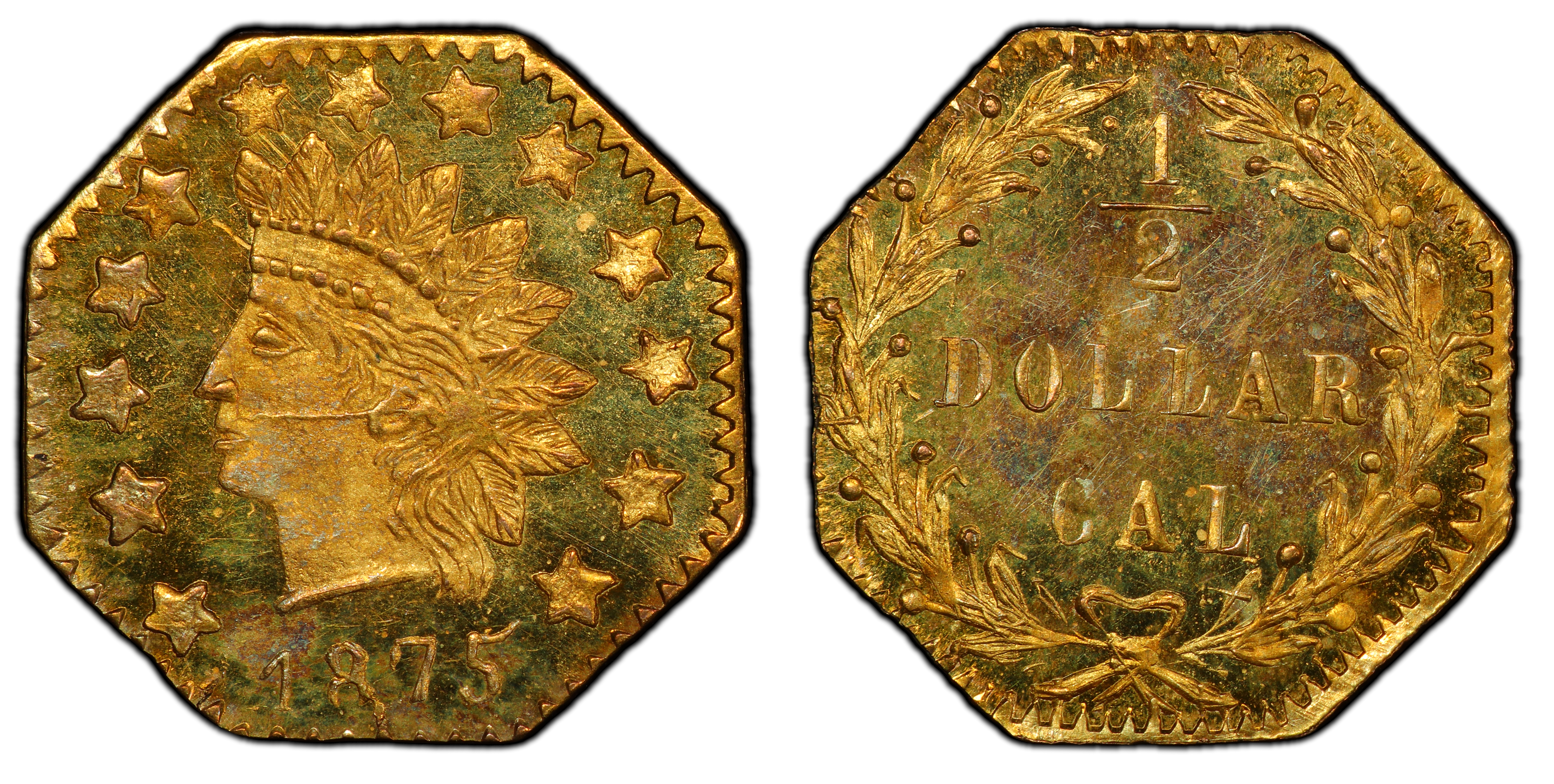
Obverse & Reverse
The 1875 50 Cents, cataloged as Breen-Gillio 946, is a quintessential example of a 'Period Two' California Fractional Gold piece. These later issues (1858-1882) represent a fascinating evolution from the earlier, circulation-focused pieces of the Gold Rush. By the mid-1870s, the acute shortage of small change in California had been largely resolved by the output of the San Francisco Mint. The purpose of fractional gold shifted from a necessary medium of exchange to that of a popular souvenir and novelty item. Jewelers in San Francisco, whose identities are now mostly lost to history, continued to produce these miniature gold coins to satisfy the public's demand for tangible mementos of the Golden State. Unlike their 'Period One' predecessors, which were struck to address a genuine economic need, these 'Jewelers' Issues' were often lighter in weight and more varied in design, featuring motifs like the Indian Head, which was not used on the earlier issues. The BG-946 was produced using the hammer method, where a planchet was placed between two dies and struck with a sledgehammer, resulting in inconsistent strike quality and frequent die failures. These pieces were not intended to meet any legal standard of weight or fineness, but rather to be sold at a premium over their minimal gold content. Their existence reflects a mature California economy where tourism and keepsakes had become a viable industry. Despite their unofficial status and the Coinage Act of 1864 which made private coinage illegal, enforcement was lax until the early 1880s, allowing these denominated tokens to be produced and sold for nearly two more decades. Today, the BG-946 is collected as an important artifact of this transitional period in California's economic and numismatic history.
Associated EventPost-Gold Rush Economic Expansion
Reason For MintingPrimarily created as souvenirs and for the jewelry trade, rather than to alleviate a coin shortage.
Minter HistoryThe specific minter of BG-946 is unknown. It is attributed to the class of anonymous San Francisco jewelers who produced a wide variety of fractional gold pieces during the 'Period Two' (1858-1882). These craftsmen leveraged their skills in working with gold to create popular and profitable novelty items for locals and tourists.
Historical SignificanceThis coin is significant as it represents the shift in the purpose of fractional gold from utilitarian coinage to commercial souvenirs. It illustrates a later phase of the Gold Rush's economic impact, where the allure of gold itself became a commodity for the burgeoning tourism and jewelry trades in California.
N/A
Denomination50 Cents
Minting Period1875
Assayer/MinterUnknown Private Minter / Jeweler
Geographic OriginSan Francisco, California
Obverse DescriptionAn Indian Head portrait facing left, surrounded by thirteen stars. The date '1875' is below the bust. The execution of the design is often crude, with the numerals of the date being irregular and appearing as if hand-engraved into the die. A key diagnostic is a raised die line or crack running across the cheek of the portrait.
Obverse Inscription1875
Reverse DescriptionA wreath composed of two branches tied with a bow at the bottom. The denomination '1/2' is in the center, with 'DOLLAR' below it and 'CAL.' above it, all enclosed within the wreath.
Reverse InscriptionCAL. 1/2 DOLLAR
CompositionGold
Stated Fineness Actual FinenessVariable, often of a lower karat than official U.S. coinage.
EdgePlain
Unknown
Survival Estimate75-125
Rarity ScaleR-4 (Scarce)
The BG-946 appeals to collectors for its distinctive octagonal shape, Indian Head design, and specific, well-documented die characteristics. It serves as an accessible example of a 'Period Two' jeweler's issue and is sought after by specialists building complete Breen-Gillio variety sets.
Key VarietiesThe primary variety is the regular business strike. There are no known proof strikings from the period of issue. Breen and Gillio identified at least three die states, with later states showing increased evidence of die lapping and wear. An unlisted die state ('State III') has been noted in auction catalogs, featuring additional lapping near the wreath's bow. No special collector restrikes are known.
Authentication TipsAuthentic examples will exhibit specific die characteristics. Look for the crudely formed numerals in the date, which appear hand-engraved. A prominent diagnostic is a die crack across the Indian's cheek. The Breen-Gillio reference also notes a characteristic weakness in the hair behind the ear, likely related to the die failure on the cheek. Replicas and fantasy pieces often have a soapy, cast-like appearance, incorrect weight, and lack these precise die markers. Any piece featuring a bear on the reverse is a modern fantasy piece.
Shopping ConsiderationsA premium quality example for its grade will show a sharp strike, especially on the stars and the details of the wreath. Many examples are weakly struck in areas due to the crude hammer-striking process. Look for original, undisturbed surfaces with prooflike or semi-prooflike fields, as these are common and desirable for the issue. Avoid examples that have been cleaned, harshly polished, or used as jewelry, which is a common fate for these pieces. The presence of the diagnostic die crack on the cheek is a confirmation of authenticity, not a flaw. A sharp, well-defined date, despite its crude engraving, is also a plus.
A coin's grade is its condition, rated on a 1-70 scale. For rare coins, this is the most critical factor in determining value, as a tiny difference in preservation can mean a huge difference in price.
Relevant Grade TypesOriginal period issues were business strikes intended for sale as novelties, and they are found in both Circulated (1-58) and Mint State (MS, 60-70) grades. Due to their nature as keepsakes, many survive in high grades. No Proof (PR/PF) examples were struck during the original period of issue. Modern collectors should not expect to find proof examples of this variety.
Mint State CharacteristicsUncirculated examples of BG-946 often possess a vibrant, semi-prooflike or fully prooflike luster, with a distinct contrast between mirrored fields and satiny devices. The strike is a key factor; many are weakly struck on the hair behind the ear and on parts of the wreath. A well-struck coin will show sharp detail in the headdress feathers and central wreath. Minor planchet flaws or striations from the crude manufacturing process are common and generally accepted.
Circulated Wear PatternsWear first appears on the high points of the design: the cheek and the feathers of the Indian's headdress on the obverse. On the reverse, the highest points of the wreath's leaves and the bow will show the first signs of friction. In lower grades (VF and below), the fine details of the feathers will merge, and the legend, particularly 'CAL.', will begin to weaken.
Key Factors For ValueValue is primarily driven by grade and surface quality. Examples with strong prooflike contrast command significant premiums. Eye appeal is crucial; coins with original, attractive golden or reddish toning are highly sought after. The sharpness of the strike is a major value determinant, with well-struck specimens being scarce. The presence of a CAC sticker adds a significant premium, confirming both the grade and the superior quality for that grade.
PCGS Price Guide
| Grade | Price | Population |
|---|---|---|
| 55 | $275.00 | 1 |
| 55+ | $285.00 | N/A |
| 58 | $300.00 | 12 |
| 58+ | $320.00 | N/A |
| 60 | $340.00 | 1 |
| 61 | $350.00 | 14 |
| 62 | $360.00 | 29 |
| 62+ | $385.00 | N/A |
| 63 | $425.00 | 26 |
| 63+ | $550.00 | N/A |
| 64 | $900.00 | 21 |
| 64+ | $1,200.00 | N/A |
| 65 | $1,650.00 | 6 |
| 65+ | $1,800.00 | N/A |
| 66 | $2,150.00 | 2 |