1875 G25C BG-847 (Regular Strike)
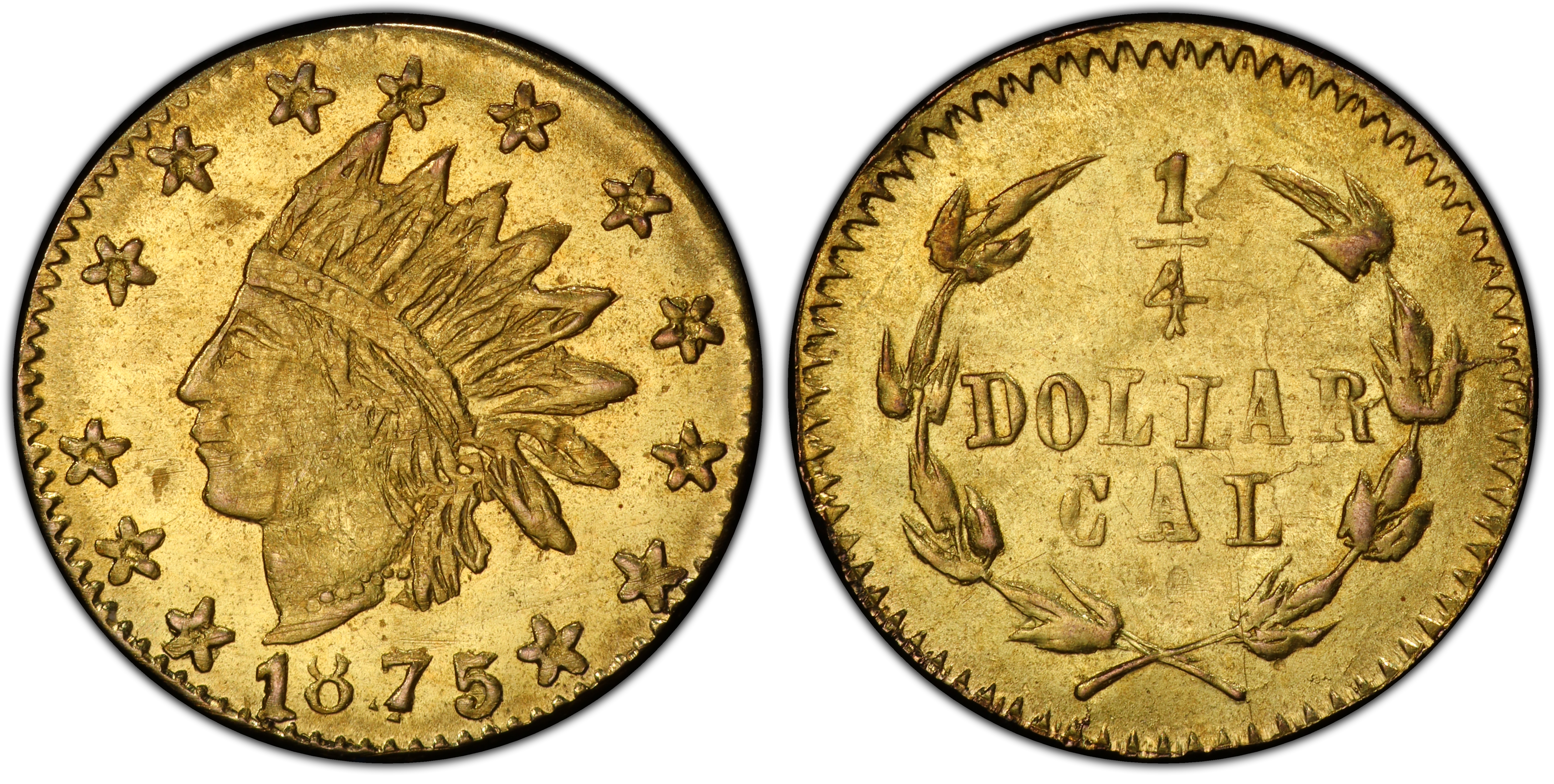
Obverse & Reverse
The 1875 25 Cents, cataloged as Breen-Gillio 847, is a product of the second great period of California fractional gold production. By the mid-1870s, the initial, urgent need for small-denomination coinage that characterized the Gold Rush of the early 1850s had long since passed. The San Francisco Mint, operating since 1854, was producing ample quantities of official U.S. silver and gold coins, satisfying the region's transactional needs. Consequently, the purpose of fractional gold pieces had transitioned from circulating currency to that of novelties, souvenirs, and jewelry items. These 'Period Two' issues, struck from roughly 1859 to 1882, are often called 'jeweler's issues' because they were primarily manufactured by San Francisco's jewelers and artisans. Unlike the earlier Period One coins which were intended to pass as money and had a higher gold content, these later pieces were intentionally made lightweight and with varying fineness, containing substantially less gold value than their stated denomination. They were marketed to tourists, sentimental locals, and those wishing to send a small, affordable piece of California's golden dream back east. The production process was often crude, utilizing hand-operated presses or even the hammer method, resulting in coins of inconsistent strike quality. The design of BG-847, a small Indian Head, was a popular motif of the era, evoking a romanticized vision of the American West. These tiny gold pieces were not a response to economic necessity but rather a commercial enterprise capitalizing on the enduring mystique of the Gold Rush. Their production continued until the U.S. Secret Service finally suppressed the manufacture of all private coinage in 1883, bringing the era of California fractional gold to a definitive close. Today, BG-847 is a tangible link to this fascinating second chapter in private minting history, representing a time when the memory and allure of the Gold Rush were themselves a valuable commodity.
Associated EventPost-Gold Rush California Tourism & Commerce
Reason For MintingTo be sold as souvenirs, keepsakes, and jewelry items capitalizing on the fame of the California Gold Rush.
Minter HistoryThe specific minter of BG-847 is unknown, a common trait for Period Two fractional gold. During this era (1859-1882), production was dominated by various San Francisco jewelers and artisans who saw a commercial opportunity in creating these gold tokens. Unlike the more formalized private mints of the early 1850s, these minters often did not mark their products with initials or names. They operated in a legal gray area, creating items that resembled coins but were technically tokens due to their insufficient gold content. Their legacy is the wide variety of designs and die states that characterize this popular collecting field.
Historical SignificanceThis coin is significant not as a monetary instrument, but as a cultural artifact. It demonstrates the commercialization of the Gold Rush legacy and the transition of fractional gold from a circulating medium of exchange to a popular souvenir item. Its existence reflects the burgeoning tourism industry in California and the desire of people to own a physical, affordable piece of the state's famous gold.
N/A
DenominationG25C (Gold 25 Cents)
Minting Period1875
Assayer/MinterUnknown Private Minter (Jeweler)
Geographic OriginSan Francisco, California
Obverse DescriptionA small, right-facing bust of a Native American chief wearing a feathered headdress. The portrait is somewhat crude, typical of jeweler's issues. The field is plain, and the entire design is enclosed within a beaded border.
Obverse Inscription Reverse DescriptionThe denomination '1/4' is central, surrounded by an open wreath of two branches tied with a bow at the bottom. The date '1875' appears above the wreath, just inside the upper beaded border. The word 'DOLLAR' is inscribed below the wreath.
Reverse Inscription1875 1/4 DOLLAR
CompositionGold
Stated Fineness Actual FinenessVariable, generally lower than monetary standards of the period.
Weight0.25 grams
Diameter9.00 mm
EdgePlain
Unknown
Survival EstimateFewer than 50 known examples. The combined NGC and PCGS population reports show approximately 40-45 graded coins.
Rarity ScaleR-6 (Very Rare: 31 to 75 known)
BG-847 is sought after as a representative of the popular 'Indian Head' type of the Period Two jeweler's issues. Its appeal lies in its connection to the romantic history of the California Gold Rush, its affordability compared to Period One issues, and the challenge of collecting the numerous Breen-Gillio varieties. The tiny size and intricate design make it a numismatic curiosity.
Key VarietiesThere are no major recognized varieties of BG-847 from the original minting period. No patterns, proofs, or official restrikes are known to exist for this specific variety. The field of California Fractional Gold is defined by the die pairings cataloged by Breen and Gillio, making BG-847 a distinct variety in itself.
Authentication TipsGenuine BG-847 coins exhibit a specific die style that should be compared to high-quality images in references like the Breen-Gillio book or online certified coin databases. The strike is often soft in areas. Common counterfeits are often brassy in color, have incorrect details in the portrait or wreath, or may feel soapy to the touch. Many fakes and replicas exist in the fractional gold space; authentication by a major third-party grading service (PCGS or NGC) is highly recommended. Genuine pieces will not feature a bear in the design.
Shopping ConsiderationsA premium quality example of BG-847 will exhibit a sharp strike for the issue, particularly on the details of the headdress and the numerals of the date and fraction. Look for smooth, lustrous surfaces free of distracting marks, cleaning, or evidence of having been mounted in jewelry (a common fate for these pieces). Original, uncleaned surfaces with a pleasant reddish-gold or yellow-gold patina are highly desirable. Given their crude manufacture, perfectly struck specimens are virtually nonexistent; therefore, finding a coin with better-than-average detail and strong eye appeal is the primary goal.
A coin's grade is its condition, rated on a 1-70 scale. For rare coins, this is the most critical factor in determining value, as a tiny difference in preservation can mean a huge difference in price.
Relevant Grade TypesOriginal examples of BG-847 were all struck as 'business strikes,' though their intended purpose was for souvenir sales rather than circulation. They are found in Circulated grades (AU-58 and below) and, more commonly, in Mint State (MS, 60-70) grades, as many were preserved as keepsakes. No original Proofs were struck during the 1870s. Any piece described as a Proof would be a much later private issue or replica and not a genuine Period Two fractional gold coin.
Mint State CharacteristicsUncirculated examples of BG-847 are characterized by their often prooflike or semi-prooflike surfaces, a result of being struck from polished dies to enhance their appeal as jewelry items. However, the strike is typically weak in the center, affecting the high points of the Indian's cheek and the wreath. Luster is typically bright and flashy. Small planchet flaws or adjustment marks are not uncommon and should be evaluated for their impact on eye appeal. Contact marks, even small ones, can be very noticeable on the mirrored fields.
Circulated Wear PatternsWear first appears on the highest points of the design: the Indian's cheek, brow, and the feathers in the headdress. On the reverse, the highest points of the wreath and the fraction '1/4' will show the first signs of friction. On lower grade examples, the beaded border may begin to merge with the rim, and the finer details of the wreath will become indistinct.
Key Factors For ValueThe primary drivers of value for an 1875 BG-847 are grade and surface quality. A sharp, well-centered strike is a significant bonus and commands a premium. Eye appeal is critical; examples with clean, original surfaces and a vibrant luster will sell for substantially more than hazy, cleaned, or heavily marked specimens of the same grade. Coins that have been removed from jewelry will have impaired surfaces and greatly reduced value. Certification by PCGS or NGC is standard for this series and essential for market liquidity, with a CAC sticker adding a further premium for coins of superior quality for the grade.
PCGS Price Guide
| Grade | Price | Population |
|---|---|---|
| 50 | $200.00 | 1 |
| 50+ | $205.00 | N/A |
| 53 | $210.00 | N/A |
| 53+ | $215.00 | N/A |
| 55 | $220.00 | 4 |
| 55+ | $225.00 | N/A |
| 58 | $230.00 | 9 |
| 58+ | $235.00 | N/A |
| 60 | $285.00 | N/A |
| 61 | $310.00 | N/A |
| 62 | $340.00 | 20 |
| 62+ | $355.00 | N/A |
| 63 | $375.00 | 19 |
| 63+ | $425.00 | N/A |
| 64 | $650.00 | 29 |
| 64+ | $725.00 | N/A |
| 65 | $1,275.00 | 4 |
| 66 | N/A | N/A |