1866 G25C BG-823 (Regular Strike)
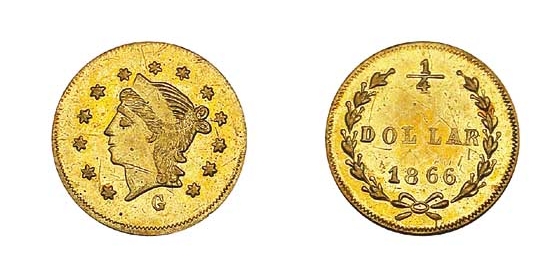
Obverse & Reverse
The 1866 BG-823 25-cent piece emerges from the second period (1859-1882) of California Fractional Gold production, a fascinating chapter in American numismatics born from the crucible of the Gold Rush. While the initial discovery of gold at Sutter's Mill in 1848 triggered a massive influx of population, it also created a severe and persistent shortage of small denomination coinage for daily commerce. Gold dust, pinches, and nuggets proved impractical and inconsistent for minor transactions. In response, private jewelers and metallurgists, primarily in San Francisco, began striking their own coins in quarter, half, and dollar denominations from 1852. These 'Period One' issues were generally intended to contain their face value in gold and served a genuine economic need. However, the landscape shifted with the Coinage Act of April 22, 1864, which explicitly outlawed the private coining of money. This federal prohibition, though not strictly enforced in the West for years, marked a turning point. The fractional gold coins produced after this act, including the BG-823, are categorized as 'Period Two' issues. These coins were often underweight for their stated value and were increasingly marketed as souvenirs and keepsakes for a growing tourist trade and as novelties to be sent back East, rather than as circulating currency. The jewelers who made them, such as Robert B. Gray & Co., operated in a legal gray area, sometimes backdating their pieces to pre-1864 to circumvent the law. The BG-823 is a product of this era, a time when the raw necessity of the Gold Rush was evolving into a romanticized memory, and these tiny gold pieces became tangible symbols of that adventurous spirit.
Associated EventPost-California Gold Rush Era / Reconstruction Era
Reason For MintingPrimarily created as souvenirs and novelties during a period when the acute shortage of small change had eased, but demand for Gold Rush mementos was high.
Minter HistoryRobert B. Gray & Co. was a prominent San Francisco jeweler and die-sinker active during the mid-to-late 19th century. Like many of his contemporaries, Gray's business capitalized on the abundance of local gold and the public's fascination with it. He was one of several craftsmen who produced a wide variety of these small denomination gold tokens, often called 'jeweler's issues.' His work is characteristic of the Period Two style, which often featured less refined but charming designs compared to the earlier, circulation-focused issues. These minters operated small, often hand-powered presses, leading to significant variation in strike quality.
Historical SignificanceThe BG-823 represents the transition of California Fractional Gold from utilitarian coinage of necessity to commercial souvenirs. It is a physical artifact of a legally ambiguous period in private minting and reflects the enduring mythology of the California Gold Rush in the American consciousness, long after the initial fever had subsided.
N/A
Denomination25 Cents (Quarter Dollar)
Minting Period1866
Assayer/MinterRobert B. Gray & Co.
Geographic OriginSan Francisco, California
Obverse DescriptionA beaded border encircles a Liberty Head design, facing left. The portrait features hair tied in a bun at the back. Thirteen stars, representing the original colonies, surround the head.
Obverse Inscription Reverse DescriptionA simple wreath, open at the top, encircles the denomination. The fraction '1/4' appears at the top, above the word 'DOLLAR'. The date '1866' is positioned below the word 'DOLLAR', all within the wreath. The letters in 'DOLLAR' are often softly struck on this variety.
Reverse Inscription1/4 DOLLAR 1866
CompositionGold
Stated Fineness Actual FinenessVaries, but typically lower fineness than U.S. Mint issues of the era.
Weight0.25 grams
Diameter10.00 mm
EdgePlain
Unknown
Survival EstimateFewer than 30 known
Rarity ScaleR-7 (4-12 known). Some sources suggest a slightly higher survival, closer to a high R-6 rating.
The BG-823 is highly sought after due to its significant rarity (R-7). As a product of the fascinating 'Period Two' of California Fractional Gold, it appeals to specialists in territorial gold and collectors who appreciate the lore and history of the Gold Rush era. Its tiny size and historical context make it a captivating collectible.
Key VarietiesThe primary classification is BG-823, a 'Regular Strike' intended for general sale. No proof restrikes or special collector issues are known from the period of issue or later. Varieties within the broader California Fractional Gold series are extensive, cataloged in the Breen-Gillio (BG) reference, but BG-823 itself is a distinct die marriage.
Authentication TipsGenuine examples are struck in gold, not plated brass. Look for die characteristics specific to BG-823; consult high-resolution images from major auction archives. The strike is often uneven, with softness on some letters of 'DOLLAR' being a common trait. Edges should be plain. Modern replicas or fantasy pieces often have different designs (like a bear), incorrect weight, or a soapy, cast-like appearance rather than the sharp details of a struck coin. Third-party grading is highly recommended for authentication.
Shopping ConsiderationsA premium quality example for its grade will exhibit a sharp strike on the central Liberty portrait and the date, even if other elements are weak. Original, lustrous surfaces with a coppery-gold or reddish toning are highly desirable. These coins are minuscule and prone to damage, so carefully check for bends, rim bumps, or evidence of having been mounted in jewelry. Avoid examples that have been harshly cleaned, which will appear unnaturally bright and show hairlines under magnification. Given the rarity, even problem-free circulated examples are highly valued, but a choice, original Mint State specimen is a landmark acquisition.
A coin's grade is its condition, rated on a 1-70 scale. For rare coins, this is the most critical factor in determining value, as a tiny difference in preservation can mean a huge difference in price.
Relevant Grade TypesAll original BG-823 coins were business strikes, intended for sale as souvenirs. They are found in Circulated grades (AG-3 to AU-58) and, more commonly, in Mint State (MS-60 to MS-70) as many were saved as keepsakes. No proofs were struck during the original period of issue, and no later-date proof restrikes are known to exist for this specific variety.
Mint State CharacteristicsUncirculated examples of BG-823 are defined by the presence of original mint luster. The quality of this luster can range from frosty to semi-prooflike. A key challenge for this issue is the strike; many were weakly struck. A premium MS coin will have a sharp Liberty head and a bold date. As is characteristic of this variety, some weakness on the letters in the word 'DOLLAR' on the reverse is common and should not be mistaken for wear. Due to the softness of the gold and crude production methods, even high-grade specimens may show minor planchet flaws or handling marks.
Circulated Wear PatternsWear first appears on the highest points of the design. On the obverse, friction will dull the luster on Liberty's cheek, the hairline, and the ear. On the reverse, the highest points of the wreath's leaves and the bow at the bottom will show the first signs of abrasion. In lower grades (VF and below), the individual strands of hair and the finer details of the wreath will become indistinct.
Key Factors For ValueRarity is the primary driver of value for BG-823. Beyond that, the specific numerical grade is critical. For Mint State examples, the quality of the strike is paramount; a coin with a fully struck-up obverse and reverse commands a significant premium over a weakly struck counterpart of the same grade. Surface preservation is also key: coins with clean, original surfaces and attractive, stable toning are prized. Conversely, specimens that have been cleaned, polished, bent, or removed from jewelry are worth substantially less. A CAC sticker on a certified coin provides third-party verification of quality for the grade and often results in a higher market value.
PCGS Price Guide
| Grade | Price | Population |
|---|---|---|
| 45 | $650.00 | 1 |
| 45+ | $680.00 | N/A |
| 50 | $750.00 | 2 |
| 50+ | $785.00 | N/A |
| 53 | $840.00 | N/A |
| 53+ | $890.00 | N/A |
| 55 | $950.00 | 1 |
| 55+ | $985.00 | N/A |
| 58 | $1,025.00 | N/A |
| 58+ | $1,050.00 | N/A |
| 60 | $1,100.00 | 1 |
| 61 | $1,500.00 | 2 |
| 62 | $2,000.00 | N/A |
| 62+ | $2,300.00 | N/A |
| 63 | $2,800.00 | 2 |