1856 G25C BG-107, PL (Regular Strike)
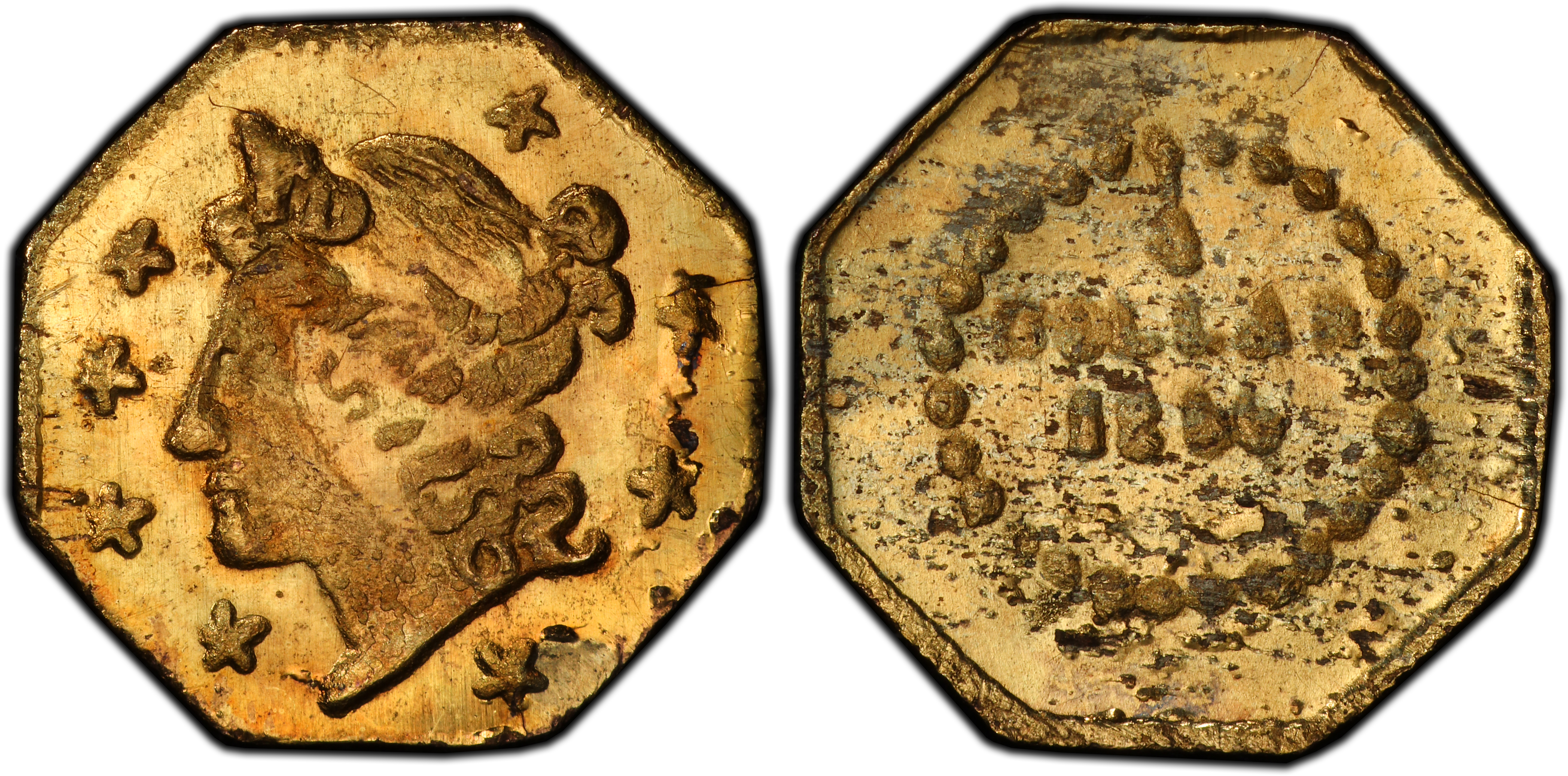
Obverse & Reverse
The 1856 BG-107 25 Cents is a quintessential artifact from the first period (1852-1857) of private Californian coinage, a direct response to the acute shortage of small-denomination currency that plagued the region during the Gold Rush. Following the massive influx of population after 1848, commerce was stifled by the lack of circulating change for everyday transactions; the smallest regular-issue U.S. gold coin was the dollar, and silver coins were scarce. In this vacuum, jewelers and private minters stepped in to create fractional gold pieces in quarter-dollar, half-dollar, and dollar denominations. The BG-107 belongs to a specific group of early octagonal quarters (BG-101 through BG-107) whose shared characteristics of crude die work, irregular planchets, and often underweight nature suggest a common, yet still anonymous, origin. Unlike the more refined pieces produced by known jewelers like Antoine Nouizillet or Frontier, Deviercy & Co., the BG-107 appears to be the product of a less-skilled artisan working under pressure to meet immediate commercial needs. The dies used for this variety were notoriously poor, often showing heavy rust and a lack of fine detail even in their earliest states. This technical crudeness, however, provides its immense historical appeal, offering a tangible link to the raw, unregulated, and entrepreneurial environment of Gold Rush San Francisco. These pieces likely circulated briefly, but their novelty and small size also made them popular souvenirs to be sent back East. The survival of high-grade, Prooflike (PL) specimens suggests that some were saved as keepsakes shortly after being struck, preserving a level of original finish rarely seen on utilitarian coinage of the era. The passage of the private coinage act of 1864 eventually rendered their production illegal, cementing their status as a finite and historically significant series.
Associated EventCalifornia Gold Rush
Reason For MintingTo alleviate a severe shortage of small-denomination coinage for daily commercial transactions in Gold Rush-era California.
Minter HistoryThe minter of the BG-101 through BG-107 series is unknown. Numismatic scholarship distinguishes this group by its crude and primitive workmanship when compared to the more professionally executed issues from known contemporary jewelers and assayers like Antoine Nouizillet. The anonymity of the maker is a key characteristic of this specific variety and its immediate siblings.
Historical SignificanceThe BG-107 is significant as a representative of the earliest, most primitive, and utilitarian phase of private fractional gold minting in California. It illustrates the practical solutions devised to overcome economic hurdles on the American frontier and stands in stark contrast to the more polished federal and later-period private issues.
BG-107
Denomination25 Cents
Minting Period1856
Assayer/MinterUnknown Assayer
Geographic OriginSan Francisco, California
Obverse DescriptionFeatures a crude Liberty Head facing left, modeled after the contemporary federal gold coinage. The portrait is executed with minimal detail. Thirteen stars, often misshapen or indistinct, encircle the portrait.
Obverse Inscription Reverse DescriptionA simple wreath composed of two branches tied with a bow at the bottom. Inside the wreath is the denomination '1/4'. The date '1856' is positioned below the wreath.
Reverse Inscription1/4
CompositionGold
Stated Fineness Actual FinenessVariable, typically made from native California gold of around .880 fineness.
Weight0.40 grams
Diameter9.50 mm
EdgePlain
Unknown
Survival Estimate50-75
Rarity ScaleR-4 / R-5
The BG-107 is highly sought after for its raw historical charm. Collectors prize the stark contrast between its exceptionally crude die work and the often-pristine, prooflike surfaces of surviving examples. It represents the gritty reality of frontier minting and is a key variety for specialists in Period One fractional gold.
Key VarietiesThere are no major recognized varieties of BG-107 from the original minting period. The primary variations among specimens relate to die state, with later strikes showing increased effects of the heavily rusted dies. Collectors should be aware of the broader context of California fractionals, which includes numerous later-period tokens and 20th-century replicas. Original Period One pieces like BG-107 are distinct and should not be confused with these non-contemporary issues.
Authentication TipsAuthentic BG-107 examples are defined by their crudeness. Look for soft details on Liberty's portrait and the wreath, and evidence of die rust (a fine, granular texture) in the fields. The strike is often uneven. Counterfeits may appear too sharp or have a modern, artificial luster. The diagnostic is the juxtaposition of this crudeness with reflective, prooflike fields on high-grade examples—a difficult characteristic to fake. Always compare with high-resolution images from major grading services.
Shopping ConsiderationsA premium quality BG-107 is one that, despite the poor die quality, shows a relatively sharp strike for the issue and possesses significant original prooflike surface. Look for mirrored fields that contrast with frosted devices (cameo). Avoid examples that have been cleaned or polished, as this destroys the original texture and value. Pay close attention to the surfaces for minute scratches, as the mirrored fields make any imperfection highly visible. Given the crude dies, weakness in peripheral lettering is common and should not be overly penalized unless it is severe.
A coin's grade is its condition, rated on a 1-70 scale. For rare coins, this is the most critical factor in determining value, as a tiny difference in preservation can mean a huge difference in price.
Relevant Grade TypesOriginal BG-107 issues were business strikes intended for circulation and are found in both Circulated (1-58) and Mint State (MS, 60-70) grades. No true Proofs were struck during the original period of issue. However, due to the preparation of the dies, many Mint State examples exhibit reflective, mirror-like surfaces and are designated as 'Prooflike' (PL) by grading services. These PL specimens are highly desirable and are considered a special category of business strike, not a separate Proof issue.
Mint State CharacteristicsAn uncirculated BG-107 is defined by its luster. High-quality examples (MS-63 and above) often exhibit deeply mirrored, prooflike fields. The dies were of such low quality that even the highest-grade specimens will show a granular texture from die rust, particularly in the protected areas of the design. Strike is a key factor; many are weakly struck, so examples with bold central details on the Liberty head and wreath command a premium. Small planchet flaws or adjustment marks are not uncommon for this crude issue.
Circulated Wear PatternsWear first appears on the highest points of the design. On the obverse, this includes Liberty's cheek, the hair just above the ear, and the highest elements of the coronet. On the reverse, the high points of the wreath's leaves and the tie of the bow will show initial friction and smoothing. In lower grades (VF and below), the stars on the obverse and the numbers in the date will begin to lose their definition and merge with the fields.
Key Factors For ValueFor the BG-107, the single most important factor is surface quality, specifically the originality and depth of the prooflike fields. A coin graded MS-64 PL can be worth significantly more than an MS-64 without the PL designation. Eye appeal is paramount; coins with minimal distracting marks and a strong cameo contrast are prized. Sharpness of strike is a secondary but important factor. A CAC sticker carries a substantial premium for this issue, as it confirms the quality of the grade and the originality of the surfaces.
PCGS Price Guide
| Grade | Price | Population |
|---|---|---|
| 63 | $675.00 | 1 |