1876 G25C BG-851 (Regular Strike)
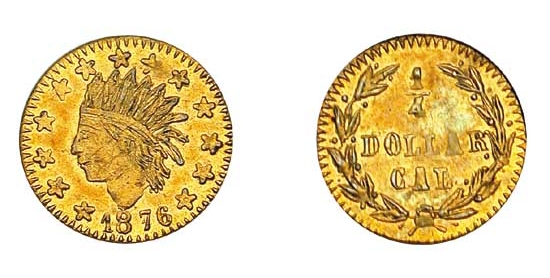
Obverse & Reverse
The 1876 G25C BG-851 is a quintessential example of a 'Period Two' California Fractional Gold piece, a fascinating and complex series born from the California Gold Rush. The initial period of these private issues (1852-1857) arose from a genuine economic necessity: a severe shortage of small-denomination coinage for daily transactions. Gold dust was plentiful, but making change was nearly impossible. Private jewelers and assayers filled this void by striking their own tiny gold coins. However, by the time the BG-851 was struck, the landscape had changed dramatically. The San Francisco Mint, opened in 1854, had largely resolved the coinage crisis. The Private Coinage Act of 1864 officially outlawed such private issues, yet enforcement was lax, particularly in the West. This legal gray area allowed jewelers like Robert B. Gray & Co. to continue production, but their motivation had shifted. These 'Period Two' pieces were no longer primarily for circulation but were instead created as souvenirs and keepsakes. The year 1876 was particularly significant as it marked the Centennial of the United States, celebrated with a massive Exposition in Philadelphia. This event fueled a nationwide craze for patriotic souvenirs and mementos, a market that San Francisco jewelers were eager to tap into. For Eastern tourists and those who simply romanticized the 'Golden West,' these miniature gold coins were the perfect, easily transportable souvenir of the Gold Rush era. They were tangible, made of the very metal that defined California, and bore iconic American imagery like the Indian Head. Thus, the BG-851 was not a coin of commerce in the traditional sense, but a numismatic token of a romanticized American frontier, produced for a national audience during a year of intense historical reflection.
Associated EventUnited States Centennial (1876)
Reason For MintingPrimarily struck as a souvenir for the tourist trade and collectors, capitalizing on the nostalgia of the Gold Rush during the U.S. Centennial year.
Minter HistoryRobert B. Gray & Co. was a prominent San Francisco jeweler and a prolific producer of Period Two fractional gold. Active from the late 1850s until the early 1870s, Gray's firm was known for the quality and relative heft of its issues compared to other contemporary makers. In 1858 or 1859, Gray acquired the business of another fractional minter, Antoine Louis Nouizillet, including his dies and punches, which influenced subsequent designs. Gray's pieces are typically identified by a 'G' mintmark on the obverse, as seen on this variety. His operation was a key player in the transition of fractional gold from necessity coinage to commercial souvenirs, continuing production long after the initial need had subsided.
Historical SignificanceThis coin represents the second phase of private gold coinage in California, where the purpose shifted from fulfilling a monetary need to satisfying a commercial demand for souvenirs. It stands as a physical artifact of the post-Gold Rush romanticism and the national fervor for memorabilia during the American Centennial. Its existence, despite being technically illegal, highlights the unique economic and cultural conditions of late 19th-century San Francisco and the federal government's slow extension of monetary authority to the West Coast.
N/A
Denomination25 Cents
Minting Period1876
Assayer/MinterRobert B. Gray & Co.
Geographic OriginSan Francisco, California
Obverse DescriptionA stylized Indian Head facing left, a design popularized by the contemporary U.S. Indian Head Cent. The portrait is somewhat crude, typical of jeweler-made issues. The head is adorned with a feathered headdress. Thirteen six-pointed stars encircle the portrait along the rim. The date '1876' is below the bust, and the minter's initial 'G' is located between the date and the portrait's neck.
Obverse InscriptionG 1876
Reverse DescriptionThe central device is the denomination '25 CENTS' arranged in two lines. This is enclosed within a wreath of two olive branches tied together at the bottom with a simple bow. The wreath is open at the top.
Reverse Inscription25 CENTS
CompositionGold
Stated Fineness Actual FinenessVariable, but typically ranges from .500 to .800 fine for Period Two issues.
Weight0.25 grams
Diameter9.80 mm
EdgePlain
Unknown
Survival EstimateFewer than 75 believed to exist.
Rarity ScaleR-6 (31 to 75 known)
This coin is highly sought after for its specific date, tying it to the U.S. Centennial, its association with a known San Francisco minter (Robert B. Gray), and its high rarity. As a Period Two issue, it tells the story of the evolution of fractional gold from circulation currency to coveted souvenir, making it a key piece for specialists.
Key VarietiesThe primary variety is the BG-851 itself, defined by this specific obverse and reverse die pairing. No major varieties, patterns, or official restrikes are known from this specific die marriage. Collectors should be aware that many different Breen-Gillio numbers exist for 1876-dated 25-cent pieces, differing by minter, die characteristics, and shape (round vs. octagonal).
Authentication TipsGenuine BG-851 pieces exhibit a somewhat crude but sharp strike from hand-cut dies. Look for the characteristic style of Gray's 'G' mintmark and the specific shape of the numerals in the date. The surfaces of genuine pieces are often slightly uneven or wavy, a hallmark of the crude private minting process. Counterfeits and modern replicas are often unnaturally flat, have a soapy or cast-like appearance, incorrect weight, and often feature a bear on the reverse, a design element never used on genuine 19th-century issues. Third-party grading is highly recommended.
Shopping ConsiderationsA premium quality example for this issue is defined by a sharp strike, particularly on the feathers of the headdress and the details of the wreath. Many examples are weakly struck in the center. Original, lustrous surfaces are paramount; look for pieces that have not been harshly cleaned, polished, or used in jewelry. A warm, reddish-gold or deep orange toning is often seen and is considered attractive. Avoid examples with rim bumps, scratches, or evidence of having been holed and plugged, as was common. Given the high rarity, any problem-free, well-struck specimen is a significant find.
A coin's grade is its condition, rated on a 1-70 scale. For rare coins, this is the most critical factor in determining value, as a tiny difference in preservation can mean a huge difference in price.
Relevant Grade TypesOriginal period issues of BG-851 were business strikes, although intended as souvenirs rather than for heavy circulation. They are found in both Circulated (1-58) and Mint State (MS, 60-70) grades. No true Proofs were struck during the original period of issue. Some Mint State examples may exhibit prooflike (PL) surfaces due to polished dies, but these are distinct from true Proof strikings and are considered a characteristic of the business strike.
Mint State CharacteristicsAn uncirculated BG-851 will exhibit full mint luster, which is often satiny rather than deeply frosty. The strike is a key differentiator; many are softly struck, so a specimen with sharp details on the high points of the Indian's hair and the leaves in the wreath commands a significant premium. Small, planchet-made imperfections and a slightly irregular surface texture are common and characteristic of the issue, and should not be confused with post-strike damage.
Circulated Wear PatternsWear first appears on the highest points of the design. On the obverse, check for flatness on the cheek of the Indian Head and the feathers of the headdress. On the reverse, the highest points of the wreath's leaves and the bow will show the first signs of friction and loss of detail. In lower grades (VF and below), the date and the word 'CENTS' will begin to weaken.
Key Factors For ValueFor the BG-851, value is driven by three main factors: rarity, grade, and eye appeal. Given that all examples are rare, the grade is the primary determinant. A Mint State coin is worth multiples of a circulated one. Beyond the numerical grade, surface quality is critical; an example with original, uncleaned surfaces and attractive toning is far more desirable than a harshly cleaned or polished piece of the same grade. Strike quality is the next consideration, with sharply struck examples commanding strong premiums. A CAC sticker for this issue provides a significant boost in value, as it confirms both the grade and the quality of the surfaces for the assigned grade.
PCGS Price Guide
| Grade | Price | Population |
|---|---|---|
| 58 | $450.00 | 1 |
| 58+ | $500.00 | N/A |
| 60 | $650.00 | N/A |
| 61 | $725.00 | N/A |
| 62 | $800.00 | 2 |
| 62+ | $950.00 | N/A |
| 63 | $1,175.00 | 4 |
| 63+ | $1,400.00 | N/A |
| 64 | $2,250.00 | 6 |
| 64+ | $2,500.00 | N/A |
| 65 | $3,000.00 | N/A |