1852 25C BG-799DD (Regular Strike)
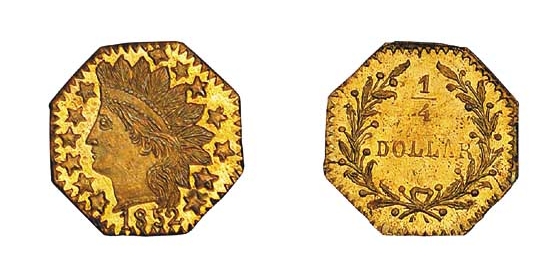
Obverse & Reverse
The BG-799DD is a quintessential artifact from the chaotic, formative years of the California Gold Rush. Following the discovery of gold at Sutter's Mill in 1848, a massive influx of prospectors and merchants descended upon California, creating a vibrant but unstable economy. While vast quantities of gold dust and nuggets were being extracted, the region suffered from a severe, crippling shortage of small-denomination coinage for daily transactions. A pinch of gold dust for a drink or a small purchase was an imprecise and unsatisfactory system. Federal coinage was scarce, as transporting it to the isolated West Coast was slow, perilous, and expensive. Into this monetary vacuum stepped numerous private minters—often jewelers or assayers by trade—who began striking their own coins in 1852. These 'California Fractional Gold' pieces, denominated in 25 cents, 50 cents, and one dollar, were the solution. The BG-799DD is classified as a 'Period One' issue (1852-1857), a critical distinction indicating it was produced with the genuine intent of circulating as money to alleviate the change shortage. This contrasts with later 'Period Two' issues (1858-1882), which were often struck with lighter weights and lower fineness, primarily to be sold as souvenirs to tourists. The octagonal shape and Indian Head motif were design choices meant to inspire confidence and acceptance in commerce, though they were not legal tender. The production methods were often crude, utilizing hand-cut dies and manual screw or hammer presses, resulting in significant variation between specimens. These tiny coins circulated for a few years until the official United States Branch Mint opened in San Francisco in 1854 and began producing sufficient quantities of federal coinage, rendering the private issues obsolete. The Coinage Act of 1864 officially outlawed private coinage, cementing the fate of these fascinating pieces. Today, the BG-799DD is a numismatic relic of immense rarity, representing the ingenuity and frontier capitalism that defined one of America's most transformative eras.
Associated EventCalifornia Gold Rush
Reason For MintingTo alleviate a severe shortage of small-denomination coinage for everyday commercial transactions in Gold Rush-era California.
Minter HistoryThe specific minter or jewelery firm responsible for the BG-799DD dies is currently unknown or unrecorded in standard numismatic references. During the 1852-1857 period, numerous jewelers and metalworkers in San Francisco, such as Antoine Louis Nouizillet and the firm of Deriberpe & Nouizillet, were known to have produced fractional gold. However, the dies for BG-799DD are not definitively attributed, reflecting the often-anonymous and competitive nature of private minting at the time. These minters operated without federal authority, relying on their reputation and the intrinsic value of their products for acceptance.
Historical SignificanceAs a 'Period One' issue, the BG-799DD is a tangible link to the raw, unregulated economy of the California Gold Rush. It represents a private sector solution to a government failure in supplying adequate currency and is a testament to the region's economic autonomy before being fully integrated into the U.S. monetary system. Its extreme rarity today underscores the ephemeral nature of these early, heavily used coins.
BG-799DD
Denomination25C
Minting Period1852
Assayer/MinterUnknown Private Minter
Geographic OriginSan Francisco, California
Obverse DescriptionFeatures a stylized male portrait facing left, commonly identified as an Indian Head, though the design is somewhat crude. The portrait is surrounded by thirteen five-pointed stars along the octagonal border.
Obverse Inscription Reverse DescriptionThe reverse design is simple, featuring the denomination '1/4' within a circle of beads or dots. The date '1852' appears below the denomination, also within the circle.
Reverse Inscription1/4 1852
CompositionGold
Stated Fineness Actual FinenessTypically varied for Period One issues, often ranging from .800 to .900, but the specific fineness for this variety is not documented.
EdgePlain
Extremely low; precise figures are unknown as private mint records were not kept or did not survive.
Survival EstimateFewer than 5 known. The NGC Census reports only 3 examples graded.
Rarity ScaleR-7 (High)
This coin's appeal lies in its extreme rarity, its direct connection to the 1852 Gold Rush, and its status as a 'Period One' circulating issue. The combination of the early date, desirable Indian Head motif, and octagonal shape makes it a trophy piece for advanced collectors of Territorial and private gold.
Key VarietiesBG-799DD is itself a key die marriage variety. No major sub-varieties from the original minting period are known due to its rarity. No later-date restrikes or special collector issues of this specific variety are known to exist.
Authentication TipsAuthentication requires expert examination. Genuine examples exhibit a specific die state and strike character. Look for sharp, albeit sometimes uneven, details from a hand-cut die. The surfaces should not be mirror-like or prooflike in the modern sense. Counterfeits are rampant in the series; many are cast or have a soft, waxy appearance. Others are gold-plated brass tokens, often with incorrect designs (like a bear on the reverse) or without a proper denomination. Comparison with high-resolution images of certified examples is essential.
Shopping ConsiderationsFor a coin of this rarity, any example is a major acquisition. A 'premium quality' specimen would be one that is well-centered and sharply struck for the issue, particularly on the portrait's details and the date. Original, uncleaned surfaces with a hint of reddish-gold or mellow greenish-gold patina are highly desirable. Most known examples are in Mint State, suggesting they were saved as curiosities early on. Avoid coins that have been harshly cleaned, polished, or mounted in jewelry, as this drastically reduces value. Given the prevalence of forgeries, purchase should only be considered if the coin is certified by a top-tier grading service like PCGS or NGC.
A coin's grade is its condition, rated on a 1-70 scale. For rare coins, this is the most critical factor in determining value, as a tiny difference in preservation can mean a huge difference in price.
Relevant Grade TypesOriginal issues of BG-799DD were business strikes intended for circulation, and thus can be found in Circulated grades (1-58) or Mint State (MS, 60-70). However, due to its immense rarity, all known examples are uncirculated, likely saved shortly after being struck. No proofs were struck during the original period of issue, and there are no known later-date proof restrikes of this specific variety.
Mint State CharacteristicsUncirculated examples of this issue are defined by their luster and strike. The luster is typically satiny and slightly subdued, not deeply frosty or prooflike. The strike can be uneven due to the crude minting process; weakness is common on the stars or parts of the beaded circle. Contact marks, even small ones, are expected on these soft gold pieces but should not be overly distracting. The finest known example is graded MS-67 PL by NGC, indicating an unusually sharp strike and reflective surfaces for the issue.
Circulated Wear PatternsWhile circulated examples are not currently known to exist, hypothetical wear would first appear on the high points of the design. On the obverse, this would be the cheek and hair details of the Indian Head. On the reverse, the numerals of the date and the fraction would be the first elements to show flatness and lose definition.
Key Factors For ValueFor the BG-799DD, rarity is the paramount factor. Given that only a few pieces are known, any example appearing for sale would command a very strong price. Beyond simple existence, value is determined by surface quality and eye appeal. An example with minimal contact marks, a sharp strike for the variety, and original, uncleaned luster will bring a significant premium. A CAC sticker would provide further validation of quality for the assigned grade and would likely add a substantial premium.
PCGS Price Guide
| Grade | Price | Population |
|---|---|---|
| 63 | $1,650.00 | N/A |
| 63+ | $1,800.00 | N/A |
| 64 | $2,000.00 | 3 |
| 64+ | $2,250.00 | N/A |
| 65 | $2,750.00 | 4 |
| 65+ | $3,250.00 | N/A |
| 66 | $4,000.00 | N/A |
| 67 | N/A | N/A |