1876 G50C BG-932A (Regular Strike)
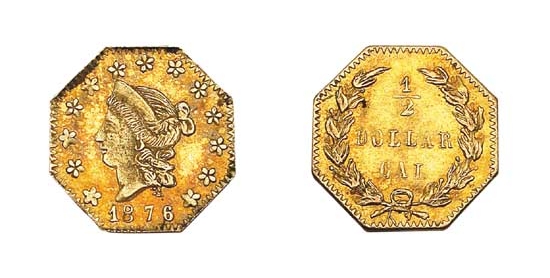
Obverse & Reverse
The 1876 G50C BG-932A is a product of the second great era of California Fractional Gold production, a period numismatists classify as 'Period Two' (1859-1882). Unlike the 'Period One' issues, which were struck out of genuine commercial necessity to alleviate a severe shortage of small change during the initial Gold Rush boom, these later pieces were created under a different set of circumstances. By the mid-1870s, the United States Mint in San Francisco was in full operation, and the acute need for privately minted coinage had subsided. However, the allure of California gold and the romance of the Gold Rush had created a robust market for souvenirs and keepsakes. Enterprising jewelers, primarily in San Francisco, stepped in to meet this demand. They began producing vast quantities and varieties of these miniature gold 'coins,' which were sold to locals, tourists, and sent back East as mementos of the Golden State. The legal footing for these pieces was precarious. The Coinage Act of 1864 expressly forbade the private issuance of coinage, but enforcement on the remote West Coast was lax until the early 1880s. Minter-jewelers operated in a grey area, continuing to place denominations on their products. The BG-932A, dated 1876—the year of the nation's Centennial—would have been a particularly popular souvenir. These pieces were not intended to and did not function as circulating currency in the same way their predecessors had; their gold content was often significantly less than their face value would imply, solidifying their status as tokens or charms. The production was crude, often employing a simple hammer-striking method where dies were manually struck onto gold planchets, resulting in inconsistent strike quality and frequent die breaks and clashes, all hallmarks of the series.
Associated EventPost-Gold Rush California Souvenir Market
Reason For MintingTo satisfy the demand for tourist souvenirs and novelty jewelry items related to the California Gold Rush.
Minter HistoryThe minters of Period Two fractional gold were almost exclusively jewelers and metalworkers, most of whom remain anonymous today. Unlike the prominent assayers of the initial Gold Rush (e.g., Moffat & Co., Wass, Molitor & Co.), these craftsmen did not typically mark their products. They operated small-scale workshops, creating their own dies and striking pieces by hand. Their primary business was jewelry, and these gold 'coins' were an extension of that trade, often incorporated into rings, pins, and bracelets. Research by Walter Breen and Ronald J. Gillio, who cataloged these pieces, suggests a handful of different workshops were responsible for the majority of designs, identified today only by stylistic similarities in their die work.
Historical SignificanceThe BG-932A represents a shift in the purpose of private gold coinage, from a necessary medium of exchange to a commercial souvenir product. It is a tangible artifact of California's burgeoning tourism industry in the 19th century and the commercialization of the Gold Rush legend. Its existence, more than a decade after private coinage was outlawed, speaks to the unique economic and legal environment of the American West. For numismatists, the vast array of die varieties from this period provides a rich and challenging field of study.
BG-932A
Denomination50 Cents
Minting Period1876
Assayer/MinterUnknown Private Jeweler
Geographic OriginSan Francisco, California
Obverse DescriptionThe obverse features a right-facing bust of a female figure representing Liberty. Her hair is tied in a bun at the back. The portrait is surrounded by 13 six-pointed stars, representing the original colonies. The date '1876' appears below the bust, often weakly struck.
Obverse Inscription1876
Reverse DescriptionThe reverse design consists of the denomination '1/2' centered within a wreath. The wreath is composed of two branches tied together at the bottom with a bow. Below the wreath is the word 'DOLLAR'.
Reverse Inscription1/2 DOLLAR
CompositionGold
Stated Fineness Actual FinenessVaries, typically 14 to 22 karats (.585 to .917 fine)
Weight0.25 grams
Diameter10.50 mm
EdgePlain
Unknown; likely a few thousand at most.
Survival Estimate75-125
Rarity ScaleR-6 (31-75 known)
This coin is highly sought after as an example of a dated Period Two fractional gold piece. Its octagonal shape, clear denomination, and connection to the U.S. Centennial make it particularly appealing. Collectors are drawn to the challenge of acquiring these scarce, crudely beautiful artifacts of a bygone era, and the Breen-Gillio catalog number provides a clear collecting goal.
Key VarietiesThe primary variety is the BG-932A itself, a specific die marriage. Within the broader BG-932 designation, minor die states may exist showing progressive die wear, cracks, or clashes. No official patterns, proofs, or restrikes are known for this specific variety; the concept was foreign to the anonymous jewelers who produced them. All known genuine examples are considered business strikes, though some may exhibit prooflike surfaces due to being struck from fresh, polished dies.
Authentication TipsGenuine pieces are die-struck, not cast. Look for sharp, albeit sometimes crude, details. The numerals in the date and letters in 'DOLLAR' should have a consistent style matching known examples. Many modern replicas exist; these are often the wrong weight, have a soapy or cast appearance, and may be made of brass or low-purity gold. Genuine pieces often show die file marks or other imperfections on the fields, a hallmark of hand-finished dies. Be wary of examples with jewelry mount solder marks or evidence of removal from a bezel, which is common for this type.
Shopping ConsiderationsA premium quality example for this issue is defined by a sharp strike, especially on the stars, the date, and the details of the wreath. Many are weakly struck in the center. Original, uncleaned surfaces with some remaining luster command a significant premium. The color can range from a light yellow-gold to a deeper reddish-orange depending on the alloy. Avoid specimens that have been harshly cleaned, polished, or show significant damage from being used as jewelry. Pay close attention to the planchet quality, as some can be uneven or clipped. A coin with nice 'crusty' originality is far more desirable than a brighter, cleaned one.
A coin's grade is its condition, rated on a 1-70 scale. For rare coins, this is the most critical factor in determining value, as a tiny difference in preservation can mean a huge difference in price.
Relevant Grade TypesAll original 1876 G50C BG-932A pieces are business strikes, created for sale as souvenirs rather than circulation. They are found in Circulated grades (AU-58 and below), often from being handled or kept as pocket pieces, and in Mint State (MS, 60-70). The concept of a 'Proof' striking was not applicable to these private jeweler issues, and no original Proofs were made. Some high-quality Mint State examples may be designated as 'Prooflike' (PL) by grading services if they were struck from freshly polished dies, but they are not true Proofs.
Mint State CharacteristicsIn uncirculated grades, the BG-932A often displays a soft, satiny luster rather than a hard, frosty one. Strike quality varies tremendously; a key determinant of an MS grade is the sharpness of the stars and the word 'DOLLAR'. The fields can be slightly wavy, a result of the hammer-striking process. Small planchet flaws, fissures, or adjustment marks (file marks) made before striking are common and generally accepted for the type, though large, distracting flaws will lower the grade. Contact marks are common due to the softness of the gold.
Circulated Wear PatternsWear first appears on the highest points: Liberty's cheek, the hair above the ear, and the leaves and bow of the wreath on the reverse. On moderately worn examples (VF-XF), the finer details of the hair and leaves will be flat, and some of the stars may begin to merge with the field. In lower grades, the date and legends become weak and Liberty's portrait becomes a near-outline.
Key Factors For ValueThe primary drivers of value are grade and surface preservation. An uncleaned coin with original skin and luster (often described as 'crusty') is worth far more than a cleaned or polished example of the same grade. Strike is critical; a fully struck piece with all 13 stars and a bold date is rare and commands a major premium. Eye appeal, including attractive original toning, also plays a significant role. Finally, certification by a top-tier service (PCGS or NGC) is essential for authenticity and grade verification, with a CAC sticker adding a further premium for coins deemed superior for their assigned grade.
PCGS Price Guide
| Grade | Price | Population |
|---|---|---|
| 58 | $12,500.00 | 1 |
| 65 | $27,500.00 | N/A |