1855 G$1 BG-533, PL (Regular Strike)
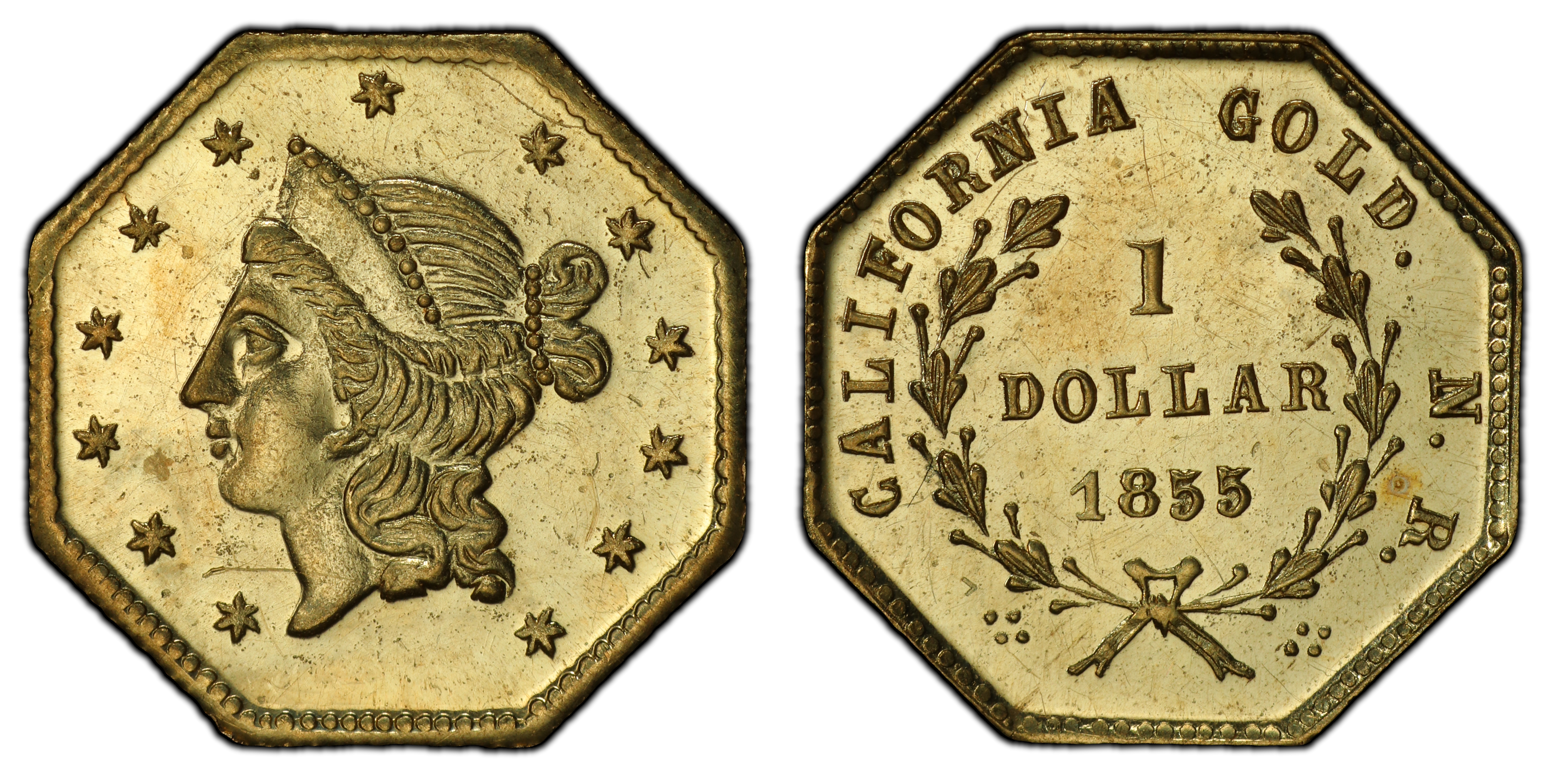
Obverse & Reverse
The 1855 Octagonal Gold Dollar, cataloged as Breen-Gillio 533, is a quintessential artifact from 'Period One' of California's fractional gold production (1852-1857). This era was defined by a critical economic necessity. The California Gold Rush had flooded the region with over 300,000 new residents, but the United States Mint in San Francisco, which only opened in 1854, was utterly incapable of meeting the demand for small-denomination coinage. In its first year, it produced only 15,000 gold dollars, and in 1855, it produced none at all. Commerce was grinding to a halt, with merchants and miners forced to transact with awkward pinches of gold dust or rely on a confusing mix of foreign silver coins. In this monetary vacuum, private jewelers and metallurgists stepped in. Utilizing the abundant local gold, they began striking their own fractional denominations—quarter dollars, half dollars, and dollars—to facilitate everyday trade. These tiny coins were not clandestine issues; they were a vital, albeit unofficial, part of the regional economy. The BG-533 was struck amidst this chaotic but enterprising environment. Like most of its contemporaries, it was produced using the crude 'hammer method,' where dies were struck by hand with a sledgehammer. This resulted in significant variability in strike quality. Though its intrinsic gold value was often less than its face value, its utility was undeniable. As the San Francisco Mint ramped up production in the late 1850s, the need for these fractional pieces as circulating currency waned. They transitioned from being tools of commerce to popular souvenirs of the Gold Rush, eagerly purchased by locals and Easterners alike as affordable mementos of the nation's great adventure. The Coinage Act of 1864 eventually made private coinage illegal, but enforcement wasn't rigorous until 1883, bringing an end to this fascinating chapter of American numismatics.
Associated EventCalifornia Gold Rush
Reason For MintingTo alleviate a severe shortage of small-denomination circulating coinage for daily commerce in Gold Rush-era California.
Minter HistoryThe specific maker of the BG-533 variety remains anonymous. Numismatic scholarship by Walter Breen and Ronald Gillio has been able to attribute many fractional gold issues to specific jewelers like Antoine Louis Nouizillet or firms like Frontier, Deviercy & Co. based on die characteristics and punch links. However, the punches used for the lettering, stars, and numerals on BG-533 do not match any known, marked work from the period. The minter was undoubtedly one of the many skilled jewelers operating in San Francisco during the mid-1850s who possessed the requisite engraving and striking capabilities to produce coinage for local use.
Historical SignificanceThe BG-533 is a tangible link to a period of economic improvisation and necessity on the American frontier, representing the private enterprise that filled a void left by the federal government and kept the Gold Rush economy functioning.
N/A
DenominationG$1
Minting Period1855
Assayer/MinterAnonymous
Geographic OriginSan Francisco, California
Obverse DescriptionA Liberty Head, facing left, with 'LIBERTY' inscribed on her coronet. The portrait is encircled by thirteen five-pointed stars, representing the original colonies.
Obverse Inscription Reverse DescriptionThe denomination '1' and 'DOLLAR' are enclosed within a wreath of two branches tied with a bow at the bottom. The date '1855' is positioned below the wreath.
Reverse Inscription1 DOLLAR 1855
CompositionGold
Stated Fineness Actual FinenessVariable, typically 14 to 22 karats for Period One issues.
Diameter12.20 mm
EdgePlain
Unknown
Survival EstimateApproximately 75-125 coins across all grades.
Rarity ScaleR-4+
This issue is highly popular due to its classic Liberty Head design, desirable octagonal shape, and its status as a true 'Period One' issue that likely circulated. The one-dollar denomination is the largest of the fractionals, giving it a more substantial feel and historical weight. Its relative scarcity adds to its allure.
Key VarietiesThe primary variety is the regular business strike. A significant and desirable sub-variety is the 'PL' (Prooflike) designation, awarded to coins struck from fresh, polished dies that exhibit mirrored fields. While not true proofs, these prooflike examples are prized for their exceptional eye appeal and are rarer than standard business strikes. No known restrikes or patterns exist for this specific variety.
Authentication TipsGenuine Period One fractionals like BG-533 must be denominated (e.g., 'DOLLAR'). Modern replicas often omit the denomination or use phrases like 'CAL GOLD CHARM'. Genuine pieces were often struck on thin planchets, resulting in weak strikes in areas, particularly the centers; counterfeit and replica pieces are often suspiciously sharp and perfectly struck. The lettering and stars should match known genuine examples in style; fakes often have crude or improperly styled features. The gold color should be consistent with the 19th-century alloy, often a slightly greenish-gold or brassy-gold, not the uniform color of modern gold plating.
Shopping ConsiderationsA premium quality BG-533 is defined by a sharp, well-centered strike, especially on the high points of Liberty's hair and the details of the wreath. Luster is critical; seek examples with either bright, satiny mint luster or deep, reflective prooflike fields. While tiny, these coins are susceptible to abrasions, so smooth, clean surfaces command a significant premium. Avoid examples that have been harshly cleaned, which strips the original patina and imparts hairline scratches. Also, be wary of ex-jewelry pieces that may have hidden solder marks or rim damage. Original, unblemished surfaces are paramount for this issue.
A coin's grade is its condition, rated on a 1-70 scale. For rare coins, this is the most critical factor in determining value, as a tiny difference in preservation can mean a huge difference in price.
Relevant Grade TypesOriginal 1855 BG-533 issues were business strikes intended for circulation. They are found in Circulated grades (AG-3 to AU-58) and Mint State grades (MS-60 to MS-70). The 'PL' (Prooflike) designation can be applied to high-grade business strikes with mirrored surfaces. No true Proofs were struck during the original period of issue, and no later restrikes are known to exist.
Mint State CharacteristicsAn uncirculated BG-533 is defined by the absence of wear and the presence of original mint luster. The quality of this luster can range from soft and satiny to deeply reflective (prooflike). The strike is a key variable; many were weakly struck, so examples with full sharpness on Liberty's hair details, the stars, and the wreath are highly desirable. Due to the softness of the gold and rudimentary handling at the time of minting, even high-grade Mint State examples will typically show some minor contact marks or planchet imperfections.
Circulated Wear PatternsWear first appears on the highest points of the design. On the obverse, this includes Liberty's cheek, the hair just above the eye, and the coronet. On the reverse, the high points of the wreath's leaves and the bow will show initial friction and flattening. In lower grades (VF and below), the legends and stars will begin to lose their sharpness, and in the lowest grades, the date can become faint or illegible.
Key Factors For ValueFor the BG-533, value is driven by a hierarchy of factors. First is grade (condition). Second is surface quality; an example with original, undisturbed surfaces will always be worth more than one that has been cleaned, polished, or repaired. Third is strike; a sharply struck coin is prized over a weakly impressed one of the same grade. Finally, eye appeal, which includes factors like attractive toning (often a reddish or greenish-gold hue) and prooflike contrast, can add a significant premium. A CAC sticker for this issue indicates superior quality for the grade and typically results in a higher market value.
PCGS Price Guide
| Grade | Price | Population |
|---|---|---|
| 64 | $5,000.00 | 1 |