1867 G50C BG-1007 (Regular Strike)
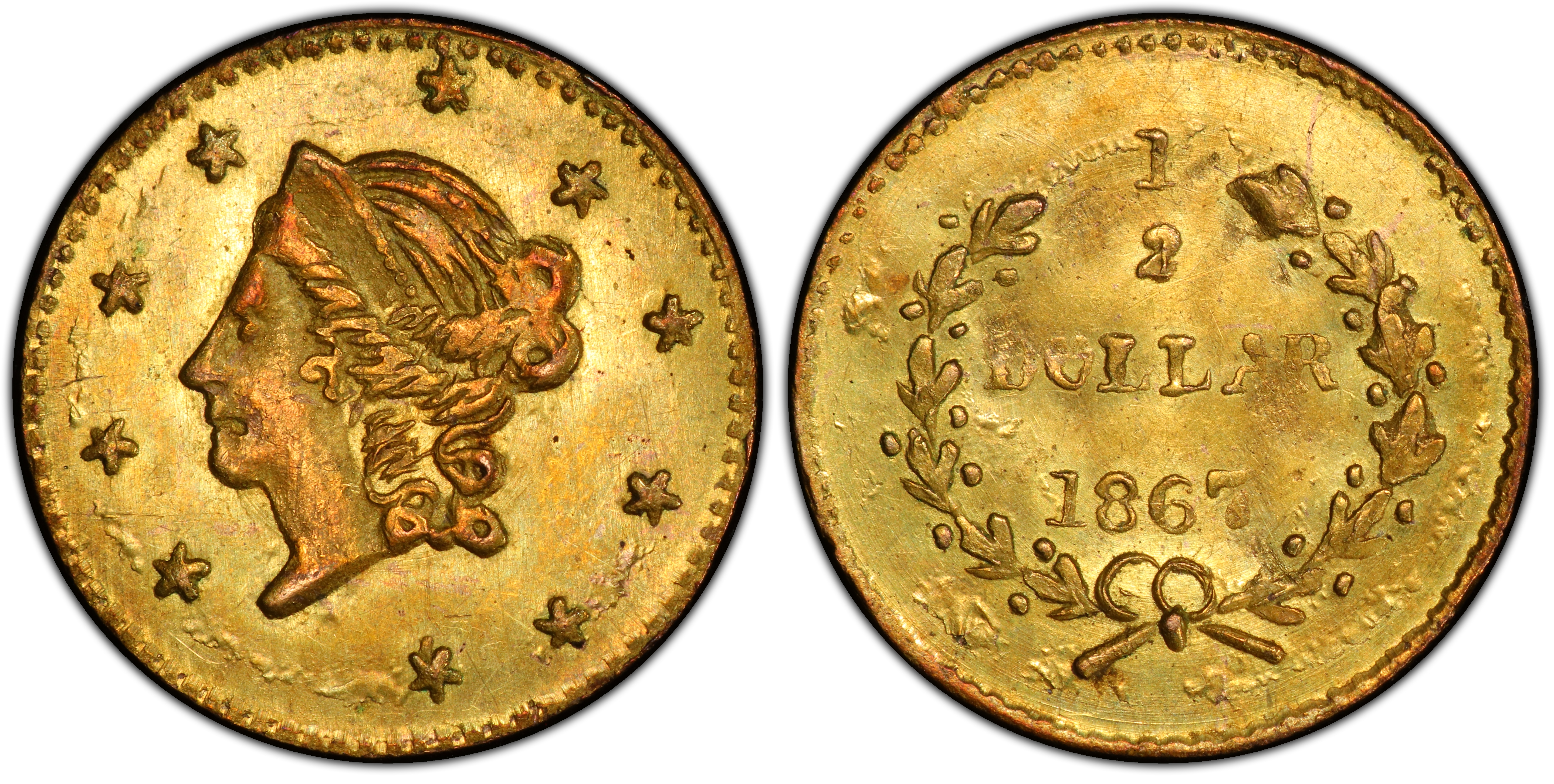
Obverse & Reverse
The 1867 BG-1007 fifty-cent piece emerges from the second major phase of California Fractional Gold production, a period numismatists designate as 'Period Two' (1859-1882). Unlike the 'Period One' issues, which were struck out of genuine necessity to alleviate a shortage of small change in the boomtown economy of the 1850s, Period Two pieces were created primarily as souvenirs and jewelry items. By 1867, the San Francisco Mint was in full operation, producing ample quantities of federal silver and gold coinage, which eliminated the commercial need for private issues. However, the allure of California and the Gold Rush had captivated the nation and the world. Jewelers and private minters, particularly in San Francisco, recognized a burgeoning market among tourists, visitors, and those back East who desired a tangible, miniature token of the Golden State's wealth. These 'jeweler's issues' were often intentionally underweight compared to their face value, a fact that was of little concern to purchasers who valued them for their novelty rather than their bullion content. The Private Coinage Act of April 22, 1864, had made the issuance of private coinage illegal, but enforcement by the Secret Service was lax and inconsistent until the early 1880s. This legal gray area allowed producers like Robert B. Gray & Co. to continue minting these denominated tokens throughout the 1860s and 1870s. The BG-1007 is a quintessential example of this era's output: a professionally crafted, yet ultimately commercial, memento. Its existence speaks to a shift in the Californian economy from a raw, frontier-based system to one that was mature enough to support a robust tourism and luxury goods trade. These tiny gold pieces, once essential for buying a drink or a meal, had evolved into charming keepsakes, encapsulating the romantic legend of the Gold Rush for a new generation.
Associated EventPost-Gold Rush California Commerce
Reason For MintingPrimarily struck to be sold as souvenirs, jewelry, and curiosities for tourists and collectors, rather than for circulation.
Minter HistoryRobert B. Gray & Co. was a prominent San Francisco jewelry firm active in the production of California Fractional Gold during 'Period Two'. Around 1859, Gray acquired the business and tools of Antoine Louis Nouizillet, another key producer of 'Period One' fractionals. This allowed Gray to utilize existing dies while also creating his own. The firm's pieces are known for their quality and relative consistency. Gray's issues are often, though not always, identifiable by a 'G' mintmark, which is absent on the BG-1007 variety. His firm was a significant contributor to the souvenir gold market until he sold his interests to the California Jewelry Co. in 1871.
Historical SignificanceThe BG-1007 is historically significant not as a circulating coin, but as a cultural artifact representing the commercialization of the Gold Rush myth. It marks a period when California's identity was being packaged and sold, transitioning from a place of rugged enterprise to a destination of romantic allure. For numismatists, it is a key representative of the extensive and complex 'Period Two' series of jeweler's issues.
BG-1007
Denomination50C
Minting Period1867
Assayer/MinterRobert B. Gray & Co.
Geographic OriginSan Francisco, California
Obverse DescriptionA Liberty Head, facing left, with hair tied in a bun. The portrait is surrounded by thirteen stars, representing the original colonies. The date '1867' is positioned below the bust truncation.
Obverse Inscription1867
Reverse DescriptionThe denomination '50 CENTS' is enclosed within a wreath. The wreath is composed of two branches tied with a ribbon at the bottom.
Reverse Inscription50 CENTS
CompositionGold
Stated Fineness Actual FinenessVariable, typical for 'Period Two' issues which were often debased and ranged from 14 to 22 karats.
Weight0.25 grams
Diameter10.00 mm
EdgePlain
Unknown
Survival EstimateFewer than 30
Rarity ScaleR-6 (Very Rare: 13-30 known)
This variety appeals to specialists in the vast California Fractional Gold series. Its high rarity (R-6) makes it a significant challenge to acquire. Collectors value it as a representative of the souvenir or 'jeweler's issue' period, and its simple, classic Liberty Head design is aesthetically pleasing despite its miniature size.
Key VarietiesThe BG-1007 is a specific die marriage and does not have major recognized varieties from the period of issue. No special collector restrikes or patterns are known or recorded for this specific variety. The primary variation within the broader series is the distinction between Period One (circulating), Period Two (souvenir), and later unofficial tokens.
Authentication TipsAuthentic Period Two examples like BG-1007 often exhibit a weak or uneven strike due to the manual hammering process. The luster can be prooflike or satiny. Replicas are extremely common; they are often overly sharp, have a soapy or unnatural luster, and may feature a bear on the reverse (no genuine Period Two pieces do). A key diagnostic for many fakes is incorrect weight and specific gravity. All genuine pieces must be denominated (e.g., 'CENTS' or 'DOLLAR'); pieces marked 'CAL GOLD' without a denomination are tokens. Comparison with high-resolution images of certified examples is essential.
Shopping ConsiderationsFor a premium quality BG-1007, a buyer should seek an example with a bold strike, particularly on the highest points of Liberty's hair and the leaves in the wreath. Original, lustrous surfaces are paramount; many surviving examples have been cleaned, polished, or used as jewelry, which drastically reduces their value. Look for unimparied, problem-free surfaces without scratches, rim bumps, or signs of tooling. Eye appeal is critical for these tiny pieces; a well-centered strike on a clean planchet commands a significant premium. Given the high rarity and prevalence of counterfeits, purchasing examples certified by top-tier grading services like PCGS or NGC is strongly recommended.
A coin's grade is its condition, rated on a 1-70 scale. For rare coins, this is the most critical factor in determining value, as a tiny difference in preservation can mean a huge difference in price.
Relevant Grade TypesOriginal examples of BG-1007 were business strikes, technically intended as souvenirs but not for circulation in the traditional sense. They are found in Circulated grades (AU-58 being a common high end for circulated pieces) and, more frequently, in Mint State (MS, 60-70) grades, as many were preserved as keepsakes. No proofs were struck during the original period of issue, and no later-date Proof restrikes are known to exist for this variety.
Mint State CharacteristicsUncirculated examples of BG-1007 often display surprisingly vibrant, prooflike or frosty luster. The strike is a key variable; many are weakly struck in the centers, with Liberty's hair details and the denomination on the reverse showing softness. Conversely, some exhibit remarkable sharpness. Due to the softness of the gold and the manufacturing process, it is common to see minor planchet flaws or adjustment marks, even on high-grade specimens. Bag marks are less of an issue than with larger coins, but small, detracting contact marks can certainly be present.
Circulated Wear PatternsOn circulated examples, wear first appears on the highest points of the design. For the obverse, this includes Liberty's cheek, the hair above the ear, and the tips of the coronet. On the reverse, the highest leaves of the wreath and the ribbon bow will show the first signs of friction and flattening. In lower grades, the stars and legends will begin to merge with the fields.
Key Factors For ValueFor the BG-1007, the primary value drivers are rarity and grade. Surface quality is paramount; an example with original, undisturbed luster will trade for multiples of a cleaned or polished coin of the same technical grade. The sharpness of the strike is a major factor in eye appeal and desirability. While toning is not common, examples with attractive, original reddish-gold hues are prized. Given the series' complexity, a CAC sticker signifying premium quality for the grade carries significant weight and adds a substantial premium.
PCGS Price Guide
| Grade | Price | Population |
|---|---|---|
| 58 | $220.00 | 3 |
| 58+ | $230.00 | N/A |
| 60 | $265.00 | 2 |
| 61 | $275.00 | 5 |
| 62 | $330.00 | 9 |
| 62+ | $340.00 | N/A |
| 63 | $360.00 | 13 |
| 63+ | $425.00 | N/A |
| 64 | $650.00 | 12 |
| 64+ | $750.00 | N/A |
| 65 | $950.00 | 10 |
| 65+ | $1,350.00 | N/A |
| 66 | $2,250.00 | 1 |