1868 G25C BG-889, PL (Regular Strike)
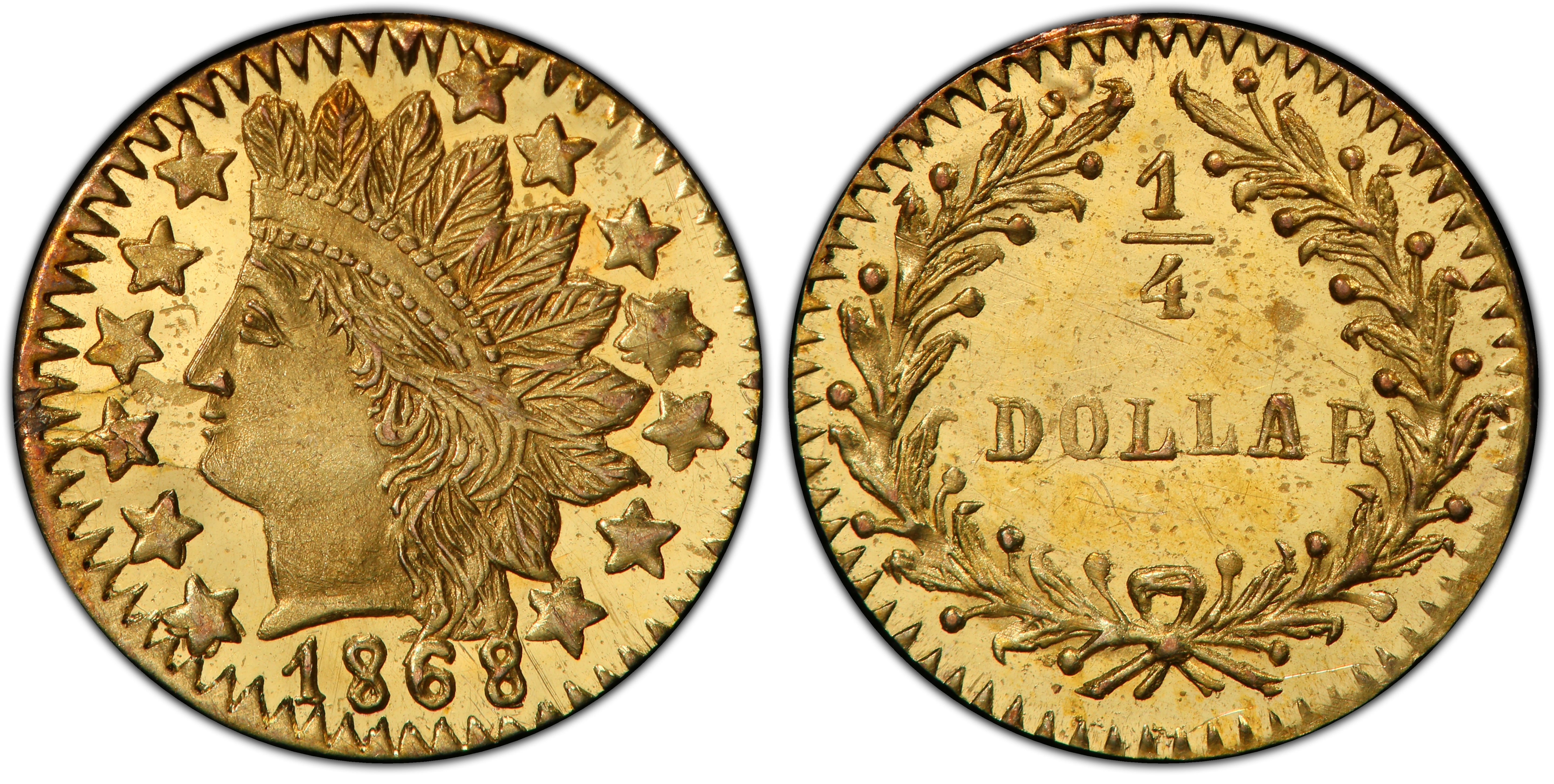
Obverse & Reverse
The 1868 BG-889 25 Cents represents a fascinating chapter in American monetary history, born from the unique economic conditions of post-Gold Rush California. By the late 1860s, the initial frenzy of the gold discovery had subsided, but California's economy remained robust and distinct from the eastern states. A chronic shortage of small-denomination federal coinage persisted on the West Coast, making everyday transactions difficult. Gold dust, once a common medium of exchange, was impractical and prone to waste and fraud. To fill this void, numerous private jewelers and metallurgists in San Francisco began striking their own small-denomination gold pieces. These are categorized by numismatists into three periods; the BG-889 falls into 'Period Two' (1859-1882), often termed the 'Jewelers' Issues.' Unlike the earlier 'Period One' pieces which were often intended to circulate at near-intrinsic value, Period Two issues were generally underweight and served a dual purpose as both quasi-currency and popular souvenirs for tourists and easterners fascinated by the 'Wild West.' The Coinage Act of 1864 had made private coinage illegal, but enforcement was lax in California until the Secret Service finally cracked down in 1883. The BG-889, with its Indian Head motif—a design choice likely inspired by the popular federal cents and eagles of the era—was produced using hand-operated screw presses or even simpler hammer methods. This resulted in inconsistent strike quality and planchet preparation, making each piece unique. Their survival in high grades, often with prooflike surfaces, suggests that many were saved as keepsakes rather than being subjected to the rigors of circulation. Today, these miniature gold coins are prized as tangible artifacts of California's vibrant and semi-autonomous economy in the latter half of the 19th century.
Associated EventPost-Gold Rush Economic Expansion
Reason For MintingTo alleviate a persistent shortage of small change for daily commerce in California and to serve as popular souvenirs.
Minter HistoryThe specific minter of BG-889 is not definitively known, a common trait for many Period Two jeweler's issues. However, the style and period of manufacture are consistent with the work of San Francisco jewelers. Prominent producers of similar fractional gold during this era included figures like Robert B. Gray & Co. and the California Jewelry Co. (successors to the Levison Brothers). These firms possessed the requisite skills in die-sinking and metallurgy. They operated in a competitive market, creating a wide variety of designs to appeal to a public starved for small change and novelty items. These jewelers were not clandestine operators but rather established businessmen who saw a market opportunity ignored by the distant federal government.
Historical SignificanceThe BG-889 and its contemporaries are historically significant as examples of private currency filling a vacuum left by official coinage. They demonstrate the ingenuity and independent spirit of California's economy and serve as a physical record of the transition from a frontier gold-dust economy to a more structured monetary system, even if that system was temporarily supplemented by private issues. Their eventual suppression by the federal government marks the end of tolerated private coinage in the United States.
BG-889
Denomination25 Cents
Minting Period1868
Assayer/MinterUnknown San Francisco Jeweler (Possibly Robert B. Gray & Co. or successor)
Geographic OriginSan Francisco, California
Obverse DescriptionFeatures a left-facing bust of a Native American princess, commonly referred to as an 'Indian Head.' The portrait is adorned with a feathered headdress. Thirteen stars, representing the original colonies, encircle the bust along the periphery. The date '1868' is positioned below the bust.
Obverse Inscription Reverse DescriptionThe central device is the denomination '25 CENTS', contained within a wreath composed of two olive branches tied together with a bow at the bottom. The legend 'CALIFORNIA GOLD' would typically encircle the wreath, but exact inscription details for this variety are not specified in available references.
Reverse Inscription CompositionGold
Stated Fineness Actual FinenessVariable, but typically lower than federal issues of the era.
EdgePlain
Unknown, but very low
Survival EstimateFewer than 20 known
Rarity ScaleHigh R-6 (13 to 30 known)
The BG-889 is highly sought after for its extreme rarity, attractive Indian Head design, and its connection to the romanticized history of California's gold-fueled economy. The frequent appearance of prooflike (PL) examples on freshly prepared planchets adds to its visual appeal, making high-grade specimens particularly prized by specialists.
Key VarietiesThe primary variety is the regular business strike, which often comes with prooflike surfaces. There are no known major die varieties, patterns, or official restrikes for BG-889. The defining characteristic of this die marriage is a prominent die crack on the obverse.
Authentication TipsThe most critical diagnostic for BG-889 is a bold, often easily visible die crack on the obverse, running from the rim at approximately 3:30, through the field, to the rim near 6 o'clock. Genuine examples are extremely thin and will have a 'tinny' feel compared to modern, thicker replicas. The strike can be uneven, but the details should be consistent with known genuine examples, not soft and mushy like many cast counterfeits. Replicas often have incorrect luster, weight, and may omit the denomination or feature a bear on the reverse, which is a fantasy element.
Shopping ConsiderationsWhen acquiring an 1868 BG-889, a buyer should prioritize certification by a top-tier grading service (PCGS or NGC) to guarantee authenticity. For a 'premium quality' example, look for sharp details on the Indian's headdress and the leaves of the reverse wreath. The 'PL' or 'DPL' (Deep Prooflike) designation commands a significant premium, so examine the reflectivity of the fields carefully. Given its rarity, even coins with minor planchet flaws or a slightly uneven strike can be desirable. The key is to find a piece with strong eye appeal, minimal distracting marks, and original, uncleaned surfaces. Always verify the presence of the obverse die crack, as it is a hallmark of this specific variety.
A coin's grade is its condition, rated on a 1-70 scale. For rare coins, this is the most critical factor in determining value, as a tiny difference in preservation can mean a huge difference in price.
Relevant Grade TypesOriginal period issues of BG-889 were business strikes, although many were produced with special care, resulting in prooflike surfaces. They are found in both Circulated (1-58) and, more commonly, Mint State (MS, 60-70) grades. No true Proofs (PR/PF) were struck during the original period of issue, and no later-date restrikes are known to exist. A Prooflike (PL) or Deep Prooflike (DPL) designation is a critical value-added attribute for this issue, signifying it was struck using polished dies on a polished planchet.
Mint State CharacteristicsUncirculated examples of BG-889 are defined by their luster and strike. Luster is typically bright and flashy due to the polished planchets used, giving them a mirrored or 'prooflike' appearance. The strike is often sharp on the central devices (Indian's portrait, wreath) but can show some weakness at the periphery, particularly among the stars. Due to the manual minting process and the softness of the gold, even high-grade specimens may exhibit tiny planchet flakes or handling marks, which should be assessed carefully.
Circulated Wear PatternsOn circulated examples, wear will first appear on the highest points of the design. For the obverse, this includes the cheek and the feathers of the headdress. On the reverse, the high points of the wreath's leaves and the bow will show initial friction and flattening. In lower grades (VF and below), the finer details of the feathers and the individual letters in the legends will begin to soften and merge.
Key Factors For ValueFor the BG-889, value is driven by several key factors in order: 1) Authenticity and Grade: A certified, high-grade Mint State coin is the baseline. 2) Surface Quality: The degree of prooflike reflectivity is paramount; a coin with deep, clear mirrors (DPL) is worth substantially more than a standard MS piece. 3) Eye Appeal: Coins with minimal contact marks, no evidence of cleaning or tooling, and attractive original gold toning are highly prized. 4) Die State: The prominence and clarity of the obverse die crack can be a point of interest for specialists. A CAC sticker will add a significant premium, confirming the coin's quality for its assigned grade.
PCGS Price Guide
| Grade | Price | Population |
|---|---|---|
| 64 | $800.00 | N/A |
| 64+ | $950.00 | N/A |
| 65 | $1,150.00 | 1 |
| 68 | N/A | N/A |