1871 G25C BG-841 (Regular Strike)
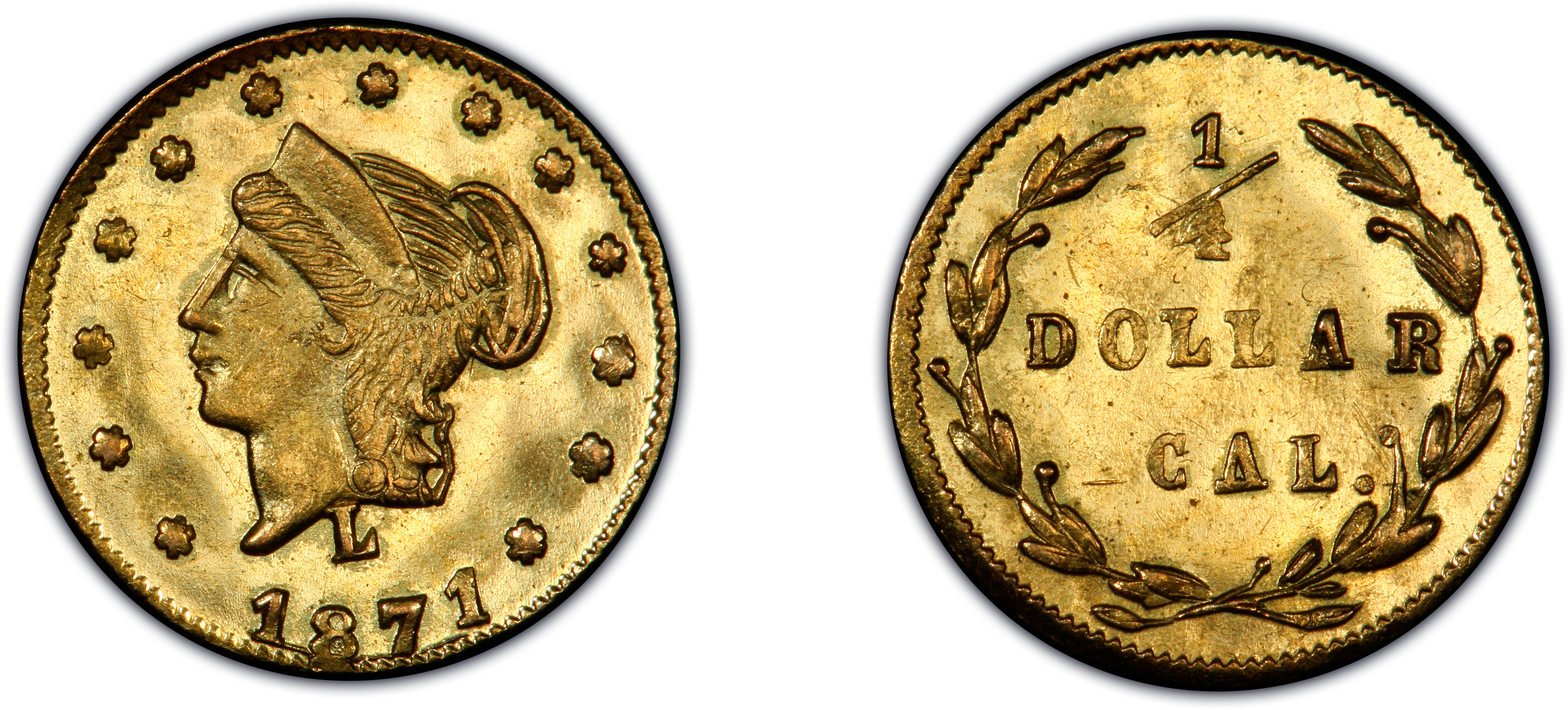
Obverse & Reverse
The 1871 BG-841 25 Cents is a quintessential example of a 'Period Two' California Fractional Gold piece, a numismatic category defined by Walter Breen and Ronald J. Gillio as 'Suppressed Jewelers' Issues.' Unlike their 'Period One' predecessors (1852-1857), which were struck with at least a pretense of alleviating the chronic shortage of small change in Gold Rush California, the Period Two issues were created in a vastly different economic and legal landscape. By 1871, the San Francisco Mint was producing ample federal silver coinage, obviating any real need for private fractional gold. Furthermore, the Private Coinage Act of June 8, 1864, had explicitly outlawed the striking of private coins. This legislation, however, was not rigorously enforced in California for many years, allowing a cottage industry of jewelers to continue producing these miniature gold pieces. Their primary purpose had shifted from commerce to curiosity. They were sold as souvenirs, keepsakes of the 'Golden State,' and affordable charms for watch chains and jewelry. These pieces were often underweight and of varying fineness, as their value was derived from their novelty rather than their intrinsic metal content. Struck by the crude 'hammer method'—a top die struck with a sledgehammer onto a planchet resting on a bottom die—their quality varied immensely. The year 1871 was a pivotal one for this trade. In San Francisco, jeweler Robert B. Gray sold his interests to the California Jewelry Co., which was associated with the prominent Levison Brothers. While many 1871-dated pieces bear a maker's mark (such as 'G' for Gray or 'L' for Levison), the dies used for BG-841 are anonymous. This anonymity may have been a deliberate attempt to avoid scrutiny from the U.S. Secret Service, which was beginning to crack down on private minters, culminating in the seizure of the Hershfield & Mitchell operation in Kansas that same year. The existence of BG-841 speaks to a persistent, if clandestine, market for these gold tokens, which captured the allure of the Gold Rush for tourists and locals alike long after its fever had passed.
Associated EventPost-Gold Rush California Souvenir Trade
Reason For MintingPrimarily struck for sale as jewelry, charms, and souvenirs rather than for monetary circulation.
Minter HistoryThe specific minter of BG-841 is unknown. However, it was produced during a period when San Francisco jewelers like Robert B. Gray & Co. and their successors, the California Jewelry Co. (Levison Brothers), were the primary manufacturers of fractional gold. These firms used a complex web of shared dies and punches, making precise attribution of anonymous varieties like BG-841 exceptionally difficult. These jewelers catered to the burgeoning tourist trade and the public's fascination with gold, operating in a legally grey area until federal enforcement tightened in the 1880s.
Historical SignificanceThe BG-841 represents the evolution of California Fractional Gold from a functional currency substitute to a popular souvenir item. It is a tangible artifact of the post-Gold Rush era's romanticized view of its own recent past and a testament to the legal ambiguities surrounding private coinage in the late 19th century.
Not Applicable
Denomination25 Cents
Minting Period1871
Assayer/MinterUnknown San Francisco Jeweler
Geographic OriginSan Francisco, California
Obverse DescriptionA Liberty Head facing left, similar in style to contemporary U.S. gold coinage but typically of cruder execution. The portrait is surrounded by thirteen six-pointed stars.
Obverse Inscription1871
Reverse DescriptionThe denomination '1/4' and 'CAL.' are enclosed within a wreath. The wreath is typically composed of two olive branches tied together at the bottom with a bow.
Reverse Inscription1/4 CAL.
CompositionGold
Stated Fineness Actual FinenessVariable, often between 14 and 22 karats for Period Two issues.
Weight0.25 grams
Diameter9.50 mm
EdgePlain
Unknown
Survival Estimate75-125
Rarity ScaleR-4 / R-5
This variety appeals to specialists in the extensive California Fractional Gold series. Its status as an anonymous 'jeweler's issue' from a key year of federal crackdown adds historical intrigue. High-grade examples with sharp strikes and prooflike surfaces are particularly desirable, offering a glimpse into the quality these artisans could achieve despite primitive methods.
Key VarietiesThe BG-841 is itself a specific die marriage. Within the broader 1871 G25C series, numerous other BG-numbered varieties exist, struck by different makers (e.g., Robert B. Gray, Hershfield & Mitchell, Levison Bros.) and featuring octagonal shapes or different die characteristics. No later-date restrikes or special collector issues of BG-841 are known to exist; all known examples are original Period Two strikes.
Authentication TipsAuthenticity is paramount. Genuine Period Two pieces are struck, not cast, and should exhibit corresponding sharpness on high points and flow lines under magnification. They are characteristically thin and lightweight. Counterfeits are often thicker, have a soapy or porous texture, incorrect weight, and mushy details. Diagnostics for BG-841 are not widely published, so comparison with certified examples is the best authentication method. Be wary of any piece with a bear motif, as these are modern fantasy items. Authentication by a major third-party grading service is strongly recommended.
Shopping ConsiderationsA premium quality example for its grade is defined by a bold, well-centered strike. Due to the hammer-striking process, many are weakly struck, particularly on the stars, the details of Liberty's hair, and the wreath on the reverse. Seek out specimens with sharp central details and as much peripheral definition as possible. Originality of surface is key; many have been cleaned or used as jewelry. Look for undisturbed, lustrous surfaces, sometimes described as 'green-gold' or having prooflike reflectivity. Avoid examples that are bent, holed, or show evidence of being mounted in jewelry, as this severely impairs value.
A coin's grade is its condition, rated on a 1-70 scale. For rare coins, this is the most critical factor in determining value, as a tiny difference in preservation can mean a huge difference in price.
Relevant Grade TypesAll original examples of BG-841 are business strikes. Although not intended for widespread circulation, they can be found in Circulated grades (1-58) from limited handling, but are more commonly encountered in Mint State (MS, 60-70). No proofs were struck during the original period of issue, and no later-date Proof restrikes are known.
Mint State CharacteristicsUncirculated examples are judged on the quality of their strike, luster, and marks. A superior MS specimen will exhibit a sharp, complete strike on both Liberty's hair and the wreath's leaves. Luster can range from satiny to semi-prooflike; examples with deep, flashy fields are highly prized. As these pieces were produced and handled with less care than federal issues, small planchet flaws or contact marks are common and must be evaluated for their impact on overall eye appeal.
Circulated Wear PatternsWear first appears on the highest points of the design: Liberty's cheek, hair details above the ear and forehead, and the leaves and bow of the wreath. On moderately worn examples, the stars will begin to lose their sharpness and merge with the fields. In lower grades, the date and legends will become weak and partially illegible.
Key Factors For ValueThe primary value driver is grade, followed by surface quality and strike. A sharply struck coin with original, attractive prooflike or lustrous surfaces will command a significant premium over a weakly struck or cleaned counterpart in the same numerical grade. Eye appeal is crucial; some specimens exhibit attractive 'green-gold' toning from alloy impurities, which is favored by collectors. A CAC sticker, indicating premium quality for the grade, adds a notable premium for this series.
PCGS Price Guide
| Grade | Price | Population |
|---|---|---|
| 53 | $180.00 | 1 |
| 53+ | $182.00 | N/A |
| 55 | $185.00 | 6 |
| 55+ | $190.00 | N/A |
| 58 | $200.00 | 8 |
| 58+ | $205.00 | N/A |
| 60 | $225.00 | 1 |
| 61 | $250.00 | 5 |
| 62 | $300.00 | 21 |
| 62+ | $350.00 | N/A |
| 63 | $400.00 | 15 |
| 63+ | $475.00 | N/A |
| 64 | $625.00 | 12 |
| 64+ | $725.00 | N/A |
| 65 | $950.00 | 2 |