1868 G50C BG-960 (Regular Strike)
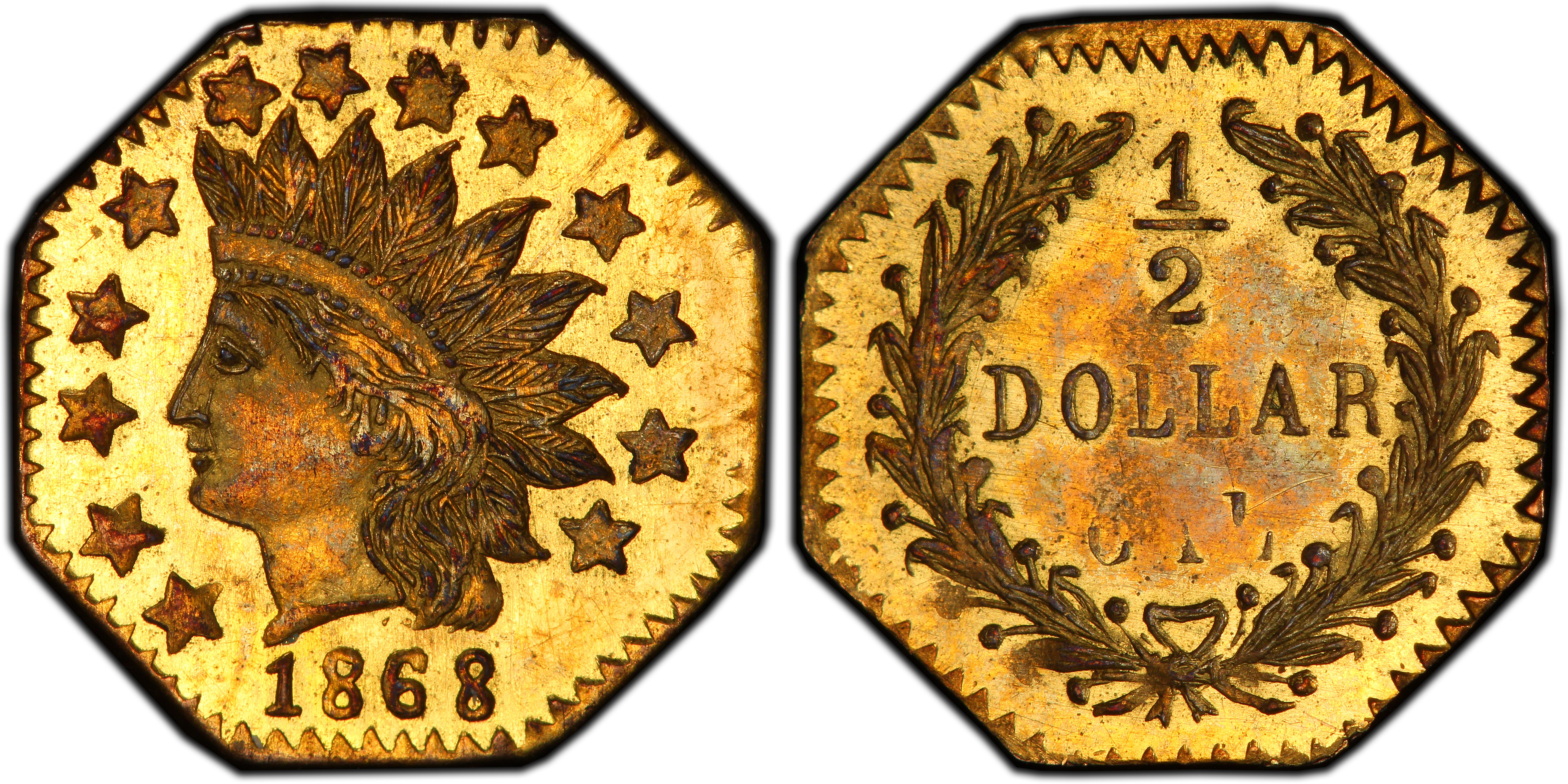
Obverse & Reverse
The 1868 BG-960 50 Cents piece emerges from the third and final period (1858-1882) of California Fractional Gold production, an era characterized by a transition from quasi-currency to commercial souvenirs. By the late 1860s, the initial, desperate need for small change that fueled the creation of the first fractional gold coins in the early 1850s had largely subsided. The United States government had established a branch mint in San Francisco in 1854, which was producing sufficient quantities of federal silver and gold coinage. However, the allure of California gold and the memory of the Gold Rush created a robust market for keepsakes and mementos. Jewelers and private minters, many of whom had previously produced pieces intended for circulation, adapted to this new market. They began striking small gold tokens, often with patriotic or symbolic motifs, designed to be sold to tourists, locals, and merchants who used them as promotional items or 'good luck' charms. The BG-960 variety is a classic example of this phenomenon. It bears no maker's mark, a common trait for Period Three pieces, making attribution difficult, though the style is often associated with the work of Robert B. Gray & Co. of San Francisco. These pieces were not officially sanctioned currency and their gold content was typically worth less than their stated face value, solidifying their status as tokens rather than true coins. Their diminutive size and attractive designs made them popular and affordable souvenirs of the Golden State's famous rush, ensuring their preservation in jewelry, lockets, and early collector cabinets.
Associated EventPost-California Gold Rush Economic Normalization
Reason For MintingPrimarily struck as a souvenir or trade token for the tourist and gift market, not for general circulation as currency.
Minter HistoryThe specific minter for BG-960 is unknown. However, the style and period of manufacture are consistent with the output of several San Francisco jewelers and private minters active at the time. Robert B. Gray & Co. is a frequently cited potential manufacturer for many Period Three issues due to their known production of similar items and their prominence in the San Francisco jewelry trade. These minters operated in a legal gray area, producing items that resembled coins but were technically tokens, thus avoiding federal counterfeiting statutes.
Historical SignificanceThe BG-960 represents the evolution of private California gold from a necessary circulating medium to a commercial keepsake. It is a tangible artifact of the burgeoning California tourism industry and the romanticism that had already begun to surround the Gold Rush, even just a couple of decades after its peak. Numismatically, it is a key component of the extensive and popular California Fractional Gold series, which tells the story of California's economic development in the 19th century.
N/A
Denomination50 Cents
Minting Period1868
Assayer/MinterUnknown, possibly Robert B. Gray & Co.
Geographic OriginSan Francisco, California
Obverse DescriptionA large Liberty head facing left, adorned with a coronet. The coronet is inscribed with the word LIBERTY. She is surrounded by 13 six-pointed stars.
Obverse InscriptionLIBERTY
Reverse DescriptionThe denomination '50 CENTS' and the date '1868' are enclosed within a wreath of two oak branches tied together with a bow at the bottom.
Reverse Inscription50 CENTS 1868
CompositionGold
Stated Fineness Actual FinenessVaries, but typically between .500 and .800 fine (12-19 karat gold).
Weight0.25 grams
Diameter10.00 mm
EdgePlain
5,000 - 10,000
Survival Estimate500 - 750
Rarity ScaleR-5
The BG-960 is popular due to its classic 'Large Liberty' design, affordability relative to earlier issues, and its status as a representative example from the souvenir period of California Fractional Gold. Its historical connection to the post-Gold Rush era and its role as a memento make it a fascinating collectible.
Key VarietiesThe primary variety is the Regular Strike, intended as a souvenir. There are no known original period proof strikings. Breen and Gillio (the 'BG' in the catalog number) do not list any major die varieties for BG-960. Later-date restrikes or modern copies are common in the broader Cal Gold market but are not associated with this specific original variety.
Authentication TipsAuthentic BG-960 pieces often exhibit a somewhat soft or slightly crude strike, particularly on the stars and the details of the wreath. The numerals in the date should match known exemplars; forgeries often have incorrect fonts. The gold color should be consistent with the typical alloy of the period, often a slightly brassy yellow. Weight and diameter should be close to the specifications. Many modern fakes are gold-plated base metal and will fail a specific gravity test. Look for die markers and compare with high-resolution images of certified specimens.
Shopping ConsiderationsA premium quality example for this issue is defined by a sharp strike, especially on Liberty's hair details, the inscription on the coronet, and the leaves of the wreath. Original, uncleaned surfaces with some remaining mint luster command significant premiums. Look for pieces with minimal distracting marks; small planchet flaws are common and can be acceptable, but significant scratches or rim bumps are detrimental. Avoid examples that appear overly bright or have unnaturally uniform surfaces, as this often indicates harsh cleaning or polishing. Also, be wary of pieces that have been removed from jewelry, looking for evidence of solder or mounting marks on the edge and rims.
A coin's grade is its condition, rated on a 1-70 scale. For rare coins, this is the most critical factor in determining value, as a tiny difference in preservation can mean a huge difference in price.
Relevant Grade TypesOriginal 1868 issues were business strikes, although intended as souvenirs rather than for circulation. They are found in Circulated grades (AU-58 and below, though heavy circulation is uncommon) and, more frequently, in Mint State (MS, 60-70) grades. No original proofs from 1868 are known to exist. Any piece described as a 'Proof' would be a later restrike or modern copy and is not a part of the original BG-960 issue.
Mint State CharacteristicsUncirculated examples of BG-960 typically display a soft, satiny luster rather than a hard, frosty one. The strike is a key determinant of quality; many were not fully struck up. A premium MS piece will show sharp details on the letters of LIBERTY and distinct leaf veins in the wreath. Due to the softness of the gold alloy and being sold as trinkets, contact marks are very common, even on high-grade pieces. Small, scattered marks are expected, but large or deep abrasions on Liberty's cheek or in the fields are detracting.
Circulated Wear PatternsWear first appears on the highest points of the design: Liberty's cheekbone, the hair above her eye, and the coronet. On the reverse, the high points of the bow and the leaves in the wreath will show the first signs of friction. In grades below AU-50, the finer details of the hair and leaves begin to merge, and the legends and date will appear flattened.
Key Factors For ValueFor the BG-960, the primary value drivers are grade and surface quality. An uncleaned coin with original skin and luster (an 'original look') is far more desirable than a cleaned, brighter-looking piece in the same grade. Strike sharpness is the next critical factor; a well-struck MS-63 can be more valuable than a weakly struck MS-64. Eye appeal is paramount; coins with a pleasing, uniform color and minimal distracting marks will always sell for a premium. A CAC sticker for this issue indicates superior quality for the grade and typically adds a significant premium, as it confirms the originality of the surfaces and the strength of the strike.
PCGS Price Guide
| Grade | Price | Population |
|---|---|---|
| 62 | N/A | N/A |
| 63 | $1,000.00 | 2 |
| 63+ | $1,250.00 | N/A |
| 64 | $1,500.00 | 7 |
| 64+ | $1,750.00 | N/A |
| 65 | $2,250.00 | 3 |