1856 G50C BG-311, PL (Regular Strike)
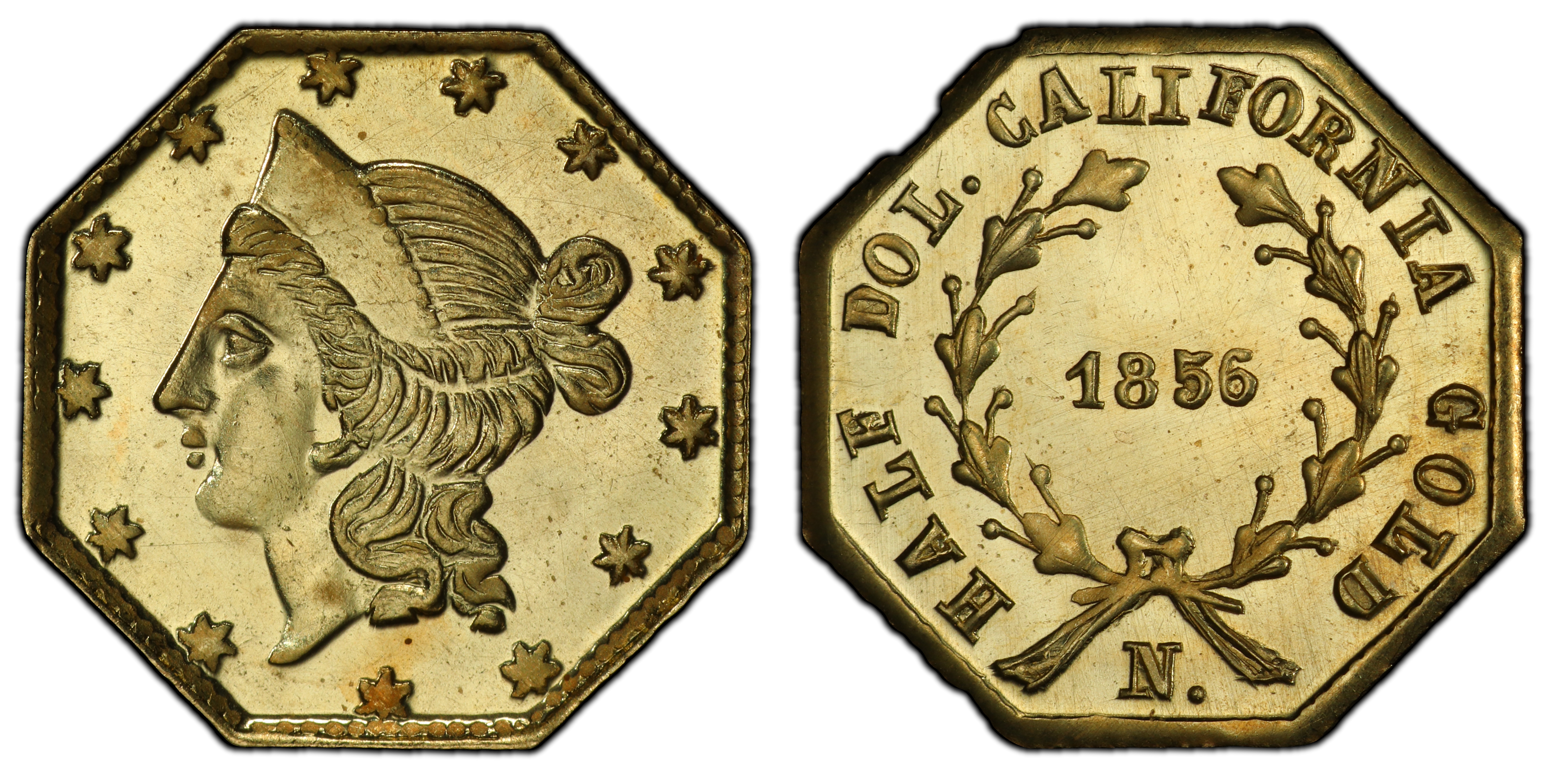
Obverse & Reverse
The 1856 Octagonal Liberty Head 50 Cents, cataloged as BG-311 in the authoritative Breen-Gillio reference, is a quintessential artifact of the 'Period One' era of California Fractional Gold. This period, from 1852 to 1857, represents the most legitimate phase of this fascinating series, when these miniature gold pieces were struck by private jewelers and metallurgists to alleviate a severe shortage of small-denomination coinage in the booming Gold Rush economy. Following the discovery of gold at Sutter's Mill in 1848, hundreds of thousands of 'forty-niners' flooded into California, creating bustling centers of commerce almost overnight. However, the United States Mint was slow to respond to the region's needs. Gold dust and nuggets served as a clumsy medium of exchange, but for everyday transactions like buying a meal or a drink, a more convenient form of currency was desperately required. Federal coinage was scarce, and the smallest official gold coin was the dollar, a significant sum. Into this void stepped a number of San Francisco jewelers, who, leveraging their experience with precious metals, began producing their own fractional-denomination coins. These pieces, in 25-cent, 50-cent, and one-dollar values, were not official government tender but were widely accepted in local commerce out of sheer necessity. The BG-311 is a product of this environment, crudely but effectively manufactured using hand-cut dies and a hammer-striking process. Most Period One fractionals, including BG-311, were intentionally made with a gold content slightly below their face value, ensuring a small profit for the anonymous minter. Despite this, their utility ensured their circulation until the San Francisco Mint began producing sufficient quantities of federal coinage in the late 1850s. The historical importance of BG-311 was dramatically underscored by the recovery of several high-grade, prooflike (PL) examples from the wreck of the S.S. Central America, which sank in a hurricane in 1857. These coins, sealed in a time capsule on the ocean floor, provide a pristine glimpse into how these pieces looked at the time of their manufacture, confirming their role as a vital part of the daily money supply for the citizens of Gold Rush California.
Associated EventCalifornia Gold Rush
Reason For MintingTo provide a crucial medium for small-change transactions in California's booming, yet coinage-starved, Gold Rush economy.
Minter HistoryThe minters of most Period One California Fractional Gold, including the BG-311 variety, remain anonymous. They were typically jewelers and metallurgists located in San Francisco who possessed the requisite skills to work with gold and create dies. They operated without official sanction and often without identifying marks, profiting from both the production of the coins and the slight seigniorage gained from their characteristically underweight nature. Their operations ceased as official U.S. coinage became more plentiful in the region.
Historical SignificanceThe BG-311, like other Period One fractionals, represents a grassroots solution to a critical economic problem on the American frontier. It is tangible evidence of private enterprise filling a void left by the federal government and is a direct monetary link to the daily lives of the merchants and miners of the California Gold Rush. The S.S. Central America specimens cemented its status as a historically significant issue.
BG-311
Denomination50 Cents
Minting Period1856
Assayer/MinterUnknown
Geographic OriginSan Francisco, California
Obverse DescriptionA crude but recognizable depiction of a Liberty Head facing left, similar in style to the contemporary federal gold coinage but of a much more primitive execution. She wears a coronet, and her hair is tied in a bun. The portrait is encircled by thirteen five-pointed stars.
Obverse Inscription Reverse DescriptionA simple wreath composed of two branches tied with a bow at the bottom. The inscription is contained within and around the wreath.
Reverse Inscription1/2 DOLLAR 1856
CompositionGold
Stated Fineness Actual FinenessVariable, but typically less than the .900 standard of federal gold.
Weight0.80 grams
Diameter11.00 mm
EdgePlain
Unknown
Survival Estimate75-125
Rarity ScaleR-5
BG-311 is highly sought after as a representative of the octagonal Period One fractionals that actually circulated during the Gold Rush. Its crude charm, direct link to frontier economics, and the added romance of the S.S. Central America shipwreck treasure make it a classic collectible.
Key VarietiesThe primary variety associated with BG-311 is the BG-915A. This is a restrike made circa 1860 using the original 1856-dated dies of BG-311. However, BG-915A is a collector's piece or counterfeit of the era, identified by being struck on a gold-plated, base-metal planchet and often having a plain or slightly filed edge, distinct from the generally sharp, hammer-struck edges of the original gold issues. No other contemporary varieties or official restrikes are known.
Authentication TipsAuthentic BG-311s are struck in solid gold, albeit often of a lower fineness. Weight can be a key indicator; they should not feel 'light' for their size in the way a plated copy would. Examine the edge; it should be plain but show the characteristic roughness of a piece struck by hammer on an octagonal blank. The strike details are often soft, but the lettering and stars should have a particular style consistent with known genuine examples. Be wary of pieces with a perfectly smooth, wire-rim edge or a color that suggests gold plating. The BG-915A restrike is the most deceptive 'variety'; it is non-gold and should be identified by its composition.
Shopping ConsiderationsA premium quality BG-311 is defined by a bold strike, which is rare for the issue. Look for sharpness on Liberty's hair details and the numerals of the date. Original, uncleaned surfaces with a hint of reddish-gold toning are highly prized. Luster is also a key factor; specimens with prooflike (PL) surfaces, such as those from the S.S. Central America, command significant premiums. Avoid examples that have been used as jewelry, evidenced by solder marks, heavy polishing, or rim filing. The crude nature of the strike often results in planchet flaws or weak areas, which are acceptable, but any post-strike damage should be carefully considered.
A coin's grade is its condition, rated on a 1-70 scale. For rare coins, this is the most critical factor in determining value, as a tiny difference in preservation can mean a huge difference in price.
Relevant Grade TypesOriginal period issues of BG-311 were all business strikes intended for circulation and are found in Circulated (1-58) and Mint State (MS, 60-70) grades. No true Proofs were struck during the original minting period. However, some Mint State examples, particularly those recovered from the S.S. Central America, exhibit highly reflective, mirror-like surfaces and are designated as 'Prooflike' (PL) by grading services. These are not a different type of strike but rather are exceptional business strikes from fresh, polished dies, and they are considered a distinct and highly desirable category by collectors.
Mint State CharacteristicsAn uncirculated BG-311 will ideally show soft, satiny luster, though many of the finest known examples are prooflike. The strike is characteristically weak in the centers, particularly on the highest points of Liberty's hair and the wreath's leaves. Due to the hand-hammering process, planchet quality can be inconsistent, with minor striations or adjustment marks being common and not necessarily detrimental unless severe. Contact marks are common due to the softness of the gold, often seen on the high points of the portrait and in the fields.
Circulated Wear PatternsWear first appears on the highest points of the design: Liberty's cheek, coronet, and the hair above her ear. On the reverse, the highest points of the wreath bow and the fraction '1/2' will show the first signs of friction. On moderately circulated examples, the stars will begin to lose their points and the legends will appear soft. In lower grades (VG and below), the date and stars may become partially obliterated, and the octagonal points will become rounded.
Key Factors For ValueFor the BG-311, the most significant value drivers are surface preservation and strike. An example with original, lustrous surfaces free of cleaning or polishing will always be prized. A sharp strike that brings up the details of the hair and wreath is exceptionally rare and commands a major premium. Eye appeal is critical; coins with a pleasing, original reddish-gold color are preferred. The Prooflike (PL) designation adds a substantial premium, and a provenance to the S.S. Central America treasure elevates the coin's value and desirability to the highest level. A CAC sticker confirms premium quality for the assigned grade and is highly sought after for this issue.
PCGS Price Guide
| Grade | Price | Population |
|---|---|---|
| 62 | N/A | N/A |
| 62+ | N/A | N/A |
| 63 | N/A | N/A |
| 64 | $3,000.00 | 1 |
| 64+ | $3,500.00 | N/A |
| 65 | $4,250.00 | N/A |
| 65+ | $4,500.00 | N/A |
| 66 | $4,750.00 | 1 |
| 66+ | $5,250.00 | 1 |
| 67 | $5,750.00 | 2 |
| 67+ | $6,250.00 | N/A |
| 68 | $7,000.00 | N/A |
| 68+ | $8,000.00 | 1 |