1871 G25C BG-837 (Regular Strike)
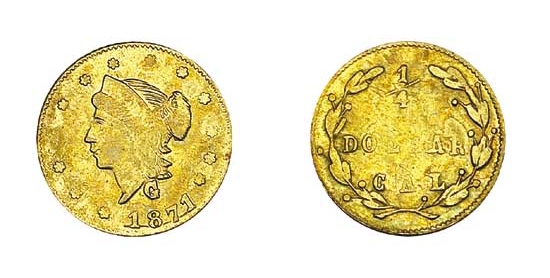
Obverse & Reverse
The 1871 G25C BG-837 is a quintessential example of a 'Period Two' California Fractional Gold piece. These fascinating and diminutive coins arose from the unique economic conditions of post-Gold Rush California. The initial wave of fractional gold, struck from 1852-1857 ('Period One'), was a genuine commercial necessity, created to alleviate a severe shortage of small-denomination coinage for everyday transactions. However, by the time the U.S. Mint in San Francisco was in full operation, it had largely satisfied this need with official federal silver coinage. This rendered the private minting of fractional gold for circulation obsolete. Rather than disappear, the practice transformed. Enterprising jewelers in San Francisco recognized a burgeoning market for souvenirs and keepsakes among tourists and residents captivated by the romance of the Gold Rush. From 1858 to 1882, these minters produced a dizzying array of 'Period Two' issues, including the BG-837. Unlike their Period One predecessors, these were not intended to pass as currency at face value; they were intrinsically underweight and often of lower fineness, functioning more as tokens or charms. The Coinage Act of 1864 had made private coinage illegal, but enforcement by the Secret Service was lax in California until the early 1880s, allowing this cottage industry to flourish for two decades. The BG-837, dated 1871, was struck during the height of this souvenir period. Its creation involved crude but effective 'hammer' minting techniques, where dies were struck by hand, leading to frequent imperfections such as weak strikes, planchet flaws, and off-center designs—hallmarks that are now cherished by collectors. The very existence of this piece speaks to a California in transition, moving from a raw frontier economy to a more settled and nostalgic society that was already beginning to mythologize its own recent past. The eventual crackdown in 1883 brought an end to the legal production of denominated fractional gold, cementing the status of pieces like the BG-837 as relics of a bygone era.
Associated EventCalifornia Gold Rush Aftermath & Souvenir Trade
Reason For MintingPrimarily created to be sold as a souvenir or charm capitalizing on the allure of the California Gold Rush.
Minter HistoryThe specific minter of the BG-837 die marriage is unknown, which is common for many 'Period Two' California Fractional Gold pieces. Production was dominated by a community of private jewelers in San Francisco, many of French origin, who often did not sign their work. These craftsmen, such as Frontier & Deviercy or Deriberpe & Nouizillet, are known for some issues, but many die varieties from this era remain anonymous, their makers identifiable only by the distinct style and workmanship of the dies they engraved.
Historical SignificanceThe BG-837 represents the second phase of fractional gold history, where the purpose shifted from necessity-driven commerce to commercial nostalgia. It is a tangible artifact of the 19th-century tourist trade and the popular romanticism surrounding the Gold Rush, produced in a legal gray area that persisted for years after the practice of private coining was officially outlawed.
BG-837
Denomination$0.25
Minting Period1871
Assayer/MinterUnknown Private Minter
Geographic OriginSan Francisco, California
Obverse DescriptionA head of Liberty facing left, her hair tied in a bun. She is surrounded by thirteen six-pointed stars arranged around the periphery. The date, 1871, appears below the bust. The portrait style is typical of the simplified, somewhat crude engraving found on Period Two issues.
Obverse Inscription1871
Reverse DescriptionThe denomination '1/4 DOLLAR' is enclosed within a simple wreath composed of two branches tied with a bow at the bottom. A characteristic feature noted on high-grade examples is a slight depression in the field above the 'R' in DOLLAR, caused by metal displacement from the high relief of Liberty's hair bun on the obverse die.
Reverse Inscription1/4 DOLLAR
CompositionGold
Stated Fineness Actual FinenessVariable, typically ranging from 14 to 22 karats (.583 to .917 fine).
EdgePlain
Extremely Low
Survival Estimate7 to 12 coins
Rarity ScaleR-7
As an R-7 variety, the BG-837 is extremely rare and highly sought after by advanced specialists of California Fractional Gold. Its appeal lies in its scarcity, its connection to the fascinating 'Period Two' souvenir era, and the challenge of acquiring one of the few known examples. Each surviving specimen is a tiny, tangible piece of Gold Rush history.
Key VarietiesThe BG-837 is a specific die marriage and has no known major varieties from its original minting period. No special collector issues, such as proofs or restrikes, are known to exist for this variety.
Authentication TipsAuthentic Period Two pieces like BG-837 must be denominated; fakes often say 'CAL GOLD' instead of 'DOLLAR' or 'CENTS'. The fabric should exhibit characteristics of a hand-hammered strike, not the uniform, sterile look of modern replicas. Look for a slightly irregular shape and potential weakness in some design elements. The engraving style, while crude, should match known examples. Be wary of pieces with fields that are too perfect or that feature a bear on the reverse, as these are common characteristics of 20th-century tokens and fakes.
Shopping ConsiderationsFor a premium quality BG-837, a buyer should prioritize a sharp strike on the central devices (Liberty's head, date, denomination) and as much legend detail as possible, as these are often weakly struck toward the periphery. Many surviving examples exhibit prooflike or semi-prooflike surfaces, which command a significant premium. Original, uncleaned surfaces with a hint of reddish-gold or greenish-gold toning are highly desirable. Check carefully for hidden problems such as tooling in the fields to 'improve' details, evidence of mounting for jewelry, or harsh cleaning which can leave hairlines and strip the coin of its original skin.
A coin's grade is its condition, rated on a 1-70 scale. For rare coins, this is the most critical factor in determining value, as a tiny difference in preservation can mean a huge difference in price.
Relevant Grade TypesOriginal BG-837 issues were business strikes, although intended as souvenirs rather than for circulation. They are found in Circulated grades (AU-58 and below) and, more commonly for this souvenir issue, in Mint State (MS, 60-70) grades. No proofs were struck during the original period of issue, and no later-date proof restrikes are known.
Mint State CharacteristicsUncirculated examples of BG-837 often exhibit surprisingly prooflike, reflective fields, a hallmark of freshly polished dies used for souvenir production. Strike quality is a key determinant of grade; weakness is commonly seen on some of the peripheral stars and wreath elements. The high relief of Liberty's hair bun often causes a corresponding softness or depression on the reverse. Luster is typically bright and flashy. Due to the softness of the gold, even high-grade Mint State examples will likely show minor contact marks or planchet imperfections inherent from the crude manufacturing process.
Circulated Wear PatternsOn circulated examples, wear first appears on the highest points: Liberty's cheek, the hair bun, and the leaves in the wreath. As wear progresses, the finer details of the hair and the individual stars will begin to soften and merge. In lower grades (VF and below), the date and legends will show significant flattening.
Key Factors For ValueFor the BG-837, value is driven first by its extreme rarity (R-7). After that, the primary factors are surface quality and eye appeal. An example with pristine, prooflike surfaces and original, attractive toning will command a massive premium over a cleaned or hairlined coin of the same numerical grade. Strike sharpness is also critical; a well-centered and boldly struck specimen is the ideal. Given the small surviving population, any example certified by PCGS or NGC is highly desirable, with a CAC sticker adding a further significant premium for superior quality within the assigned grade.
PCGS Price Guide
| Grade | Price | Population |
|---|---|---|
| 45 | $350.00 | 1 |
| 45+ | $390.00 | N/A |
| 50 | $450.00 | N/A |
| 50+ | $480.00 | N/A |
| 53 | $525.00 | N/A |
| 53+ | $545.00 | N/A |
| 55 | $675.00 | 1 |
| 55+ | $800.00 | N/A |
| 58 | $1,050.00 | 1 |
| 58+ | $1,125.00 | N/A |
| 60 | $1,250.00 | 1 |
| 61 | $1,450.00 | 3 |
| 62 | $2,000.00 | 4 |
| 62+ | $2,250.00 | N/A |
| 63 | $2,750.00 | 1 |