1864 G25C BG-821 (Regular Strike)
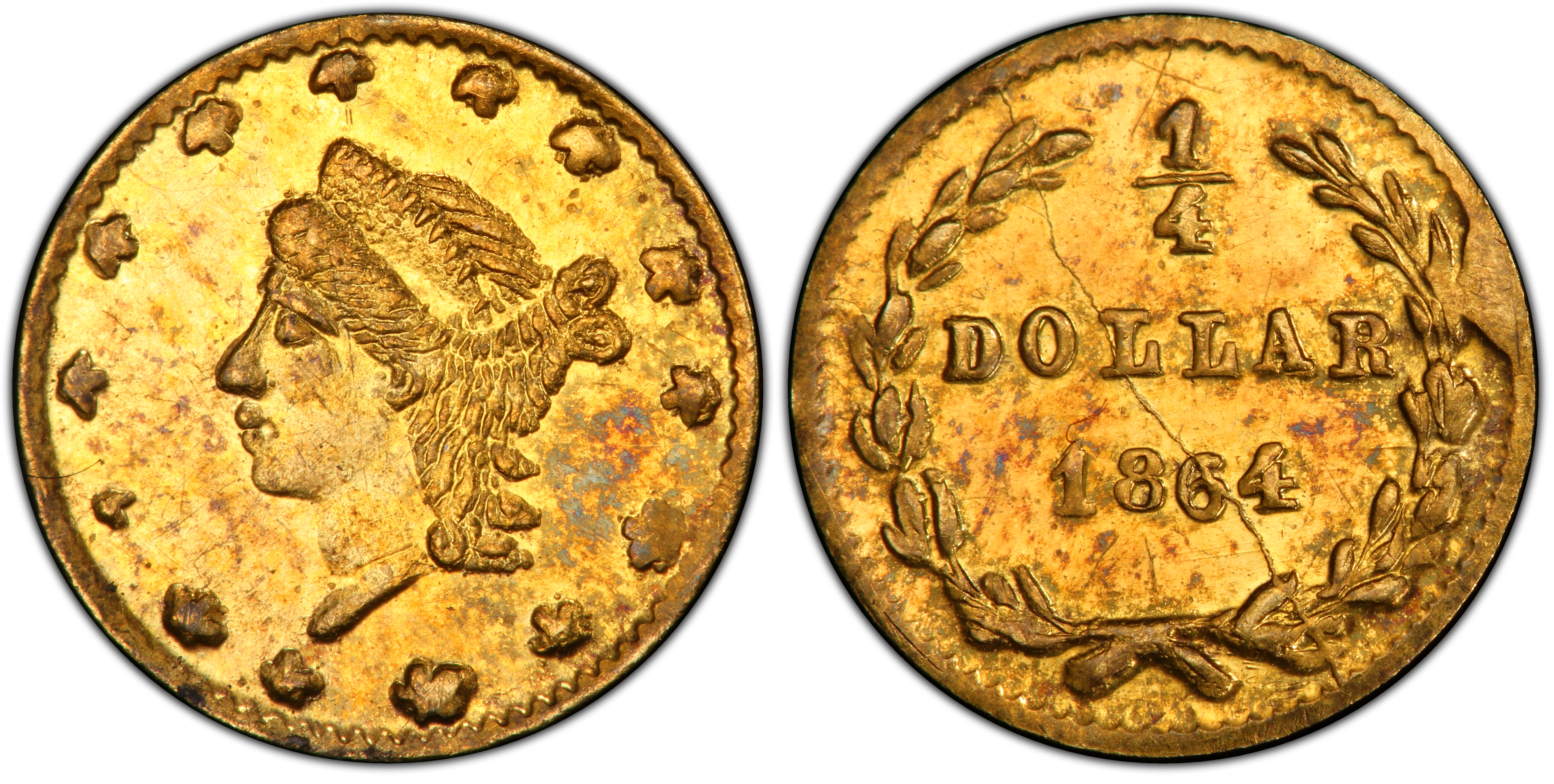
Obverse & Reverse
The 1864 BG-821 25 Cents is a quintessential example of 'Period Two' California Fractional Gold. The initial wave of fractional gold, struck from 1852 to 1857 ('Period One'), arose from a genuine and severe shortage of small-denomination coinage in Gold Rush California. These early pieces, while privately issued, were intended to and often did facilitate daily commerce. However, by the time the BG-821 was created, the economic landscape had shifted. The San Francisco Mint, opened in 1854, was producing sufficient quantities of federal silver and gold coins, alleviating the acute need for private issues. Consequently, the motivation behind 'Period Two' pieces (1858-1882) transformed. Rather than serving as essential currency, they were primarily manufactured by jewelers as souvenirs, keepsakes, and novelty items for tourists and locals nostalgic for the heady days of the Gold Rush. This shift is reflected in their physical characteristics; Period Two coins are generally lighter and thinner than their predecessors, with a gold content often significantly below their face value, rendering them essentially tokens. The Coinage Act of April 22, 1864, made the private issuance of coinage illegal. However, this federal law was not actively enforced against the small fractional pieces in California until the Secret Service cracked down in 1883. This legal gray area allowed jewelers like Robert B. Gray & Co. to continue producing denominated pieces like the BG-821 throughout the 1860s and beyond, often using dates that may not have reflected the actual year of striking. These miniature gold pieces captivated the public, serving as tangible, affordable mementos of the region's fabled mineral wealth.
Associated EventCalifornia Gold Rush (Aftermath and Commemoration)
Reason For MintingPrimarily created as a souvenir or charm for the tourist and jewelry trade, capitalizing on the legacy of the California Gold Rush.
Minter HistoryRobert B. Gray & Co. was a prominent San Francisco jeweler and a prolific producer of Period Two fractional gold. In late 1858 or 1859, Gray acquired the business of another established fractional gold minter, Antoine Louis Nouzillet, including his dies and hubs. Gray struck pieces using Nouzillet's old dies before creating his own, which are often identifiable by a small hallmark 'G' on the obverse of many varieties (though not present on BG-821). Gray's operation was notable for producing some of the heaviest and most intrinsically valuable pieces of the Period Two era, suggesting a higher commitment to quality than some of his competitors. The firm continued its production until 1871, when it was sold to the California Jewelry Co. (Levison Bros.).
Historical SignificanceThe BG-821 represents the evolution of private coinage from a commercial necessity to a nostalgic commodity. It is a physical artifact of the post-Gold Rush economy in San Francisco, where the romance of the '49ers was monetized by enterprising jewelers. Its existence highlights a period of lax federal oversight and showcases the craftsmanship of private minters who created these intricate, miniature gold coins that remain a popular and complex collecting field.
N/A
Denomination25 Cents
Minting Period1864
Assayer/MinterRobert B. Gray & Co.
Geographic OriginSan Francisco, California
Obverse DescriptionFeatures a Liberty Head portrait facing left, stylistically similar to the contemporary federal gold coinage but of a more simplistic, local execution. The portrait is surrounded by thirteen stars representing the original colonies. The date '1864' is below the bust.
Obverse Inscription1864
Reverse DescriptionA wreath composed of two branches tied together by a bow at the bottom. The denomination '25 CENTS' is inscribed in two lines within the center of the wreath.
Reverse Inscription25 CENTS
CompositionGold
Stated Fineness Actual FinenessVaries, but typically between .500 and .800 for Period Two issues.
Weight0.25 grams
Diameter9.80 mm
EdgePlain
Unknown
Survival Estimate31-75 known specimens
Rarity ScaleR-5
The BG-821 is sought after as a representative of the popular 'souvenir' era of fractional gold. Its small size, gold composition, and direct link to the lore of the California Gold Rush make it a historically engaging and affordable entry point into the series for many collectors. The specific Breen-Gillio variety adds a layer of numismatic challenge.
Key VarietiesThe primary variety is the regular business strike. No known proof restrikes, patterns, or trial pieces are recorded for this specific BG number. The major variations within the broader fractional gold series are defined by differences in design (Liberty vs. Indian heads), shape (round vs. octagonal), and the numerous die pairings cataloged by Breen and Gillio.
Authentication TipsAuthentic Period Two pieces like the BG-821 are characteristically thin and were struck on genuine gold planchets. Fakes and modern replicas are often thicker, have a soapy or cast-like appearance, and may be gold-plated brass. A key diagnostic for genuine fractional gold is the presence of a denomination (e.g., 'CENTS' or 'DOLLAR'). Later souvenir tokens made after 1883 to circumvent counterfeiting laws typically omit a denomination, instead using phrases like 'CAL GOLD' or featuring a bear on the reverse. Weak strikes are common on genuine pieces due to the hand-hammering process, whereas modern fakes are often sharply and uniformly struck. Consulting the Breen-Gillio reference for die characteristics is the ultimate verification method.
Shopping ConsiderationsA premium quality BG-821 for its grade will exhibit a sharp strike for the issue, especially on Liberty's hair details and the numerals of the date. Seek out examples with clean, original surfaces that retain some mint luster, often appearing satiny or prooflike. Avoid coins that have been harshly cleaned, which imparts a dull, lifeless surface, or those with scratches, rim bumps, or evidence of having been used in jewelry (solder marks). Attractive, even toning ranging from bright yellow to a deep reddish-gold can enhance eye appeal. Given the high number of counterfeits in this series, purchasing examples certified by a top-tier grading service (PCGS or NGC) that attributes the BG variety is strongly recommended.
A coin's grade is its condition, rated on a 1-70 scale. For rare coins, this is the most critical factor in determining value, as a tiny difference in preservation can mean a huge difference in price.
Relevant Grade TypesOriginal examples of BG-821 were business strikes, technically intended for sale rather than circulation, and are found in both Circulated (1-58) and Mint State (MS, 60-70) grades. No proofs were struck during the original period of issue, and there are no known later-date collector restrikes for this specific variety. The majority of surviving examples are in higher grades (AU and MS), as they were typically kept as souvenirs and saw little to no actual circulation.
Mint State CharacteristicsUncirculated examples of BG-821 often display a soft, satiny luster. Strike quality can be inconsistent due to the crude 'hammer' minting process; a well-struck example with full central details is rare and desirable. Planchets are typically very thin. Small planchet flaws or adjustment marks are not uncommon and should be evaluated for their impact on eye appeal. Contact marks, even small ones, can be prominent due to the softness of the gold.
Circulated Wear PatternsOn circulated examples, wear first appears on the high points of Liberty's hair above the eye and on the ear. The cheek and the lettering of 'CENTS' on the reverse are also susceptible to early friction. In lower grades (VF and below), the stars on the obverse and the individual leaves of the wreath will begin to lose their definition and merge.
Key Factors For ValueFor the BG-821, value is driven by three main factors: grade, surface quality, and eye appeal. A high-grade Mint State coin will command a significant premium over a circulated one. Surface quality is paramount; an example with original, undisturbed luster and minimal marks is far more valuable than a cleaned or scratched coin of the same grade. Finally, eye appeal, including the quality of the strike and attractive natural toning, can make two coins in the same holder sell for vastly different prices. A CAC sticker for this issue confirms premium quality for the grade and adds a significant premium.
PCGS Price Guide
| Grade | Price | Population |
|---|---|---|
| 50 | $200.00 | 7 |
| 50+ | $205.00 | N/A |
| 53 | $210.00 | 1 |
| 53+ | $215.00 | N/A |
| 55 | $220.00 | 11 |
| 55+ | $235.00 | N/A |
| 58 | $260.00 | 6 |
| 58+ | $275.00 | N/A |
| 60 | $350.00 | 1 |
| 61 | $425.00 | 7 |
| 62 | $550.00 | 11 |
| 62+ | $600.00 | N/A |
| 63 | $850.00 | 3 |
| 63+ | $950.00 | N/A |
| 64 | $1,600.00 | 1 |