1870 G50C BG-908 (Regular Strike)
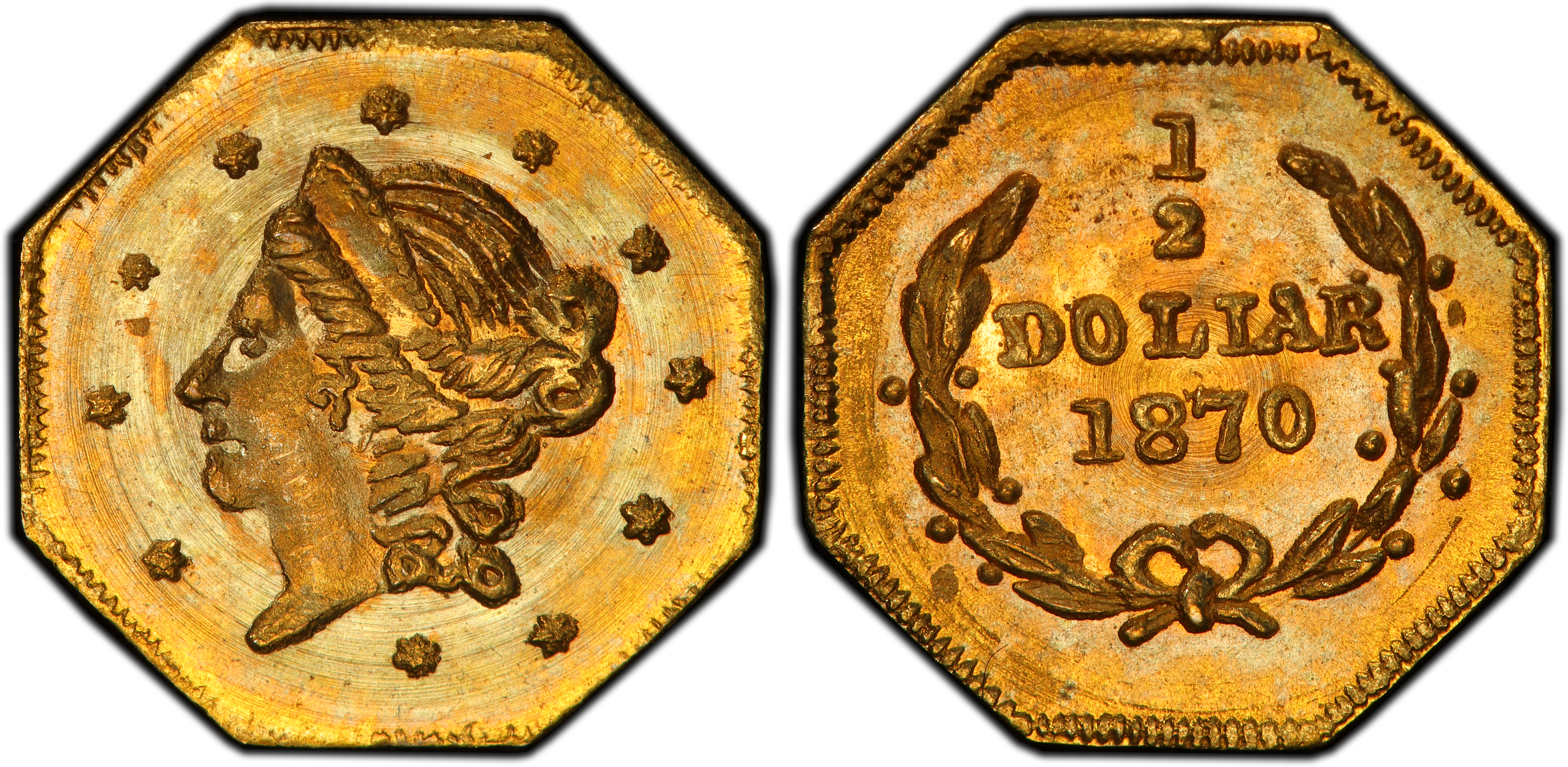
Obverse & Reverse
The 1870 Octagonal 50 Cents, cataloged as Breen-Gillio 908, is a quintessential artifact from the second period of California's private gold coinage. Born from the acute shortage of small denomination currency that plagued the West Coast following the 1849 Gold Rush, California Fractional Gold pieces initially served a vital role in commerce. By 1870, however, their purpose had evolved. The first period (1852-1856) saw the production of coins intended to genuinely circulate, closely mimicking federal issues in design and intrinsic value. The second period (1859-1882), to which the BG-908 belongs, is known as the 'jeweler's period.' During this era, production was dominated by San Francisco jewelers, such as Robert B. Gray & Co., who manufactured these small gold pieces with a dual purpose. While they could still facilitate minor transactions, their reduced gold content and often more ornate designs made them popular as souvenirs and keepsakes for tourists and locals alike, who wished to send a small, affordable piece of California's famous gold back home. These pieces were typically struck by hand, using a hammer to strike the top die, resulting in variable strike quality. The passage of federal laws in 1864 prohibiting private coinage made their production legally tenuous, but enforcement was lax in distant California for years, allowing firms like Gray to continue minting these 'tokens' well into the 1870s. The BG-908, therefore, represents a fascinating transition from utilitarian necessity to a numismatic collectible, embodying both the lingering economic realities of the Gold Rush and the burgeoning tourist trade of post-railroad San Francisco.
Associated EventCalifornia Gold Rush aftermath and westward expansion
Reason For MintingTo serve as a medium for small transactions and as a popular souvenir item during a period of chronic shortage of federal small-denomination coinage in California.
Minter HistoryRobert B. Gray & Co. was a jeweler and manufacturer active in San Francisco during the 'Second Period' of fractional gold production. Like other jewelers of the era, such as Frontier, Deriberpe & Co., Gray's firm capitalized on the demand for small gold pieces for both commerce and the souvenir trade. These minters operated in a legally gray area after 1864, technically violating federal statutes against private coinage but benefiting from lax enforcement on the West Coast. Their production was characterized by hand-striking methods and the use of proprietary dies, leading to numerous distinct varieties cataloged by Breen and Gillio. The firm was a significant contributor to the diverse tapestry of fractional gold available in California during the 1860s and 1870s.
Historical SignificanceThe BG-908 is historically significant as a representative of the 'jeweler's issue' period of California Fractional Gold, illustrating the evolution of these private coins from essential currency to popular souvenirs. It highlights the persistent need for small change on the isolated West Coast and reflects the craftsmanship and enterprise of San Francisco's private minters operating outside of federal authority.
N/A
Denomination50 Cents
Minting Period1870
Assayer/MinterRobert B. Gray & Co.
Geographic OriginSan Francisco, California
Obverse DescriptionA Liberty Head facing left, her hair tied in a bun at the back. She is encircled by 13 six-pointed stars, representing the original colonies. The date '1870' is positioned below the truncation of the neck.
Obverse Inscription1870
Reverse DescriptionThe denomination '1/2' is central, surrounded by an open wreath of leaves and berries tied with a bow at the bottom. The legend 'CALIFORNIA GOLD' encircles the wreath along the upper periphery, separated by a star at the top center.
Reverse InscriptionCALIFORNIA GOLD 1/2
CompositionGold
Stated Fineness Actual FinenessVariable, typical for Period Two issues to be of lower fineness, often ranging from .500 to .800 fine.
EdgePlain
Unknown
Survival EstimateFewer than 75; likely in the 30-50 range based on population reports.
Rarity ScaleR-5 (31-75 known). Some sources have listed it as high as R-7 (4-12 known), suggesting high-grade examples are exceptionally rare.
This coin is highly sought after for its connection to the California Gold Rush, its distinctive octagonal shape, and its status as a scarce Period Two jeweler's issue. Its appeal is enhanced by its specific attribution to a known San Francisco minter and its relative scarcity in all grades.
Key VarietiesThe BG-908 itself is a specific die marriage. No major varieties, patterns, or official restrikes are known to exist for this specific catalog number. The broader series of fractional gold contains hundreds of die pairings, making the Breen-Gillio attribution paramount.
Authentication TipsGenuine examples exhibit a characteristic hand-struck appearance, often with slight unevenness in strike depth. The luster on high-grade pieces is typically satiny or semi-prooflike, not the deeply mirrored fields of modern strikes. Look for sharp details on the stars and wreath, though some softness is expected. Many counterfeits exist, often with a 'soapy' or cast appearance, incorrect weight, or tool marks around the letters and stars. Authentication by a major grading service (PCGS, NGC) is highly recommended.
Shopping ConsiderationsA premium quality BG-908 will exhibit a sharp, well-centered strike on both obverse and reverse. Look for radiant, original luster and minimal distracting contact marks. The surfaces should be free of cleaning, tooling, or repairs. Peach-gold or straw-gold toning is considered attractive by many collectors. Pay close attention to the high points—Liberty's hair bun and the details of the wreath—for evidence of a strong strike. Given the hand-minting process, coins with superior eye appeal and strong strikes command significant premiums over weakly struck or heavily marked examples of the same grade.
A coin's grade is its condition, rated on a 1-70 scale. For rare coins, this is the most critical factor in determining value, as a tiny difference in preservation can mean a huge difference in price.
Relevant Grade TypesAll original 1870 BG-908 examples are business strikes, produced for potential circulation and souvenir sales. They are found in Circulated grades (AG-3 to AU-58) and Mint State grades (MS-60 to MS-70). No Proof examples were struck during the original period of issue, and there are no known later-date Proof restrikes associated with these dies.
Mint State CharacteristicsUncirculated examples of BG-908 often display a beautiful, satiny golden luster. The strike can be variable; exemplary pieces are sharply detailed, but many show some softness on the highest points due to the manual coining process. Small, planchet-related flaws or minor contact marks are common due to the softness of the gold and handling at the time of manufacture. Premium MS examples have minimal marks and a vibrant, undisturbed 'skin'.
Circulated Wear PatternsWear first appears on the highest points of the design. On the obverse, this includes Liberty's cheek, the hair above the ear, and the hair bun. On the reverse, the high points of the wreath's leaves and bow will show initial friction. In lower circulated grades (VF and below), the finer details of the hair and wreath become flattened, and the stars begin to lose their points.
Key Factors For ValueThe primary drivers of value for an 1870 BG-908 are grade and surface quality. An example with original, undisturbed luster will be worth multiples of a cleaned or polished coin in the same grade. Strike quality is also critical; a sharply struck coin with full details is far more desirable than a weakly impressed one. Eye appeal, encompassing attractive original toning and a lack of distracting marks, plays a major role. Finally, certification by a top-tier service like PCGS or NGC is essential for market acceptance, and a CAC sticker indicating premium quality for the grade adds a significant premium.
PCGS Price Guide
| Grade | Price | Population |
|---|---|---|
| 45 | $210.00 | 1 |
| 45+ | $215.00 | N/A |
| 50 | $225.00 | N/A |
| 50+ | $235.00 | N/A |
| 53 | $245.00 | N/A |
| 53+ | $255.00 | N/A |
| 55 | $270.00 | 1 |
| 55+ | $285.00 | N/A |
| 58 | $300.00 | N/A |
| 58+ | $325.00 | N/A |
| 60 | $350.00 | N/A |
| 61 | $375.00 | N/A |
| 62 | $400.00 | 1 |
| 62+ | $450.00 | N/A |
| 63 | $525.00 | 9 |
| 63+ | $585.00 | N/A |
| 64 | $675.00 | 15 |
| 64+ | $825.00 | N/A |
| 65 | $1,200.00 | 9 |
| 65+ | $1,350.00 | N/A |
| 66 | $2,000.00 | 6 |
| 66+ | $2,250.00 | N/A |
| 67 | $2,650.00 | 1 |