1882 G25C BG-892 (Regular Strike)
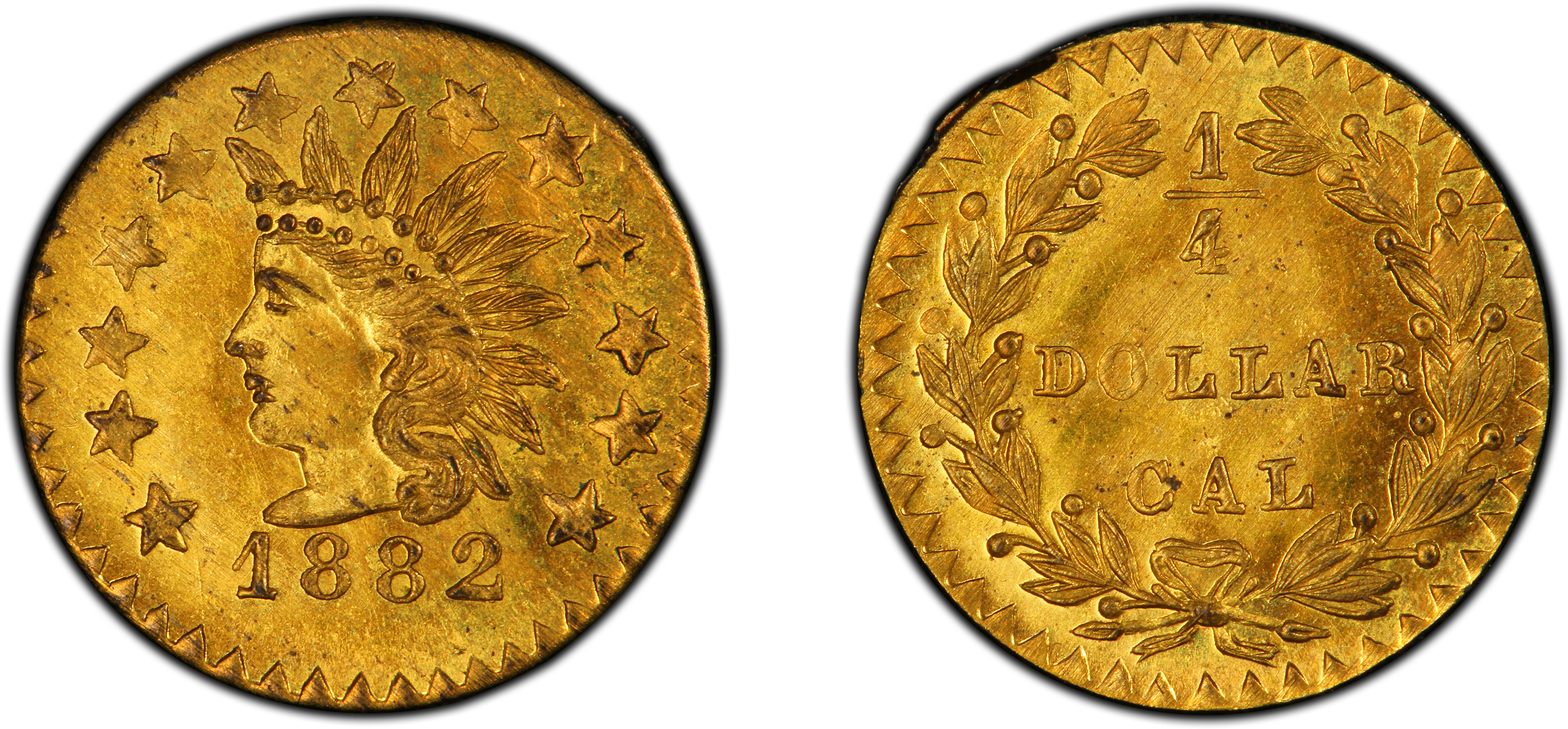
Obverse & Reverse
The 1882 BG-892 25 Cents represents the twilight of the California Fractional Gold era, a fascinating thirty-year period of private coinage born from necessity and entrepreneurial spirit. By 1882, the original impetus for these tiny coins—a severe shortage of small-denomination currency during the initial Gold Rush boom—had long since passed. The San Francisco Mint, established in 1854, was producing ample quantities of federal silver and gold coinage, satisfying the region's commercial needs. Consequently, the fractional gold pieces of this 'Period Two' (1859-1882) transitioned from being quasi-circulating currency to serving primarily as souvenirs, keepsakes for tourists, and jewelry items. The Coinage Act of 1864 had already made private coinage illegal, but the law was not strictly enforced against these small, popular tokens until 1883. Thus, the 1882 issues were among the very last to be produced before a U.S. Secret Service crackdown shuttered the remaining private mints. These later-period pieces were often lighter in weight than their stated face value would imply and were manufactured by various, often anonymous, jewelers in San Francisco. The production method for most fractionals was crude, often employing a sledgehammer to strike the top die onto a planchet resting on the bottom die, leading to inconsistent strike quality. Despite their diminished role in commerce, these final issues are numismatically significant. They capture the end of a uniquely Western American phenomenon and are a tangible link to the enduring legacy of the Gold Rush, which had transformed California into an economic powerhouse. The BG-892, with its distinctive 'Statue of Liberty' style bust, is a very rare and highly sought-after variety from this final year of sanctioned production, embodying the last gasp of a celebrated and controversial chapter in U.S. monetary history.
Associated EventPost-Gold Rush California Economy
Reason For MintingPrimarily struck for use as souvenirs and jewelry items for a growing tourist trade, rather than to alleviate a coin shortage as the earlier issues had been.
Minter HistoryThe specific minter for BG-892 is unknown, which is typical for 'Period Two' California Fractional Gold. Production during this era was decentralized among various San Francisco-based jewelers and private minters who often did not apply any identifying mint marks. Notable producers of the era included firms like Deriberpe & Nouizillet (D.N.) and Frontier & Deviercy (F.D.), though many others operated anonymously, creating a wide variety of designs to appeal to the souvenir market.
Historical SignificanceThis coin represents the final year of the controversial but tolerated production of California Fractional Gold before the federal government crackdown in 1883. It marks the transition of these pieces from essential circulating currency to novelty items and souvenirs, reflecting California's own transition from a raw frontier to a more established and touristed state.
N/A
DenominationG25C (25 Cents)
Minting Period1882
Assayer/MinterUnknown, likely various San Francisco jewelers or private minters.
Geographic OriginSan Francisco, California
Obverse DescriptionFeatures a bust of Liberty facing right, with hair tied in the back. Her appearance is often described as reminiscent of the Statue of Liberty. Thirteen stars encircle the bust.
Obverse Inscription Reverse DescriptionThe denomination '1/4' is enclosed within a wreath of leaves. The inscription 'CALIFORNIA GOLD' appears above the wreath, and the date '1882' is below it.
Reverse InscriptionCALIFORNIA GOLD 1/4 1882
CompositionGold
Stated Fineness Actual FinenessVaries by piece, but Period Two issues are often of a lower fineness and lighter weight than their face value would suggest.
EdgePlain
Unknown
Survival EstimateVery few; likely less than 15-20 known examples.
Rarity ScaleR-7 (High R.7) indicating 4 to 12 known specimens.
The BG-892 is highly coveted for its extreme rarity as a final-year issue, its attractive and distinct 'Statue of Liberty' design, and its status as one of the last legally-tolerated private gold coins in American history. It appeals to specialists in territorial gold and collectors seeking key date rarities.
Key VarietiesThe primary variety is the regular business strike. A Proof-Like (PL) or Deep Mirror Proof-Like (DMPL) designation is a key variation in surface quality and is highly prized, commanding a significant premium. No known restrikes or special collector issues were made.
Authentication TipsAuthentic examples should exhibit die characteristics consistent with known specimens. Pay close attention to the style of the bust, the shape of the numerals in the date, and the details of the wreath. Counterfeits are common in this series; many are gold-plated base metal tokens or modern replicas. Genuine pieces, even if crudely struck, will have the soft luster and correct weight (albeit often light for the denomination) of real gold. Authentication by a major grading service like PCGS or NGC is highly recommended.
Shopping ConsiderationsFor a premium quality BG-892, look for a sharp strike, particularly on Liberty's hair details and the numerals of the date. Central weakness is common, but examples with strong central details are preferred. Original, uncleaned surfaces with some remaining luster are paramount. The fields should be free of distracting marks, although small planchet flaws or adjustment marks from the crude manufacturing process are sometimes acceptable. Avoid examples that have been holed or used as jewelry, as this severely impacts value. A specimen with a Proof-Like (PL) designation is exceptionally rare and desirable. Given the coin's rarity, any example, even in lower grades, is significant, but buyers should prioritize eye appeal and surface originality.
A coin's grade is its condition, rated on a 1-70 scale. For rare coins, this is the most critical factor in determining value, as a tiny difference in preservation can mean a huge difference in price.
Relevant Grade TypesOriginal period issues were business strikes, technically intended for circulation but by 1882 were mostly sold as novelties. They are found in Circulated (1-58) and, more commonly for this late date, Mint State (MS, 60-70) grades. No true Proofs were struck during the original period. However, some business strikes were produced with highly polished dies and planchets, resulting in a Proof-Like (PL) or Deep Mirror Proof-Like (DMPL) appearance, which are noted by grading services and are considered distinct for their superior quality.
Mint State CharacteristicsUncirculated examples of BG-892 often exhibit a soft, satiny luster. The strike is a key differentiator; many pieces show weakness on the peripheral lettering or stars and on the highest points of the design due to the hammer-striking process. High-end examples will have sharp central details and reflective fields, sometimes earning a PL designation. Small, inherent planchet flaws are not uncommon. Contact marks can be present, but given their use as souvenirs rather than currency, high-grade examples can be found with remarkably clean surfaces.
Circulated Wear PatternsOn circulated examples, wear will first appear on the highest points of Liberty's cheek, hair, and the knot of the bow on the reverse. The leaves in the wreath and the fraction '1/4' are also susceptible to early friction. In lower grades (VF and below), the stars and peripheral legends will start to become indistinct.
Key Factors For ValueThe primary value driver for an 1882 BG-892 is its extreme rarity (R-7). Beyond that, grade is critical, with a significant jump in value for each point in Mint State. The quality of the strike is paramount; a well-struck piece with full details will command a substantial premium over a weakly struck one of the same grade. Surface preservation, meaning original luster and a lack of cleaning, hairlines, or damage, is crucial. The presence of a Proof-Like (PL) or Deep Mirror Proof-Like (DMPL) designation elevates the coin to the highest tier of desirability and value. A CAC sticker for this issue confirms premium quality for the grade and adds a strong premium.
PCGS Price Guide
| Grade | Price | Population |
|---|---|---|
| 53 | $550.00 | 1 |
| 53+ | $600.00 | N/A |
| 55 | $750.00 | N/A |
| 55+ | $785.00 | N/A |
| 58 | $850.00 | N/A |
| 58+ | $925.00 | N/A |
| 60 | $1,000.00 | 1 |
| 61 | $1,750.00 | 1 |
| 62 | $1,900.00 | 1 |
| 62+ | $1,975.00 | N/A |
| 63 | $2,100.00 | N/A |
| 63+ | $2,165.00 | N/A |
| 64 | $2,250.00 | 3 |
| 64+ | $3,500.00 | N/A |
| 65 | $6,750.00 | 1 |
| 65+ | $9,000.00 | N/A |
| 66 | $12,500.00 | 2 |