1869 G25C BG-826 (Regular Strike)
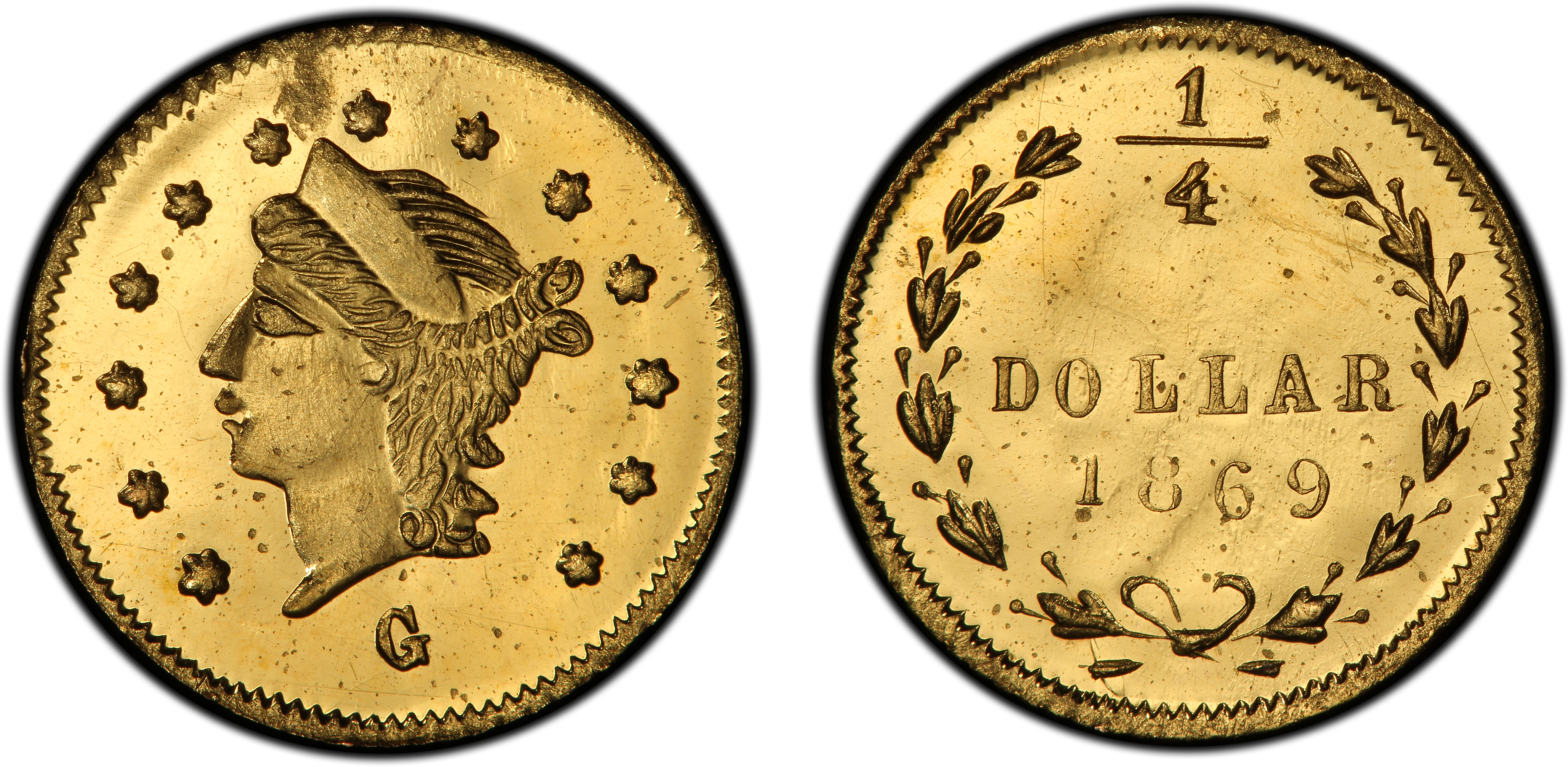
Obverse & Reverse
The 1869 BG-826 25 Cent piece emerges from the second great era of California fractional gold, a period numismatically defined as 'Period Two' (1858-1882). By the late 1860s, the initial, desperate need for small denomination coinage that characterized the Gold Rush's peak had subsided. The San Francisco Mint, established in 1854, was in full operation, supplying the region with official federal silver and gold coins. The socio-economic landscape of California, and San Francisco in particular, had matured from a chaotic frontier into a burgeoning center of Pacific commerce. The completion of the First Transcontinental Railroad in May 1869 further cemented this, opening the floodgates to tourism and business from the East. It was in this environment that the purpose of fractional gold fundamentally shifted. No longer essential for commerce, these miniature gold pieces became highly popular as souvenirs, keepsakes, and jewelry items. Enterprising local jewelers, like Robert B. Gray & Co., astutely met this demand. The Coinage Act of April 22, 1864, had technically outlawed private coinage, yet federal enforcement was lax to non-existent on the West Coast until a Secret Service crackdown in 1883. This legal gray area allowed jewelers to continue striking denominated pieces without fear of reprisal. The BG-826 was not intended to make change at a saloon, but rather to be purchased by a tourist on Montgomery Street as a memento of their California adventure, or by a local resident to be set into a piece of jewelry. These 'suppressed jewelers' issues,' as termed by Breen and Gillio, were typically underweight and often made of lower fineness gold than their Period One predecessors, as their value was in their novelty, not their intrinsic content. Struck by hand or with rudimentary presses, their quality could vary, yet they represent a fascinating and legitimate chapter in America's private coinage history, reflecting a prosperous and increasingly connected post-Civil War California.
Associated EventPost-Gold Rush California Economic Growth & Tourism
Reason For MintingPrimarily struck to be sold as jewelry, keepsakes, and souvenirs of the California Gold Rush era to a growing tourist market.
Minter HistoryRobert B. Gray & Co. was a prominent San Francisco jewelry firm and a prolific producer of 'Period Two' California fractional gold. Around 1859-60, Gray purchased the business of another established jeweler and fractional gold maker, Antoine Louis Nouizillet, acquiring his dies and equipment. Gray continued to produce pieces using some of Nouizillet's old dies before creating new ones of his own, some of which bore his initial 'G'. The firm's issues are generally considered to be of higher weight and quality compared to many other souvenir pieces of the era. Gray operated until 1871, when he sold his interests to the California Jewelry Co., which was run by the Levison Brothers.
Historical SignificanceThe BG-826 is an exemplar of the 'Period Two' or 'Jeweler's Issue' of California fractional gold, representing the transition of these pieces from utilitarian currency of necessity to commercial souvenirs. It signifies a maturing Californian economy, the rise of tourism following the Transcontinental Railroad, and a period of lax federal oversight on private minting, making it a tangible artifact of a unique period in American numismatic and economic history.
N/A
Denomination25 Cents
Minting Period1869
Assayer/MinterRobert B. Gray & Co.
Geographic OriginSan Francisco, California
Obverse DescriptionA crudely rendered Liberty Head facing left, her hair tied in a bun. The portrait is notable for its 'archaic bulging eye,' a key diagnostic for this variety that gives it an almost ancient Greek appearance. The head is surrounded by 13 five-pointed stars, with the date '1869' below.
Obverse Inscription1869
Reverse DescriptionThe denomination '1/4' is centered within a wreath composed of two branches tied with a bow at the bottom. The legend 'CALIFORNIA GOLD' encircles the wreath along the upper periphery. The 'C' in CALIFORNIA is sometimes noted as being low relative to the 'AL'.
Reverse InscriptionCALIFORNIA GOLD 1/4
CompositionGold
Stated Fineness Actual FinenessVariable, often lower than federal standards, typical for Period Two issues.
EdgePlain
Unknown
Survival EstimateApproximately 75-125 known
Rarity ScaleR-4 / R-5
The primary appeal of BG-826 is its highly distinctive and somewhat primitive obverse design, specifically the 'archaic bulging eye' of Liberty, which sets it apart from more conventional portraits. As a dated 'Period Two' issue from a known maker, it is a historically significant and sought-after representative of the souvenir era of fractional gold.
Key VarietiesNo major varieties are noted for the BG-826 regular strike. As a 'Period Two' jeweler's issue, it was created as a commercial product and no special collector restrikes, patterns, or proofs from a later period are known to exist.
Authentication TipsGenuine examples must have the denomination '1/4' on the reverse; souvenir tokens made after the 1883 crackdown lack a denomination. The strike is often weak at the periphery but sharper in the center. The 'bulging eye' is a key diagnostic. Replicas are common but often have a soapy, cast-like appearance and incorrect details. Weight and fineness can vary, but genuine pieces are solid gold, not plated base metal.
Shopping ConsiderationsA premium quality example for its grade will show a sharp central strike, particularly on Liberty's hair details and the numerals on the reverse. Many surviving examples are Mint State, often with prooflike or semi-prooflike fields, which command a premium. Luster should be bright and frosty. Avoid examples that have been obviously cleaned, polished, or removed from jewelry, indicated by scratches, rim damage, or solder remnants. A weakly struck periphery is common and should be expected, but an unusually weak center is a drawback. Eye appeal is paramount, with attractive original golden or slightly rose-gold toning being highly desirable.
A coin's grade is its condition, rated on a 1-70 scale. For rare coins, this is the most critical factor in determining value, as a tiny difference in preservation can mean a huge difference in price.
Relevant Grade TypesAll original examples of BG-826 are considered business strikes. As they were primarily sold as souvenirs and not intended for heavy circulation, they are most commonly found in Mint State (MS, 60-70) grades. Circulated examples (1-58) exist but are less common. No proofs were struck during the original minting period, and there are no known later-date proof restrikes.
Mint State CharacteristicsUncirculated examples of BG-826 are characterized by a sharp strike on the central devices, though the peripheral stars and legends may show some softness. Luster is typically bright and satiny, and many specimens exhibit semi-prooflike or fully prooflike fields from polished dies, a common trait for these jeweler's issues. Small planchet flaws or a slightly bubbly surface can be seen and are characteristic of the private manufacturing process. Contact marks, even on high-grade examples, are common due to their small size and handling over the years.
Circulated Wear PatternsWear first appears on the highest points of the design. On the obverse, friction will flatten the hair above Liberty's eye and ear, and the cheekbone. On the reverse, the highest leaves and berries of the wreath and the ribbon bow will show wear first. In lower grades (VF and below), the date and finer details of the wreath will begin to merge with the fields.
Key Factors For ValueThe most significant value drivers for this variety are grade, surface quality, and eye appeal. A high Mint State grade (MS-63 or better) with clean, mark-free surfaces carries a substantial premium. The degree of prooflike reflectivity in the fields is a major factor; coins with deep, watery mirrors are highly prized. Strike quality is also key; a coin with unusually sharp peripheral details is rare and desirable. Finally, attractive, original toning and a CAC sticker, signifying premium quality for the grade, will add a significant premium.
PCGS Price Guide
| Grade | Price | Population |
|---|---|---|
| 50 | $210.00 | 2 |
| 50+ | $215.00 | N/A |
| 53 | $220.00 | 3 |
| 53+ | $225.00 | N/A |
| 55 | $230.00 | 11 |
| 55+ | $240.00 | N/A |
| 58 | $250.00 | 15 |
| 58+ | $260.00 | N/A |
| 60 | $270.00 | 3 |
| 61 | $280.00 | 12 |
| 62 | $300.00 | 20 |
| 62+ | $325.00 | N/A |
| 63 | $400.00 | 13 |
| 63+ | $450.00 | N/A |
| 64 | $700.00 | 4 |
| 64+ | $850.00 | N/A |
| 65 | $1,150.00 | N/A |
| 65+ | $1,500.00 | 1 |