1880 G25C BG-799J, PL (Regular Strike)
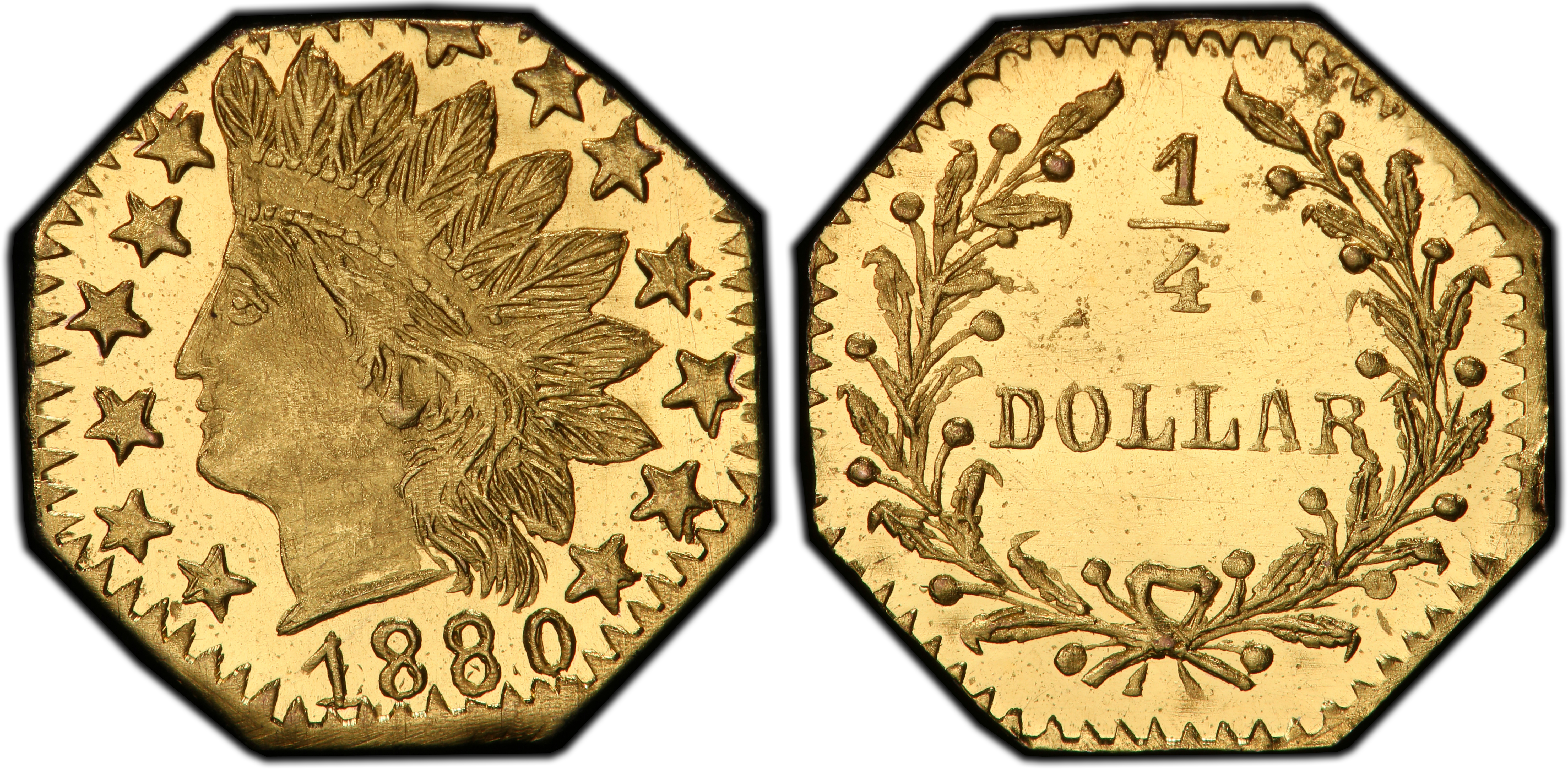
Obverse & Reverse
The 1880 G25C BG-799J is a quintessential example of a 'Period Two' California Fractional Gold piece. These small denomination tokens emerged decades after the initial Gold Rush, not out of a desperate need for circulating small change as their 'Period One' (1852-1857) predecessors had, but as commercial keepsakes and souvenirs. By 1880, the San Francisco Mint was producing ample federal coinage, rendering private issues for commerce obsolete. Instead, local jewelers, many of French origin, capitalized on the romantic allure of the Gold Rush by manufacturing these miniature gold pieces for tourists and residents alike. The socio-economic climate of San Francisco in this era was one of established prosperity and growing tourism. The wild, chaotic days of the '49ers had given way to a more cosmopolitan city that was keen to market its unique history. These small gold pieces, often featuring popular motifs like the Indian Head, were tangible, affordable mementos of California's golden identity. The Coinage Act of 1864 had made private coinage illegal, but the law was not strictly enforced against these small, low-value tokens until the Secret Service finally cracked down in 1883. This legal gray area allowed for a prolific output of hundreds of varieties throughout the 1870s and early 1880s. The manufacturing process was rudimentary, often employing a sledgehammer to strike a planchet between two hand-cut dies. This 'hammered' method accounts for the frequent off-center strikes, die cracks, and overall crude appearance of many specimens. The gold used was often of a lower fineness than Period One issues, making them profitable to produce and sell as novelties. Today, the BG-799J and its contemporaries are not valued for their intrinsic gold content but for their historical resonance, rarity, and connection to the enduring legacy of the California Gold Rush.
Associated EventCalifornia Gold Rush (Legacy & Tourism Period)
Reason For MintingPrimarily struck as a souvenir or curio for the tourist and jewelry trade, not for general circulation.
Minter HistoryThe specific minter of BG-799J is unknown, which is typical for many 'Period Two' issues. They were produced by various jewelers in San Francisco who often did not sign their work. Prominent Period Two manufacturers included firms like Deriberpe & Nouizillet (D.N.) and Frontier & Deviercy (F.D.), but a direct link to this specific variety has not been established. These craftsmen were skilled metallurgists and engravers who adapted their trade to meet a commercial demand for Gold Rush memorabilia.
Historical SignificanceThe coin is significant not as a medium of exchange, but as a historical artifact representing the commercialization of the Gold Rush legacy. It marks a transition from utilitarian private coinage to souvenir tokens, reflecting the evolving economy and identity of California in the late 19th century. Its existence demonstrates a legal loophole that allowed private minting to continue for two decades after being outlawed.
BG-799J
Denomination25 Cents
Minting Period1880
Assayer/MinterUnknown Private Jeweler
Geographic OriginSan Francisco, California
Obverse DescriptionFeatures a stylized Indian Head facing left. The portrait is somewhat crude, typical of jeweler's issues. The head is adorned with a feathered headdress. The date '1880' is below the bust. Thirteen stars, often weakly struck or irregularly spaced, encircle the central motif.
Obverse Inscription1880
Reverse DescriptionA wreath, composed of two branches, surrounds the denomination. The wreath is open at the top. The denomination '1/4' is in the center, and the word 'DOLLAR' is below it. A small decorative element may be present at the base of the wreath.
Reverse Inscription1/4 DOLLAR
CompositionGold
Stated Fineness Actual FinenessVariable, but generally lower than federal coinage, often ranging from 14 to 22 karats.
EdgePlain
Unknown
Survival Estimate126-500 (per R-3 rating)
Rarity ScaleR-3
Sought after as an affordable and representative example of the popular 'Indian Head' octagonal type from the 'Period Two' era of California Fractional Gold. Its defined Breen-Gillio number allows for precise cataloging, and its status as a dated souvenir from the post-Gold Rush era holds strong historical appeal.
Key VarietiesNo major varieties, patterns, or restrikes are widely documented for the BG-799J die pair itself. The primary variation within the broader series is the distinction between 'Period One' (circulating), 'Period Two' (souvenir), and 'Period Three' (back-dated) issues. No special collector strikings, such as proofs from the era of issue, are known to exist.
Authentication TipsGenuine pieces are denominated '1/4 DOLLAR'. Replicas or tokens from later periods often say 'CALIFORNIA GOLD' or feature a bear on the reverse; genuine BG-799J pieces do not. The strike should appear somewhat crude, consistent with hammered coinage techniques of the era, and may show planchet striations or die rust. Be wary of pieces with a modern, machine-struck appearance, incorrect weight/size, or a soapy, cast-like texture. Authentication by a major third-party grading service (PCGS or NGC) is highly recommended.
Shopping ConsiderationsA premium quality example for this issue is defined by a sharp strike, especially on the high points of the Indian's cheek and headdress, as well as the numerals in the date and the details of the wreath. Many examples are weakly struck in the center or on the peripheral stars. Look for original, undisturbed surfaces with attractive luster; a 'prooflike' (PL) designation indicates reflective fields and commands a significant premium. Avoid examples that have been harshly cleaned, polished, or mounted in jewelry, as this is common for these souvenir pieces and drastically reduces value. Pay attention to die cracks and clash marks, which are common and can add to the character of the coin without necessarily detracting from the grade.
A coin's grade is its condition, rated on a 1-70 scale. For rare coins, this is the most critical factor in determining value, as a tiny difference in preservation can mean a huge difference in price.
Relevant Grade TypesOriginal issues were business strikes produced for commercial sale as souvenirs. They are found in both Circulated (1-58) and, more commonly, Mint State (MS, 60-70) grades due to their nature as keepsakes. No proofs were struck during the original period of issue. The 'PL' (Prooflike) and 'DMPL' (Deep Mirror Prooflike) designations are applied to business strikes with exceptionally reflective surfaces and are highly prized.
Mint State CharacteristicsIn uncirculated condition, the BG-799J typically exhibits a soft, satiny luster. The quality of the strike is a key determinant of grade and eye appeal; many are seen with weakness on the stars or the center of the wreath. High-grade examples (MS-64 and above) will have a much sharper strike. Due to the softness of the gold and rudimentary handling, small, scattered contact marks are common and acceptable, but large, distracting marks will limit the grade. Prooflike examples are rare and sought after, showing a distinct contrast between frosty devices and mirrored fields.
Circulated Wear PatternsAlthough most examples are uncirculated, any wear would first appear on the highest points: the Indian's cheekbone, the feathers in the headdress, and the leaves and bow of the wreath on the reverse. On lower-grade circulated examples, the date and stars would begin to lose definition.
Key Factors For ValueThe primary value drivers for a BG-799J are grade and surface quality. A sharp, well-centered strike commands a significant premium over a weakly struck example of the same grade. Original, lustrous surfaces are paramount; coins that have been cleaned or polished are heavily penalized in the market. Eye appeal is crucial, with coins having a pleasing, uniform golden color being most desirable. The presence of a Prooflike (PL) designation dramatically increases value. Certification by PCGS or NGC is standard and essential for market acceptance, with a CAC sticker adding a further premium for exceptional quality within the assigned grade.
PCGS Price Guide
| Grade | Price | Population |
|---|---|---|
| 25 | N/A | N/A |
| 64 | $650.00 | N/A |
| 64+ | $775.00 | N/A |
| 65 | $925.00 | 1 |
| 65+ | $1,175.00 | 1 |
| 66 | $2,000.00 | N/A |
| 66+ | $2,350.00 | N/A |
| 67 | $3,000.00 | 2 |