1871 G50C BG-1042 (Regular Strike)
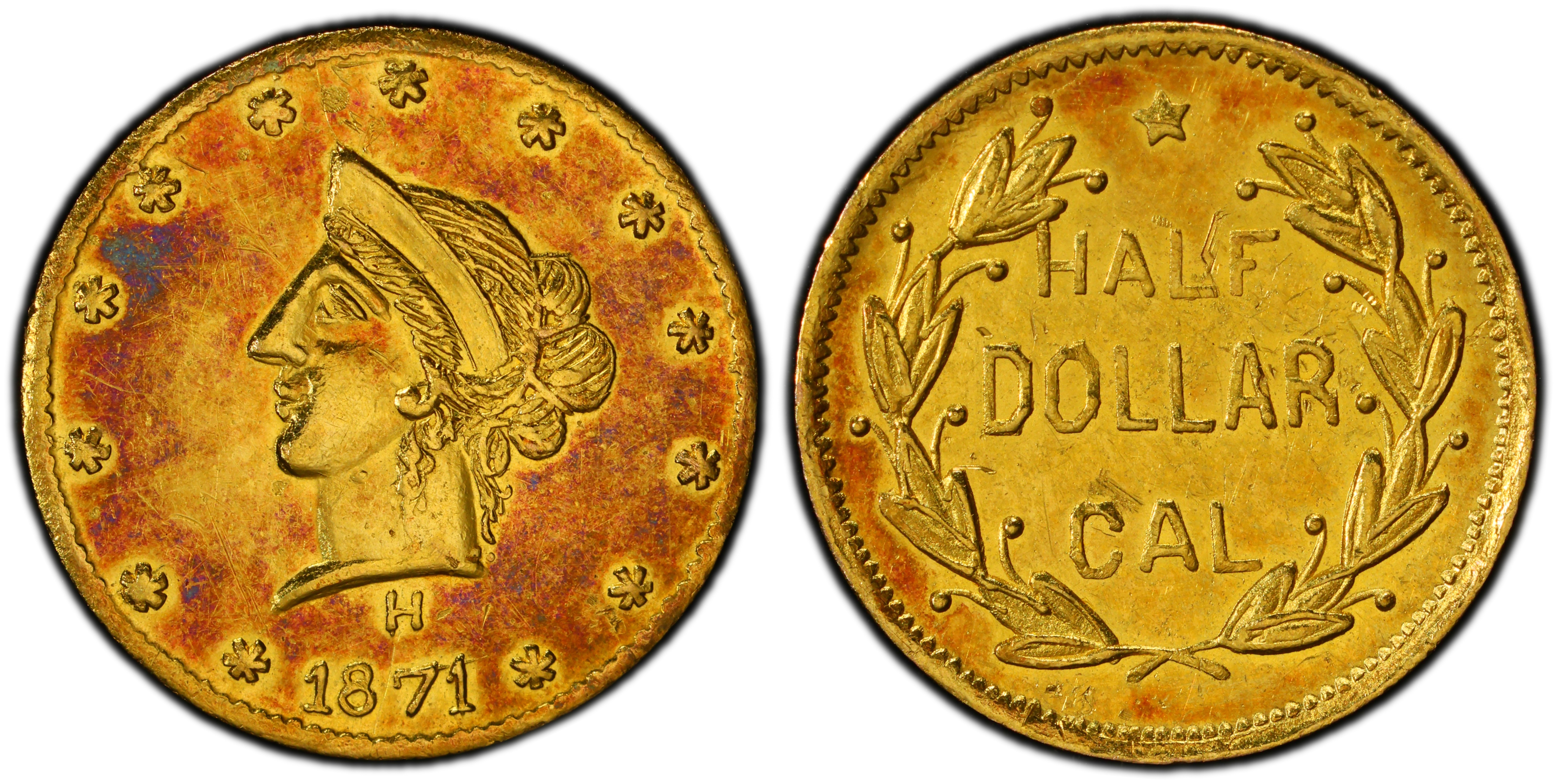
Obverse & Reverse
The 1871 G50C BG-1042 stands as one of the great rarities within the California Fractional Gold series, a fascinating relic from the post-Gold Rush era of private coinage. These diminutive gold pieces are categorized by numismatists into three periods; the BG-1042 is a prime example of a 'Period Two' (1859-1882) issue. Unlike their 'Period One' predecessors, which were struck out of commercial necessity to alleviate a shortage of small change in California, Period Two issues were primarily created as souvenirs and jewelry items. By the 1870s, the United States Mint in San Francisco was in full operation, and the commercial need for private fractional gold had vanished. Instead, jewelers capitalized on the romantic allure of the Gold Rush, producing these miniature coins for tourists and for those back East who desired a tangible piece of the Western frontier. What makes the BG-1042 and its brethren particularly intriguing is its geographic origin. While sold as 'California' gold, they were in fact struck by the firm of Reuben N. Hershfield and Noah Mitchell in Leavenworth, Kansas. These jeweler-entrepreneurs recognized the lucrative market for gold souvenirs and produced a variety of denominated tokens that mimicked the California issues. Their operation, however, attracted the unwanted attention of the U.S. Secret Service. Citing the Private Coinage Act of 1864, which made it illegal for private entities to mint coinage, federal agents raided Hershfield and Mitchell's establishment in August 1871, confiscating their dies and a significant portion of their stock. This seizure is the primary reason for the extreme rarity of all Hershfield & Mitchell ('H' mintmark) issues. The BG-1042, being a product of this short-lived and dramatically curtailed operation, thus represents not only the souvenir coinage trend but also the federal government's increasing efforts to suppress all forms of private currency. Most known examples survived because they had already been sold and disseminated before the raid, and nearly all are found in high grades, suggesting they were immediately saved as keepsakes rather than used in trade.
Associated EventPost-Civil War Economic Expansion and Federal Coinage Enforcement
Reason For MintingTo be sold as souvenirs, jewelry, and collectible keepsakes capitalizing on the legacy of the California Gold Rush.
Minter HistoryReuben N. Hershfield and Noah Mitchell were jewelers and businessmen operating in Leavenworth, Kansas. They entered the lucrative market for 'California Fractional Gold' in the early 1870s, producing 25-cent and 50-cent pieces bearing an 'H' on the reverse. Their enterprise was short-lived; in August 1871, U.S. Secret Service agents, enforcing the long-standing but often ignored 1864 anti-private-coinage law, raided their facility, seizing dies and struck pieces. This action effectively ended their production and created an instant rarity of all their issues.
Historical SignificanceThe BG-1042 is significant as an artifact of the 'Period Two' souvenir phase of fractional gold and for its unusual non-California origin. Its extreme rarity is a direct result of a well-documented U.S. Secret Service raid, making it a tangible link to the federal government's final suppression of private coinage in the American West.
N/A
Denomination50 Cents
Minting Period1871
Assayer/MinterReuben N. Hershfield and Noah Mitchell
Geographic OriginLeavenworth, Kansas
Obverse DescriptionA classic Liberty Head motif, facing left. The portrait is styled after the contemporary U.S. Mint gold coinage, with hair tied in a bun. The bust is flanked by a circle of thirteen six-pointed stars representing the original colonies.
Obverse Inscription Reverse DescriptionA wreath composed of two branches tied with a ribbon at the bottom encircles the denomination. The date '1871' is positioned below the wreath. The minter's initial 'H' for Hershfield & Mitchell is sometimes associated with this series and appears on the reverse, although its presence and placement can vary by specific die marriage.
Reverse InscriptionCALIFORNIA GOLD / 50 CENTS
CompositionGold
Stated Fineness Actual FinenessTypically underweight for the stated denomination, as was common for Period Two issues. Fineness varied but was generally of a lower purity than U.S. Mint issues.
EdgePlain
Extremely low; exact figures are unknown due to the 1871 Secret Service seizure of stock.
Survival Estimate4-6 known examples.
Rarity ScaleR-7+ (High)
This is a landmark rarity in the California Fractional Gold series. Its appeal is multi-faceted: it's a high R-7+ coin, it has a compelling backstory involving the Secret Service, and it originates from the unusual Kansas-based mint of Hershfield & Mitchell. It is a trophy coin for advanced specialists.
Key VarietiesThe primary variety is the regular strike business issue. No proof strikings or later restrikes are known to exist for this specific variety, given the circumstances of its creation and the seizure of the dies.
Authentication TipsAuthenticity is paramount for this issue. Genuine examples exhibit sharp, albeit sometimes uneven, die work characteristic of private jewelers. Look for the precise die markers and style of the lettering and stars illustrated in the Breen-Gillio reference. Counterfeits are often soapy, lack fine detail, or have incorrect lettering fonts. The surface fabric should be consistent with 19th-century gold planchets, which often show fine parallel striations from the drawing process. Any piece not certified by a top-tier grading service (PCGS or NGC) should be regarded with extreme suspicion.
Shopping ConsiderationsFor a coin of this rarity, any available example is a major acquisition. A 'premium quality' example would be one that is well-centered and sharply struck for the variety, as strikes can be inconsistent. Seek out specimens with minimal marks and original, lustrous surfaces, often with a slightly prooflike or reflective quality in the fields. Avoid examples that have been mounted for jewelry, exhibit harsh cleaning, scratches, or have been bent, as these issues dramatically impair the value. Given that most survivors were saved as souvenirs, many are found in Mint State, and the distinction between MS62, MS63, and higher grades lies in the subtlety of contact marks and the quality of the original luster.
A coin's grade is its condition, rated on a 1-70 scale. For rare coins, this is the most critical factor in determining value, as a tiny difference in preservation can mean a huge difference in price.
Relevant Grade TypesAll original examples of BG-1042 are business strikes intended to be sold as souvenirs. They are found in Circulated (1-58) grades, though this is exceptionally rare, and more commonly in Mint State (MS, 60-70) grades. No proofs were struck during the original period of issue, and due to the seizure and destruction of the dies, no legitimate restrikes exist.
Mint State CharacteristicsUncirculated examples of BG-1042 often possess a slightly prooflike or satiny luster, a hallmark of many Period Two fractionals struck by jewelers. The strike can be variable; look for sharpness in the stars and Liberty's hair details, as these are high points. Planchets were not always perfectly prepared, so minor, original imperfections or striations may be present and should not be confused with post-strike damage. Contact marks are the primary differentiator between MS grades, with the fields and Liberty's cheek being the most susceptible areas.
Circulated Wear PatternsOn the rare occasion a circulated example is encountered, wear will first appear on the highest points of the design. For the obverse, this includes Liberty's cheek, the coronet, and the hair above the ear. On the reverse, the high points of the wreath's leaves and the numerals of the denomination will show the first signs of friction and flattening.
Key Factors For ValueRarity is the dominant value factor. With only a handful of survivors, any example is valuable. After that, grade and surface quality are paramount. An example with original, uncleaned surfaces and strong luster will command a significant premium. Eye appeal is crucial; coins with a sharp strike and attractive, slightly reddish-gold toning are highly prized by specialists. Certification by PCGS or NGC is mandatory for market acceptance, and a CAC sticker would add a further premium, confirming the quality for the assigned grade.
PCGS Price Guide
| Grade | Price | Population |
|---|---|---|
| 58 | N/A | N/A |
| 60 | $2,500.00 | 1 |
| 61 | $2,750.00 | 1 |
| 62 | $3,000.00 | 2 |
| 62+ | $3,250.00 | N/A |
| 63 | $3,500.00 | 3 |
| 63+ | $4,750.00 | N/A |
| 64 | $5,750.00 | 1 |