1864 G25C BG-707 (Regular Strike)
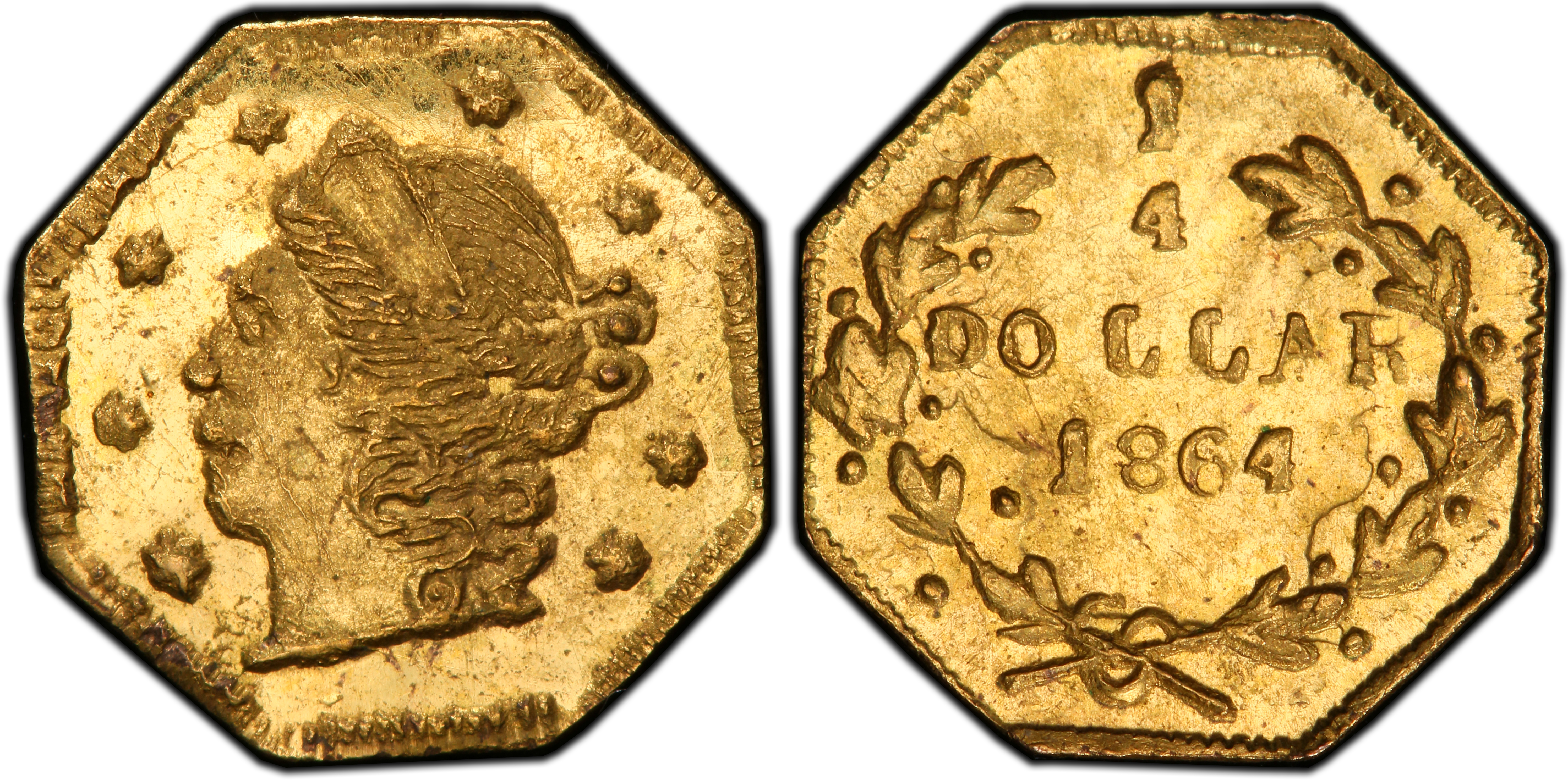
Obverse & Reverse
The 1864 G25C BG-707 is a fascinating artifact from the second phase of California's private gold coining era, known to numismatists as 'Period Two' (1858-1882). Unlike the earlier 'Period One' issues, which were struck out of genuine commercial necessity to alleviate a chronic shortage of small change during the initial Gold Rush boom, Period Two pieces were created in a vastly different socio-economic context. By 1864, the San Francisco Mint was in full operation, supplying ample federal coinage for daily transactions. The acute need for privately-minted fractional gold had evaporated. Instead, these later issues were produced primarily as souvenirs, keepsakes, and jewelry items for a populace fascinated by the romanticism of the Gold Rush and for tourists visiting the now-famous city of San Francisco. The year 1864 was a tumultuous time for the nation, deeply embroiled in the Civil War. While California was physically removed from the main conflict, its gold production was critical to the Union's financial stability. In this same year, on April 22, the U.S. Congress passed a Coinage Act that explicitly outlawed all private coinage. This legislation, however, was not rigorously enforced in distant California until the 1880s. San Francisco jewelers like Robert B. Gray & Co. continued to produce their miniature gold pieces, operating in a legally gray area. The BG-707, therefore, represents a direct defiance—or at least a confident disregard—of federal law. These pieces were no longer intended to pass as currency, but rather to be sold as novelties at a premium over their negligible intrinsic value. Their typically low weight and fineness reflect this shift in purpose from functional money to charming mementos. As an issue of extreme rarity, cataloged as High R-7, the BG-707 is a testament to the small-scale, artisanal nature of its production and its limited original distribution, securing its status as a highly coveted prize among advanced specialists of territorial coinage.
Associated EventPost-Gold Rush Era / American Civil War
Reason For MintingPrimarily minted as a souvenir or jewelry item for tourists and locals, not for general circulation, following the establishment of the San Francisco Mint.
Minter HistoryRobert B. Gray was a San Francisco-based jeweler and die sinker. Around 1859-1860, his firm, Robert B. Gray & Co., acquired the business of another prominent Period One fractional gold producer, Antoine Louis Nouizillet. This acquisition included Nouizillet's dies, hubs, and punches, which Gray's firm reportedly used to strike various pieces. Gray also created new dies, some of which bore his hallmark 'G', though the BG-707 is not marked as such. His firm was a key producer during the 'Period Two' (1858-1882) era of fractional gold, a time when the pieces were transitioning from circulating currency to souvenir items. Gray's issues are noted for their generally higher quality and weight compared to some other jewelers' issues of the period. In 1871, Robert B. Gray & Co. sold its interests to the California Jewelry Co., which was associated with the Levison Brothers.
Historical SignificanceThe BG-707 is significant as it represents the transition of fractional gold from necessary currency to souvenir coinage and was produced in the very year a federal act made such private minting illegal, highlighting the unique economic and legal environment of Civil War-era California.
K-Unlisted (Territorial Slug)
Denomination25 Cents
Minting Period1864
Assayer/MinterRobert B. Gray & Co.
Geographic OriginSan Francisco, California
Obverse DescriptionFeatures a crudely rendered, left-facing bust of Liberty. The design is a distinct 'Period Two' style, far removed from the official federal motifs. The field contains a specific arrangement of eight five-pointed stars: one positioned directly in front of Liberty's nose, another near her mouth, and the remaining six arranged around the periphery. Crucially, there are no stars below the bust. The date '1864' is below the truncation of the neck.
Obverse Inscription1864
Reverse DescriptionA simple wreath of two branches tied with a bow at the bottom encircles the denomination. The inscription 'CALIFORNIA GOLD' is at the top periphery, outside the wreath. The denomination is expressed as '1/4'. This reverse die is known to be identical to the one used for the BG-706 variety.
Reverse InscriptionCALIFORNIA GOLD 1/4
CompositionGold
Stated Fineness Actual FinenessVariable, often debased from Period One standards.
Weight0.24 grams
Diameter9.60 mm
EdgePlain
Unknown
Survival Estimate4-12 pieces known
Rarity ScaleHigh R-7
The 1864 G25C BG-707 is a premier rarity in the California Fractional Gold series, appealing to advanced collectors for its 'High R-7' rating, its connection to the Civil War-era ban on private coinage, and its distinctive obverse die with eight stars. Its status as a 'Period Two' issue tells the story of the evolution of these fascinating miniature coins.
Key VarietiesThe BG-707 is a key variety in itself. It is closely related to the BG-706, which shares an identical reverse but features a different obverse with ten stars. No later-date restrikes, patterns, or trial pieces are known or recorded for the BG-707, making any original example an ultimate prize.
Authentication TipsAuthentication requires die-specific analysis. Verify the obverse has exactly eight stars, with one near the nose and one near the mouth. The reverse die must match that of BG-706. Genuine pieces exhibit a characteristic crude strike and often have a slightly prooflike or reflective surface from the polished dies used by jewelers. Look for the correct style of numerals in the date. Counterfeits are common in the series and often have incorrect details, a soapy or cast appearance, incorrect weight, or may omit the denomination entirely, which genuine Period Two pieces like this one possess.
Shopping ConsiderationsA premium quality example for this variety would be a well-struck piece in a high Mint State grade (MS-63 or better), ideally with prooflike surfaces. Look for sharp details on the stars and Liberty's hair, which are often weak. Original, lustrous 'orange-gold' surfaces are highly desirable. As these were often kept as souvenirs, circulation wear is less common than handling marks or damage from jewelry use. Scrutinize any example for evidence of being removed from a bezel, solder marks, or harsh cleaning. A coin certified by a top-tier grading service (PCGS or NGC) is essential for a transaction involving a rarity of this magnitude.
A coin's grade is its condition, rated on a 1-70 scale. For rare coins, this is the most critical factor in determining value, as a tiny difference in preservation can mean a huge difference in price.
Relevant Grade TypesOriginal period issues were business strikes. Since they were primarily made as souvenirs and not for heavy commerce, they are most often encountered in Mint State (MS, 60-70) grades, though circulated examples (1-58) exist and are very rare. The highly polished dies used by jewelers often impart prooflike (PL) or deep mirror prooflike (DMPL) qualities to business strikes, but these are not true Proofs. No Proof (PR/PF) examples were struck during the original minting period, and no later-date Proof restrikes are known to exist.
Mint State CharacteristicsUncirculated examples of BG-707 are characterized by the manufacturing process. Strikes are typically weak in the centers, particularly on the highest points of Liberty's hair and the wreath on the reverse. The luster is often flashy and reflective rather than satiny, a byproduct of the polished dies. Due to the small size and artisanal striking process, planchet quality can be irregular, with minor striations or adjustment marks considered normal for the issue. The presence of uninterrupted, brilliant luster in the fields is a key determinant of a high grade.
Circulated Wear PatternsOn circulated examples, wear first appears on the high points of Liberty's hair, particularly the strands above the ear, and on her cheek. The star nearest the nose is another early friction point. On the reverse, the leaves and bow of the wreath will show the first signs of flattening. In lower grades (VF and below), the date and peripheral stars will begin to lose their sharpness and merge with the fields.
Key Factors For ValueFor the BG-707, value is driven by three main factors: rarity, grade, and surface quality. As a High R-7 variety, any example is valuable. A higher Mint State grade dramatically increases the value. The most significant premium is placed on coins with pristine, original surfaces that have not been cleaned, polished, or previously mounted in jewelry. Exceptional eye appeal, characterized by a sharp strike for the issue and deep, prooflike fields, will command a record price. A CAC sticker on a certified coin would provide an additional layer of confidence and would be highly sought after for such a major rarity.
PCGS Price Guide
| Grade | Price | Population |
|---|---|---|
| 63 | $3,000.00 | 1 |
| 63+ | $3,750.00 | N/A |
| 64 | $8,000.00 | 4 |
| 67 | N/A | N/A |