1853 G$1 BG-519, PL (Regular Strike)
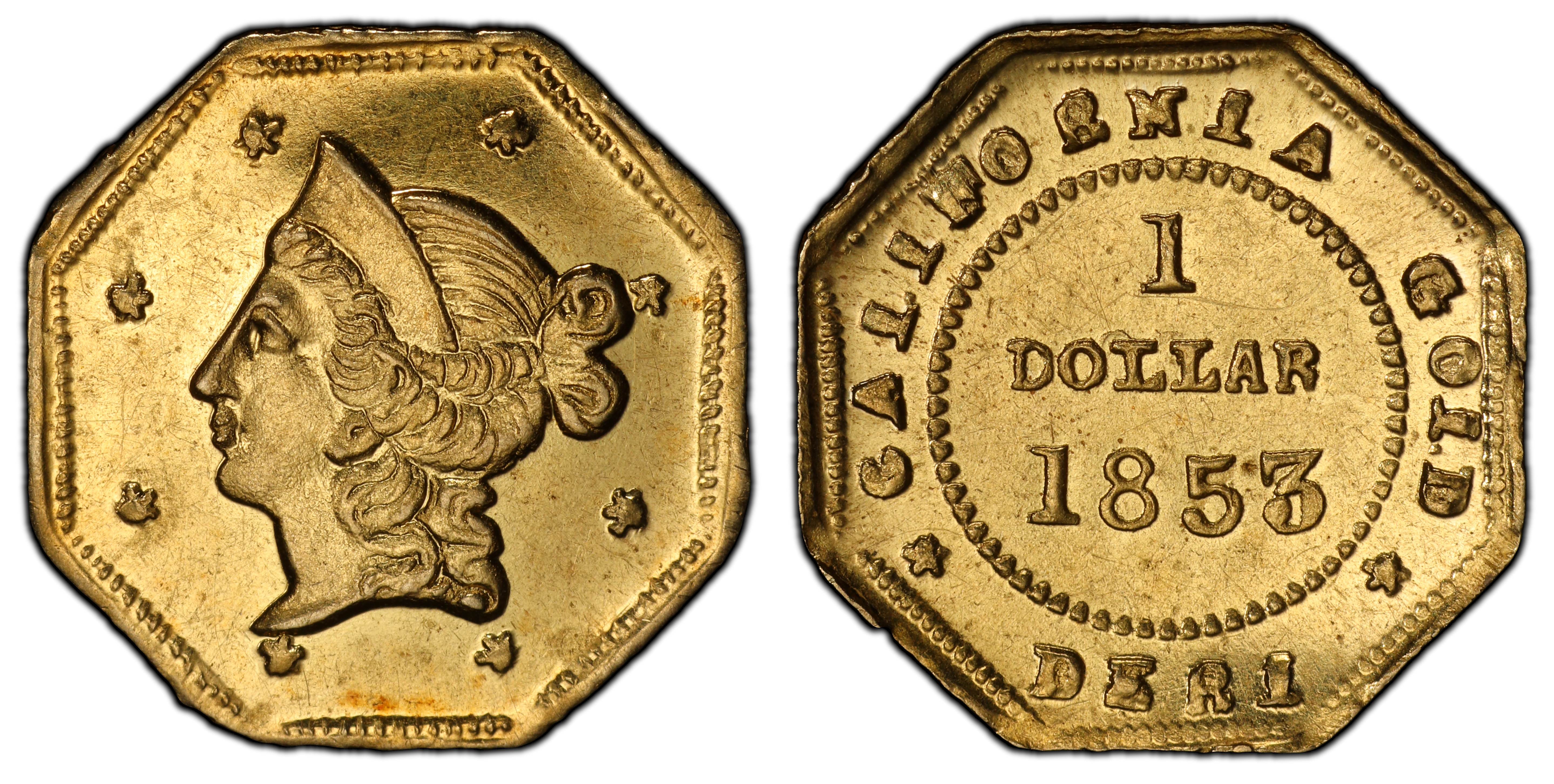
Obverse & Reverse
The 1853 Octagonal Gold Dollar, cataloged as Breen-Gillio 519, stands as a tangible relic from the chaotic zenith of the California Gold Rush. Following the initial discoveries of 1848, a massive influx of prospectors and merchants flooded into California, creating a vibrant but monetarily starved economy. Gold dust and nuggets, while plentiful, were impractical for small, daily transactions. A 'pinch' of gold for a drink or a small item was a highly inexact and contentious system. Federal coinage was scarce on the West Coast, with the San Francisco Mint not scheduled to open until 1854. This severe shortage of circulating small change created a vacuum that private minters, primarily jewelers and metallurgists in San Francisco, rushed to fill. M. Deriberpe, a French jeweler whose initials 'DERI' often appear on the reverse of his issues, was one of the most prominent of these private coiners. Operating in the bustling commercial heart of the city, he produced a variety of octagonal and round fractional gold pieces. The BG-519 is a 'Period One' issue (1852-1857), a designation for the earliest fractionals that were genuinely intended to and did circulate as currency. These pieces were struck by hand, using a hammer to impress the design from steel dies onto small, hand-cut gold planchets. This crude but effective method resulted in coins of varying strike quality and irregular shapes. Public reception was initially positive due to sheer necessity, but the coins were not without controversy. Their intrinsic gold value was often significantly less than their face value, a fact not lost on the public or contemporary assayers. However, in an economy desperate for a medium of exchange, they were accepted. As federal coinage from the newly established San Francisco Mint began to saturate the region in the mid-1850s, the necessity for these private issues waned, and they gradually disappeared from circulation, transitioning from economic tools to curiosities, souvenirs, and jewelry items.
Associated EventCalifornia Gold Rush
Reason For MintingTo alleviate a severe shortage of small-denomination circulating coinage for daily commerce in Gold Rush-era San Francisco.
Minter HistoryM. Deriberpe was a San Francisco-based jeweler and one of the key private minters of 'Period One' California Fractional Gold. Active in the early 1850s, his name or initials are associated with a wide variety of dollar, half dollar, and quarter dollar gold pieces. His work is characteristic of the era: functional, often crudely struck by hand, yet historically vital. Like other private minters such as Antoine Louis Nouizillet and Frontier, Deviercy & Co., Deriberpe capitalized on the desperate need for a medium of exchange. His operation was likely a small-scale affair, producing coins on demand to serve local commerce before the establishment of the U.S. Branch Mint rendered his enterprise obsolete.
Historical SignificanceThe BG-519 is historically significant as a direct product of U.S. economic expansionism and the chaos of the Gold Rush. It represents a period when private citizens, out of necessity, performed a function of the sovereign government. As a 'Period One' issue, it is among the select group of fractional pieces verifiably intended for and used in commerce, making it a crucial artifact of daily life in one of the most formative periods of American history.
BG-519
Denomination$1
Minting Period1853
Assayer/MinterM. Deriberpe
Geographic OriginSan Francisco, California
Obverse DescriptionThe obverse features a small, somewhat crudely rendered Liberty Head facing left, modeled after the contemporary U.S. federal gold dollars designed by James B. Longacre. She wears a coronet, though the inscription 'LIBERTY' is often illegible or soft. A circle of thirteen six-pointed stars, representing the original colonies, surrounds the portrait. The stars are often unevenly spaced and variably impressed.
Obverse Inscription Reverse DescriptionThe reverse is dominated by a simple wreath composed of two branches tied together at the bottom with a bow. Within the wreath is the numeral '1' above the word 'DOLLAR'. Along the periphery, outside the wreath, is the inscription 'CALIFORNIA GOLD' and the minter's mark 'DERI'. Two stars typically flank the minter's mark.
Reverse Inscription1 DOLLAR CALIFORNIA GOLD DERI
CompositionGold
Stated Fineness Actual Fineness0.800-0.850 (Approximately 20K, variable)
Weight0.97 grams
Diameter12.50 mm
EdgePlain
Unknown
Survival Estimate11-30
Rarity ScaleR-5
The BG-519 is highly sought after for its direct connection to the California Gold Rush, its distinctive octagonal shape, and its status as a 'Period One' circulating issue. Its high rarity (R-5) ensures constant demand from specialists in territorial and fractional gold. Each piece, being hand-struck, is unique, adding to the collecting challenge and appeal.
Key VarietiesNo major varieties are cataloged for BG-519 from the original minting period. As a 'Period One' business strike, there are no known contemporary proof strikings or official restrikes. The primary variations among surviving examples are in strike quality, planchet shape, and die state, which are artifacts of the crude hand-minting process rather than intentional varieties. No special collector issues are known to exist.
Authentication TipsAuthentication requires careful examination. Genuine examples are struck in gold, not brass or gilt metal, and should have a specific gravity consistent with ~20K gold. The die work is characteristically crude; lettering and stars are often uneven. Look for a mushy or soft strike, which is common. Modern replicas often have sharp, perfectly formed details and fields that are too smooth or prooflike. On the reverse, the positioning of 'DERI' relative to the stars is a key diagnostic. Many pieces show file marks or adjustment marks on the planchet, which are indicative of the hand-preparation process and are actually a positive sign of authenticity.
Shopping ConsiderationsWhen acquiring a BG-519, prioritize originality of the surfaces and clarity of the central design elements. A premium quality example will exhibit minimal post-strike damage and retain some of its original, often slightly reddish-gold, luster. Many survivors have been cleaned, repaired, or used as jewelry; avoid examples with obvious tooling, solder marks, or harsh abrasions. Strike is a critical factor. Look for a piece with a relatively bold Liberty Head and a clear '1 DOLLAR' and 'DERI' on the reverse. It is common for the peripheral stars and lettering to be weak, but the central devices should be as sharp as possible for the grade. Given the rarity, even a problem-free, evenly worn circulated example is a significant acquisition.
A coin's grade is its condition, rated on a 1-70 scale. For rare coins, this is the most critical factor in determining value, as a tiny difference in preservation can mean a huge difference in price.
Relevant Grade TypesAll original BG-519 issues were business strikes intended for circulation and are found in Circulated (1-58) and Mint State (MS, 60-70) grades. Due to their utilitarian origin and crude manufacture, no Proof (PR/PF) examples were struck during the original period of issue. No later-date Proof restrikes or special collector strikings of this specific variety are known to exist; any piece described as a Proof is almost certainly a modern replica.
Mint State CharacteristicsAn uncirculated BG-519 will show original mint luster, which is typically soft and satiny rather than bright and flashy. Strike quality is a major factor; these are almost never fully struck. Weakness is common on the peripheral stars and the word 'CALIFORNIA'. The high points of Liberty's hair and the leaves of the wreath may be softly defined even on a Mint State coin. The planchets are often slightly irregular in shape and may exhibit original file marks from weight adjustment. Small, light contact marks are expected due to the softness of the gold and the crude handling at the time of minting.
Circulated Wear PatternsWear first appears on the highest points of the design. On the obverse, friction will first dull the luster and flatten the details on Liberty's coronet, the hair just above her eye, and her cheekbone. On the reverse, the highest points of the wreath's leaves and the bow will show wear first. In lower grades (VF and below), the denomination '1 DOLLAR' and the minter's mark 'DERI' will begin to weaken, and the peripheral lettering will become faint or merge with the border.
Key Factors For ValueThe primary drivers of value for a BG-519 are rarity, grade, and surface quality. An example with original, uncleaned surfaces and attractive, reddish-gold toning commands a significant premium. Sharpness of the strike is crucial; a coin with a well-defined Liberty portrait and clear legends on the reverse will be far more desirable than a weakly struck counterpart in the same grade. Eye appeal is paramount. Many specimens have been damaged from use in jewelry, so problem-free examples are especially prized. Certification by a major grading service (PCGS or NGC) is standard for this series, and a CAC sticker indicating premium quality for the grade adds a further, significant premium.
PCGS Price Guide
| Grade | Price | Population |
|---|---|---|
| 63 | $3,750.00 | 1 |