1873 G50C BG-1012 (Regular Strike)
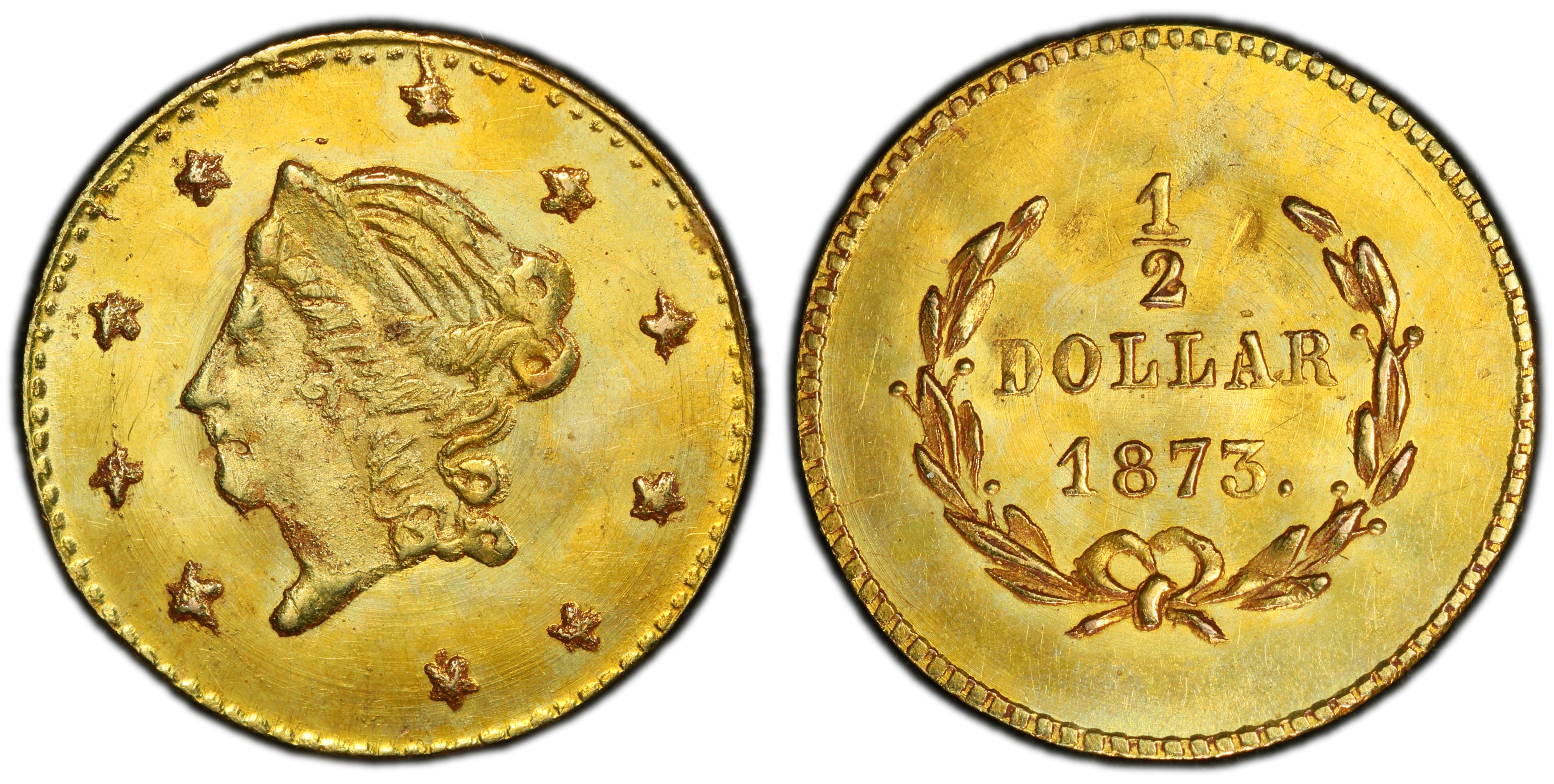
Obverse & Reverse
The 1873 BG-1012 50 Cents represents a fascinating and complex chapter in American numismatics, born from the lingering economic conditions of the California Gold Rush. By the 1870s, the initial frenzy of the Rush had subsided, but California's economy remained distinct from the rest of the nation. Federal silver coinage was scarce on the West Coast, a situation exacerbated by the Coinage Act of 1873 which would soon demonetize silver and unofficially place the U.S. on a gold standard. In this environment, small transactions remained problematic. Privately minted gold coins, often called 'tokens' or 'charms' to circumvent federal laws against private coinage, continued to fill this crucial commercial niche. Gaetano F. Blois, a San Francisco jeweler and die-sinker, was a prolific producer of these small-denomination gold pieces. Unlike the rudimentary issues of the early 1850s, Blois's work from this period was more refined, intended to resemble official U.S. coinage to inspire public confidence. The Indian Head motif, popularized by James B. Longacre's designs for the U.S. Mint, was a common choice for these private issues. These coins were not legal tender but were widely accepted in local commerce due to their intrinsic gold value and the dire need for circulating small change. However, their production was a legal gray area. The U.S. Secret Service actively pursued and prosecuted private minters, viewing their products as counterfeits, especially after federal legislation in 1864 explicitly outlawed private currency. Despite this, production continued sporadically into the early 1880s. The BG-1012 variety, specifically, is a product of this later period, showcasing the persistence of a localized, gold-based economy in California long after the Gold Rush's peak.
Associated EventPost-Gold Rush California Economy
Reason For MintingA persistent shortage of official U.S. small-denomination circulating coinage in California necessitated the private production of fractional gold pieces for daily commerce.
Minter HistoryGaetano F. Blois was an Italian immigrant and a prominent San Francisco jeweler, die-sinker, and engraver active from the 1850s into the 1870s. Operating from his shop on Commercial Street, he became one of the most significant producers of California Fractional Gold, alongside contemporaries like Robert B. Gray. Blois was known for the quality of his work and the sheer variety of his issues. His designs often mimicked federal coinage, using motifs like the Liberty Head and Indian Head to foster acceptance. He faced legal challenges from the U.S. government, which sought to suppress private coinage, but he persisted in manufacturing these popular and necessary commercial tokens.
Historical SignificanceThis coin is a tangible remnant of the unique, gold-centric economy of 19th-century California and a testament to the local solutions devised to overcome the deficiencies of the national currency system. It represents the later, more refined period of private minting, which transitioned from a necessity of the Gold Rush to a persistent commercial convenience that operated in defiance of federal law. The BG-1012 and similar pieces are crucial artifacts for understanding the prolonged economic isolation and distinct character of the American West.
N/A
Denomination50 Cents (Half Dollar)
Minting Period1873
Assayer/MinterGaetano F. Blois
Geographic OriginSan Francisco, California
Obverse DescriptionA female head facing left, often referred to as an 'Indian Princess' design. She wears a feathered headdress, and the band is inscribed with the word LIBERTY. The portrait is surrounded by 13 six-pointed stars, representing the original colonies.
Obverse InscriptionLIBERTY
Reverse DescriptionThe denomination '1/2' is centered within a wreath composed of two branches tied together by a ribbon at the bottom. The legend 'CALIFORNIA GOLD' appears above the wreath, and the date '1873' is below it.
Reverse InscriptionCALIFORNIA GOLD / 1/2 / 1873
CompositionGold
Stated Fineness Actual FinenessVaries, but typically between .500 and .800 fine.
Weight0.25 grams
Diameter10.00 mm
EdgePlain
Unknown
Survival Estimate250-400
Rarity ScaleR-4
The BG-1012 is popular due to its classic Indian Head design, affordability relative to earlier issues, and its status as a widely accepted, historically significant private gold coin. It serves as an accessible entry point into the complex and fascinating world of California Fractional Gold.
Key VarietiesThe primary classification is 'Regular Strike' as requested. The Breen-Gillio catalog identifies this specific die marriage as BG-1012. While there are no major varieties of BG-1012 itself from 1873, the broader series of 1873-dated 50 Cent pieces includes other die marriages with subtle differences in positioning of the date, stars, or legends. No known Proofs or special collector strikings were made during the period of issue.
Authentication TipsAuthentic examples have a distinctive look. The strike is often slightly soft on the high points of the feathers and the word LIBERTY on the headband. The numbers in the date '1873' have a specific style unique to Blois's dies. Counterfeits are common and may be cast, showing a porous or soapy texture, or struck with incorrect letter and number punches. Many fakes are made of brass or have thin gold plating. Weight and specific gravity tests are crucial for authentication.
Shopping ConsiderationsA premium quality example for its grade will exhibit a sharp strike for the issue, with clear details on the headdress feathers and the leaves of the reverse wreath. Seek out pieces with smooth, lustrous surfaces and minimal distracting marks. Original, undisturbed 'skin' with a slightly reddish-gold patina is highly desirable and commands a significant premium over cleaned or polished examples. Check for hidden tooling in the fields or repairs on the rim, which are common issues used to conceal damage.
A coin's grade is its condition, rated on a 1-70 scale. For rare coins, this is the most critical factor in determining value, as a tiny difference in preservation can mean a huge difference in price.
Relevant Grade TypesOriginal period issues were business strikes intended for circulation, and are found in Circulated (1-58) and Mint State (MS, 60-70) grades. No Proof (PR/PF) examples were struck during the original period of issue for this variety, and there are no known later-date Proof restrikes.
Mint State CharacteristicsUncirculated examples of BG-1012 typically exhibit a soft, satiny luster. The strike is characteristically weak on the highest points, particularly the feathers above the ear and the word LIBERTY. Small planchet flaws, such as tiny laminations or striations, are common and generally accepted for the type. Bag marks are frequent due to the softness of the gold alloy and the way these small coins were handled in bulk. A truly choice Mint State coin will have minimal marks and a strong strike for the variety.
Circulated Wear PatternsWear first appears on the high points of the design: the cheek, the feathers in the headdress, and the bow on the reverse wreath. On moderately worn examples (VF-XF), the details in the feathers will begin to merge, and the word LIBERTY on the headband will become faint. In lower grades (F and below), the headdress becomes flat, the stars will be weak, and the finer details of the wreath will be lost.
Key Factors For ValueThe primary drivers of value are grade and surface quality. An example with original, uncleaned surfaces and a minimum of distracting contact marks will always be more valuable than a harshly cleaned or damaged coin of the same grade. Strike quality is also critical; a well-struck piece with sharp details can command a premium over a typically soft-struck example. Eye appeal, enhanced by attractive original toning, is a significant factor. For this series, a sticker from CAC (Certified Acceptance Corporation) confirming the quality for the grade often results in a substantial price increase.
PCGS Price Guide
| Grade | Price | Population |
|---|---|---|
| 53 | $235.00 | 1 |
| 53+ | $240.00 | N/A |
| 55 | $250.00 | 3 |
| 55+ | $255.00 | N/A |
| 58 | $265.00 | N/A |
| 58+ | $275.00 | N/A |
| 60 | $300.00 | N/A |
| 61 | $365.00 | 7 |
| 62 | $460.00 | 6 |
| 62+ | $500.00 | N/A |
| 63 | $550.00 | 7 |
| 63+ | $600.00 | N/A |
| 64 | $650.00 | 9 |
| 64+ | $775.00 | N/A |
| 65 | $1,250.00 | 5 |
| 66 | N/A | N/A |
| 67 | N/A | N/A |