1871 G25C BG-865 (Regular Strike)
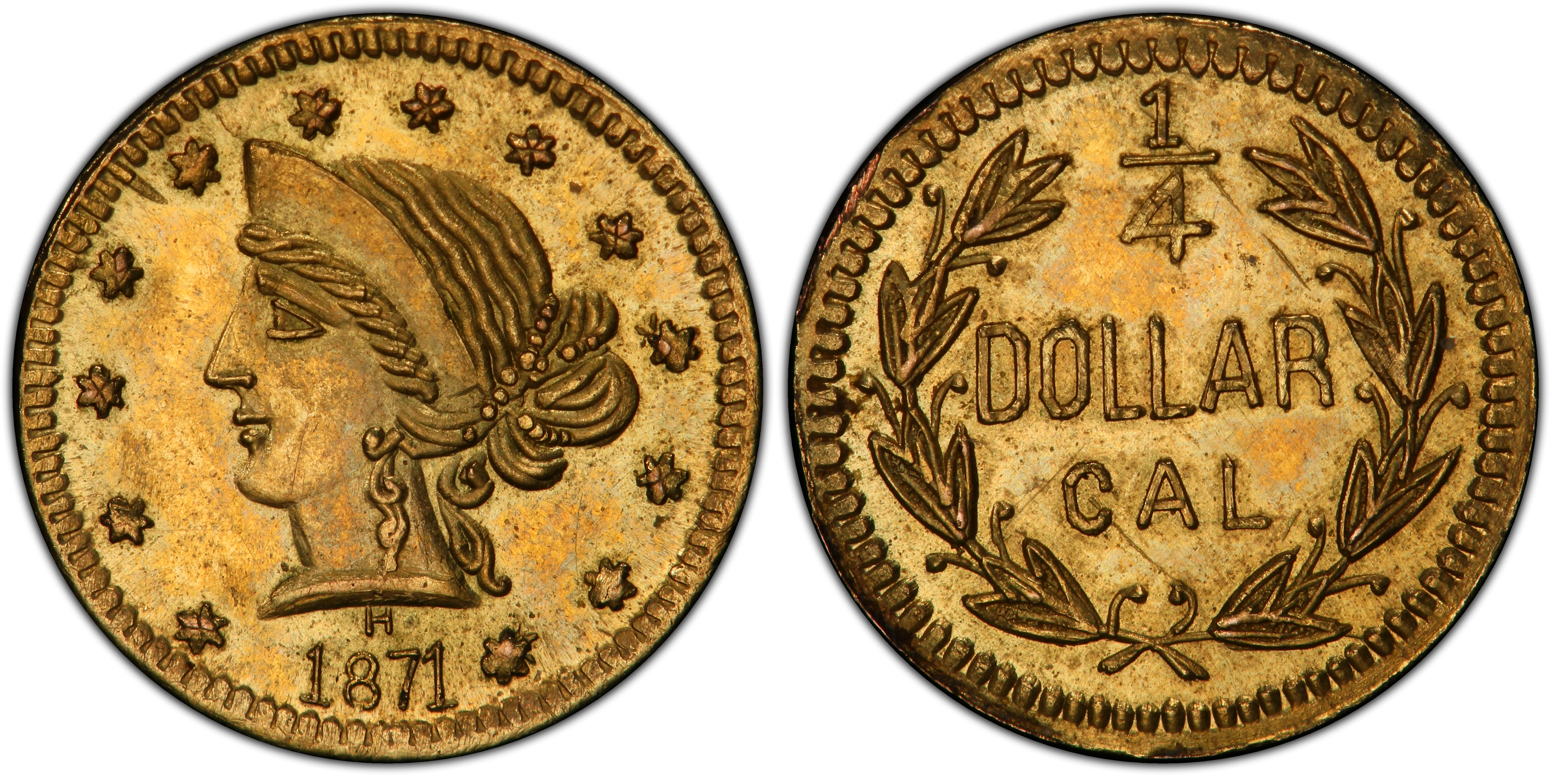
Obverse & Reverse
The 1871 Round Liberty Head 25 Cents, cataloged as Breen-Gillio 865, is a quintessential example of 'Period Two' California Fractional Gold. By the early 1870s, the initial, urgent need for small-denomination coinage that characterized the Gold Rush had largely subsided. The San Francisco Mint was producing ample federal coinage, and the economic landscape of California had matured significantly. The production of fractional gold pieces during this era shifted from filling a critical monetary void to serving a burgeoning numismatic and souvenir market. These small gold pieces were no longer primarily intended to facilitate everyday transactions in mining camps but were instead crafted by local jewelers as keepsakes, charms, and collectibles for locals and tourists alike. The Coinage Act of 1864 had officially prohibited private coinage, but enforcement was lax, particularly in the West. This legal ambiguity allowed a vibrant industry of 'jeweler's issues' to flourish. These pieces, often lighter and with more artistic variance than their 'Period One' predecessors, were skillfully made but contained gold value significantly below their stated face value. The BG-865, with its classic Liberty head motif, mimicked the design of official U.S. gold coinage, enhancing its appeal as a miniature treasure. The anonymous nature of its minter is typical of the period; many jewelers produced these pieces without specific identifying marks, focusing on craftsmanship and sales rather than creating a proprietary currency. Their continued production until the Secret Service finally cracked down in the early 1880s speaks to their enduring popularity as a memento of the great California Gold Rush.
Associated EventPost-Gold Rush Economic Maturation in California
Reason For MintingPrimarily created to be sold as souvenirs, keepsakes, and jewelry items rather than to circulate as money.
Minter HistoryThe specific minter for the BG-865 die pair is not definitively known, a common trait for 'Period Two' issues. It was produced by one of the many skilled jewelers operating in San Francisco during the 1870s. These artisans, often of French or German descent, leveraged their metallurgical and engraving skills to create a wide variety of these popular gold tokens for the robust local market. Their work was distinct from the earlier, more functional issues and focused on novelty and aesthetic appeal.
Historical SignificanceThe BG-865 represents the evolution of California Fractional Gold from a necessary circulating medium to a commercial souvenir product. It highlights a period of prosperity and nostalgia in post-Gold Rush San Francisco, where the memory of the '49ers was already being commodified. As a 'jeweler's issue,' it is an important artifact of 19th-century San Francisco commerce and the developing hobby of numismatics.
N/A
Denomination25 Cents (G25C)
Minting Period1871
Assayer/MinterUnknown San Francisco Jeweler
Geographic OriginSan Francisco, California
Obverse DescriptionA classic Liberty Head facing left, her hair tied in a bun with a trailing ribbon. Thirteen stars encircle the portrait, representing the original colonies. The date, 1871, is positioned below the bust truncation.
Obverse Inscription1871
Reverse DescriptionA simple wreath composed of two branches tied together with a bow at the bottom. The denomination '1/4' is in the center, and the word 'DOLLAR' is inscribed just below it. The inscription 'CALIFORNIA GOLD' is absent from this variety.
Reverse Inscription1/4 DOLLAR
CompositionGold
Stated Fineness Actual FinenessTypically around .500 to .750 fine for Period Two issues, though it varies.
Weight0.25 grams
Diameter9.50 mm
EdgePlain
Unknown
Survival Estimate30-50 coins are estimated to exist across all grades.
Rarity ScaleR-5 (Very Scarce)
This variety is sought after for its classic Liberty Head design, clear date, and status as a representative 'Period Two' issue. Its R-5 rarity makes it a challenging but achievable acquisition for specialists. Most known examples are in high grades, appealing to collectors who prioritize condition.
Key VarietiesNo significant die varieties of BG-865 are widely recognized. This issue consists of a single known die pairing. No original proof strikings are known, nor are any later-date restrikes, as is typical for this class of token.
Authentication TipsAuthentic examples have a sharp, wire-rim border. The stars on the obverse should be well-formed, not mushy or blob-like as seen on many contemporary counterfeits. The numerals in the date are crisply punched. The reverse lettering should be clear and properly spaced. The gold content is lower than federal issues, so weight and specific gravity tests can be deceptive; focus on die characteristics and fabric. Be wary of modern replicas which are often brassy in color and lack fine detail.
Shopping ConsiderationsA premium quality example for its grade will exhibit a sharp, complete strike, particularly on Liberty's hair details and the leaves of the wreath. Seek out coins with bright, original mint luster and minimal distracting contact marks. The surfaces should be clean and free of evidence of tooling, harsh cleaning, or removal from jewelry, the last of which is a common problem for this series. Eye appeal is paramount; coins with a smooth, pleasing appearance command significant premiums.
A coin's grade is its condition, rated on a 1-70 scale. For rare coins, this is the most critical factor in determining value, as a tiny difference in preservation can mean a huge difference in price.
Relevant Grade TypesAll original examples of BG-865 were struck as business strikes. Because they were sold primarily to collectors and for use in jewelry, they saw little to no actual circulation. Consequently, they are almost exclusively found in Mint State (MS, 60-70) grades. Circulated examples (1-58) are exceedingly rare. No Proof (PR/PF) examples were struck during the original period of issue, and no later restrikes are known.
Mint State CharacteristicsUncirculated examples of BG-865 typically display a bright, slightly flashy luster. The strike can be variable, with some examples showing minor weakness on the highest points of the hair above Liberty's eye or on the wreath's bow. The fields are small but can be susceptible to tiny planchet flaws or contact marks from handling over the years. A superior MS example will have a full strike, vibrant luster, and nearly mark-free surfaces.
Circulated Wear PatternsOn the rare occasion a circulated example is found, wear will first appear on the high points of Liberty's cheek, hair curls, and the eyebrow. On the reverse, the highest points of the leaves and the bow of the wreath will show the first signs of friction and flattening.
Key Factors For ValueFor the BG-865, value is overwhelmingly determined by grade and surface quality. A sharp strike is a major driver of value, as many fractionals are softly struck. Coins with pristine, lustrous surfaces free of marks, hairlines, or carbon spots are prized. Eye appeal is critical; a coin with a beautiful, original 'skin' will always be worth more than a dipped or cleaned counterpart in the same technical grade. A CAC sticker adds a significant premium, confirming the quality for the grade.
PCGS Price Guide
| Grade | Price | Population |
|---|---|---|
| 53 | $240.00 | 1 |
| 53+ | $240.00 | N/A |
| 55 | $250.00 | 2 |
| 55+ | $250.00 | N/A |
| 58 | $265.00 | 6 |
| 58+ | $275.00 | N/A |
| 60 | $300.00 | 2 |
| 61 | $320.00 | 3 |
| 62 | $375.00 | 16 |
| 62+ | $390.00 | N/A |
| 63 | $500.00 | 10 |
| 63+ | $550.00 | N/A |
| 64 | $750.00 | 5 |
| 64+ | $875.00 | N/A |
| 65 | $1,100.00 | 2 |
| 65+ | $1,250.00 | N/A |
| 66 | $1,750.00 | 1 |