1876 G25C BG-852 (Regular Strike)
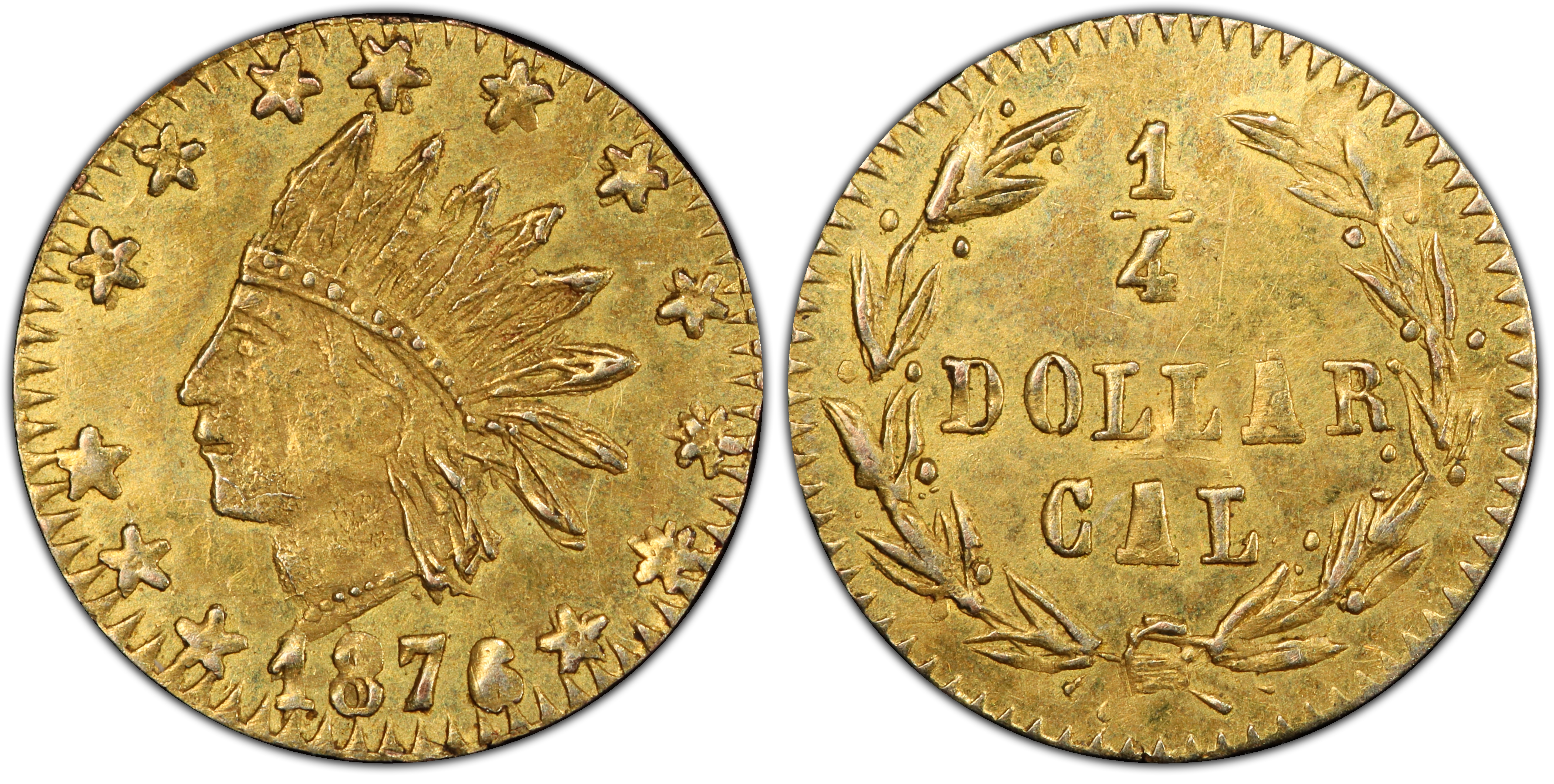
Obverse & Reverse
The 1876 BG-852 25 Cent piece emerges from the second great period of California Fractional Gold production (1859-1882), a fascinating chapter in American numismatics born from necessity and sustained by novelty. The initial California Gold Rush created an acute shortage of small-denomination coinage, prompting private jewelers and metallurgists to strike fractional-value coins from 1852 to 1857. These 'Period One' issues were generally of high purity and intended for circulation. However, by the late 1850s, the San Francisco Mint was producing enough federal silver and gold to satisfy commercial needs, rendering the private issues obsolete for daily transactions. A new market quickly emerged for these tiny gold pieces: souvenirs and keepsakes. Jewelers recognized the immense national and international fascination with the California Gold Rush and began producing new fractional gold coins, known as 'Period Two' or 'Jeweler's Issues,' to meet this demand. The BG-852 is a quintessential example of this later period. Struck in 1876, the year of the nation's Centennial, it was produced not to pay for a shave or a drink, but to be sold as a memento of the romanticized West. These Period Two pieces were often intentionally underweight and of varying fineness, as their value was in their novelty, not their intrinsic content. They were frequently mounted into jewelry, such as stickpins, watch fobs, and cufflinks. The Private Coinage Act of 1864 had officially outlawed such private issues, but the law was not strictly enforced against these small souvenir pieces until a Secret Service crackdown in 1883 finally halted their production. The BG-852, with its classic Indian Head design, represents the maturity of this souvenir market, a tiny, tangible link to the enduring legacy of the '49ers.
Associated EventCalifornia Gold Rush Aftermath & Souvenir Trade
Reason For MintingPrimarily created for sale as a souvenir or keepsake of the California Gold Rush, rather than for circulation.
Minter HistoryThe minters of 'Period Two' California Fractional Gold were typically anonymous San Francisco jewelers and artisans. Unlike the more prominent private minters of the early 1850s (e.g., Moffat & Co., Wass, Molitor & Co.), these later producers did not mark their wares with identifiable insignias. They operated small-scale workshops, using hand-operated presses or simple hammer-striking methods to produce a wide variety of designs for the tourist and jewelry trade. Their anonymity was likely a deliberate choice, especially after the Private Coinage Act of 1864 made their activities technically illegal.
Historical SignificanceThis coin is significant not as a circulating medium of exchange, but as a cultural artifact. It demonstrates the transition of fractional gold from a practical necessity to a popular souvenir, reflecting the national romanticism surrounding the Gold Rush. As a 'Jeweler's Issue,' it represents a period of numismatic creativity and entrepreneurship that existed outside the bounds of official government coinage, catering to a burgeoning tourist market in post-Gold Rush San Francisco.
N/A
Denomination25 Cents
Minting Period1876
Assayer/MinterUnknown Private Minter
Geographic OriginSan Francisco, California
Obverse DescriptionFeatures a stylized bust of an Indian princess facing left, wearing a feathered headdress. Thirteen stars encircle the portrait, representing the original colonies. The date, 1876, is positioned below the bust.
Obverse Inscription1876
Reverse DescriptionA wreath of leaves and berries, tied with a bow at the bottom, encircles the denomination. The denomination is expressed as '25 CENTS' in two lines at the center.
Reverse Inscription25 CENTS
CompositionGold
Stated Fineness Actual FinenessVaries (typically 14-22 karats for Period Two issues)
EdgePlain
Unknown
Survival Estimate31-75 (based on rarity scale)
Rarity ScaleR-5+
The BG-852 is prized for its classic Indian Head design, its connection to the Centennial year of 1876, and its status as a scarce 'Period Two' fractional. These tiny gold pieces are a popular and historically rich collecting area, offering a tangible link to the lore of the Old West. The challenge of collecting by Breen-Gillio (BG) variety adds a layer of sophisticated appeal.
Key VarietiesThe primary variety is the regular business strike. A Prooflike (PL) designation is sometimes given to specimens with highly reflective fields, a result of being struck from freshly polished dies. No special collector issues, patterns, or official restrikes are known to exist for this variety. All known examples are considered original 'Jeweler's Issues' from the period.
Authentication TipsAuthentic Period Two pieces must have a denomination (e.g., '25 CENTS' or '1/4 DOL.'). Souvenir tokens made after the 1883 crackdown often lack a denomination and may say 'CAL GOLD' instead. Look for sharp, albeit sometimes crude, striking details typical of hand-striking. Replicas are extremely common; they often have a soapy, indistinct appearance, incorrect weight, or may feature a bear on the reverse (a design element never used on genuine fractional gold). A key die diagnostic for BG-852 is that the tip of the bust points directly at the numeral '1' in the date 1876.
Shopping ConsiderationsA premium quality example for its grade will possess a sharp strike, especially on the feathers of the headdress and the details within the wreath. Luster is a key value driver; specimens with original, frosty or prooflike surfaces command significant premiums. Because these were sold as souvenirs and often kept as pocket pieces or made into jewelry, carefully check for signs of removal from jewelry, rim damage, harsh cleaning, or scratches. Look for pleasing, original reddish-gold or yellow-gold toning. A weakly struck date or peripheral lettering is common and not necessarily a major detriment if the central devices are bold.
A coin's grade is its condition, rated on a 1-70 scale. For rare coins, this is the most critical factor in determining value, as a tiny difference in preservation can mean a huge difference in price.
Relevant Grade TypesOriginal period issues were business strikes, although they were not intended for widespread circulation. They are found in Circulated (1-58) grades, though this is less common, and more frequently in Mint State (MS, 60-70) grades, as many were preserved as souvenirs. No true Proofs were struck during the original period. However, some examples struck from highly polished dies exhibit reflective surfaces and may be designated as Prooflike (PL) by grading services; these are considered a subset of business strikes and are not separate collector issues.
Mint State CharacteristicsIn uncirculated grades, the BG-852 typically exhibits a soft, satiny luster. High-grade examples can be prooflike with deeply mirrored fields and frosted devices. Strike quality varies; many show some weakness on the peripheral stars and wreath leaves. The highest points, such as the cheek of the Indian princess and the tips of the feathers, are prone to the slightest contact marks. Planchet quality can be irregular, and it is not uncommon to see minor original planchet flaws or striations from the hand-preparation process.
Circulated Wear PatternsOn circulated examples, wear first appears on the high points of the design: the cheek, the eyebrow, and the feathers in the headdress on the obverse. On the reverse, the highest points of the wreath's leaves and the numerals of the denomination will show initial friction and flattening. In lower grades (VF and below), the date and stars will begin to merge with the fields, and the individual leaves of the wreath will become indistinct.
Key Factors For ValueThe primary value drivers for this coin are grade and surface quality. An example with original, undisturbed luster will be worth multiples of a cleaned or polished piece. Sharpness of strike is critical; a well-struck coin showing full detail in the headdress is highly desirable. Eye appeal, encompassing attractive original color and a lack of distracting marks or planchet flaws, is paramount. Coins with a Prooflike (PL) designation or a CAC sticker command significant premiums as they are verified as being high-end for the grade.
PCGS Price Guide
| Grade | Price | Population |
|---|---|---|
| 58 | $250.00 | 1 |
| 58+ | $265.00 | N/A |
| 60 | $300.00 | 1 |
| 61 | $325.00 | N/A |
| 62 | $375.00 | 4 |
| 62+ | $400.00 | N/A |
| 63 | $500.00 | 7 |
| 63+ | $625.00 | N/A |
| 64 | $1,050.00 | 10 |
| 64+ | $1,300.00 | 1 |