1868 G25C BG-890 (Regular Strike)
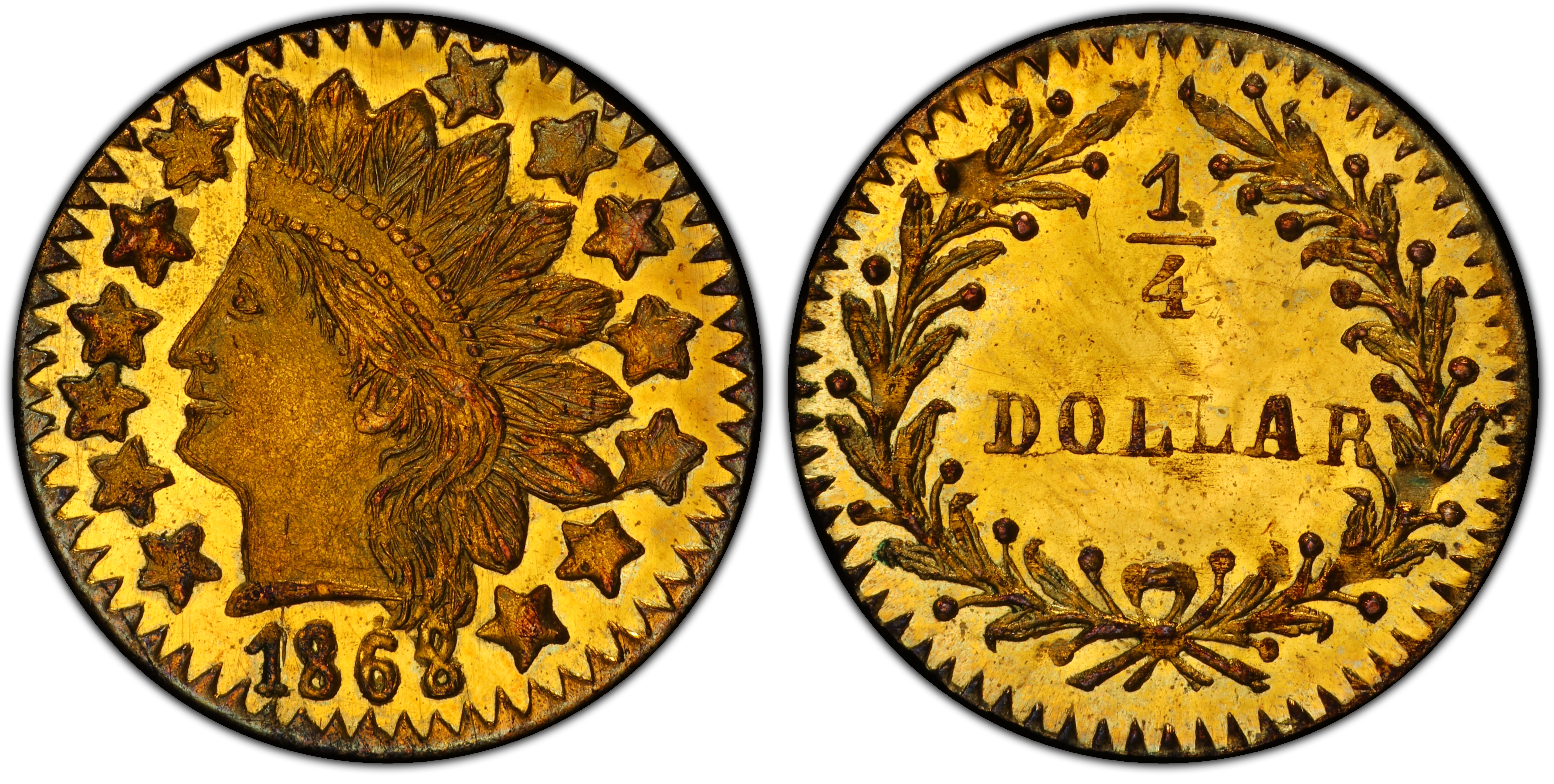
Obverse & Reverse
The 1868 BG-890 25 Cent piece is a quintessential example of 'Period Two' California Fractional Gold. The historical narrative of these pieces is distinct from their 'Period One' predecessors, which were struck from 1852-1857 to alleviate a severe shortage of small change during the initial chaos of the Gold Rush. By the late 1860s, the San Francisco Mint was in full operation, supplying the region with ample federal coinage and rendering private issues for circulation obsolete. The impetus for striking fractional gold had thus shifted dramatically. The BG-890 and its contemporaries were not created to facilitate commerce but to satisfy a burgeoning tourist and souvenir market. San Francisco had transformed from a rugged boomtown into a major American city and a destination. Visitors, eager for a keepsake of the romanticized Gold Rush, created a robust demand for these miniature gold coins. Jewelers, many of whom had produced the earlier circulating issues, adapted their business models to cater to this new clientele. These 'jeweler's issues' were often struck with lower gold content and on thinner planchets than the Period One coins, as their value was not in their metallic content but in their novelty. The Coinage Act of 1864 had made private coinage illegal, but the law was not strictly enforced against these small, low-value pieces until the Secret Service cracked down in 1883. This legal gray area allowed jewelers to produce a wide variety of designs, like the Indian Head motif seen on the BG-890, throughout the post-Civil War era. These pieces circulated primarily as keepsakes, charms, and jewelry items, preserving a tangible, albeit commercialized, link to the now-legendary California Gold Rush for a new generation.
Associated EventPost-Gold Rush California Tourism
Reason For MintingTo be sold as souvenirs and keepsakes of the California Gold Rush to tourists and locals.
Minter HistoryThe specific minter or jeweler responsible for the BG-890 variety is not definitively known, a common trait for many Period Two fractional gold issues. Production was decentralized among various San Francisco-based jewelers who often used shared or stylistically similar dies. Firms known to be active in this trade during the era included Frontier, Deviercy & Co., Robert B. Gray & Co. (who also made medals and engraved dies), and numerous smaller, often French-emigre, artisans. These craftsmen operated small-scale minting operations, using screw presses or even cruder hammer-striking methods to produce these pieces on demand. Their primary business was jewelry and watchmaking, with the fractional gold pieces serving as a popular and profitable sideline.
Historical SignificanceThe BG-890 is significant not as a coin used in commerce, but as a historical artifact representing the commercialization and mythologizing of the California Gold Rush. It marks the transition of fractional gold from a necessary medium of exchange to a nostalgic souvenir, reflecting California's own evolution from a frontier society to an established and romanticized destination. Numismatically, it is part of a complex and highly specialized collecting field with over 500 recognized varieties.
N/A
Denomination25 Cents
Minting Period1868
Assayer/MinterUnknown Private Jeweler
Geographic OriginSan Francisco, California
Obverse DescriptionA small, right-facing bust of a Native American chief. The portrait features a feathered headdress. The bust is surrounded by thirteen six-pointed stars, representing the original colonies. The date '1868' is positioned below the truncation of the neck.
Obverse Inscription1868
Reverse DescriptionThe denomination '25 CENTS' is displayed within a wreath composed of two branches tied together at the bottom with a bow. The wreath is ornate, with numerous leaves and berries.
Reverse Inscription25 CENTS
CompositionGold
Stated Fineness Actual FinenessVariable, often between .500 and .750 fine (12-18 karat), as these were unregulated jeweler's issues.
EdgePlain
Unknown
Survival Estimate31-75 (The Breen-Gillio rarity scale of R-5+ indicates 31-75 known examples. The combined PCGS and NGC population reports show a very small number graded, supporting this high rarity.)
Rarity ScaleR-5+
This coin appeals to specialists in the vast and intricate series of California Fractional Gold. Its high rarity (R-5+), attractive Indian Head design, and status as a Period Two souvenir issue make it a desirable and challenging piece for advanced collectors attempting to build variety sets.
Key VarietiesThe BG-890 is a specific die marriage and represents a single variety. No major varieties, patterns, or restrikes from the original minting period are recorded. All known examples are business strikes. Collectors should be aware that the broader California Fractional Gold series includes hundreds of die pairings (BG numbers), with subtle differences in date placement, star count, wreath design, and portrait style.
Authentication TipsGenuine Period Two fractionals like the BG-890 are typically struck on very thin planchets, often the thickness of a business card. Replicas are frequently too thick and heavy. The strike on genuine pieces can be uneven, with some softness in the details, whereas modern fakes often have a sharp, uniform, 'too perfect' appearance. The luster should be authentic and not the result of modern polishing or plating. Crucially, no genuine 19th-century California Fractional Gold pieces feature a bear on the reverse; this is a hallmark of 20th-century tokens and replicas. All Period Two pieces should have a stated denomination (e.g., 'CENTS' or 'DOLLAR'); pieces marked 'CAL GOLD' with no denomination are typically later tokens. Given the prevalence of counterfeits, third-party certification by PCGS or NGC is highly recommended.
Shopping ConsiderationsFor a premium quality BG-890, a buyer should seek an example with a sharp strike, particularly on the details of the headdress feathers and the numbers in the date. The surfaces should be clean for the grade, without distracting marks, evidence of cleaning, or previous mounting as jewelry, which is a common issue. Original, unconserved surfaces are paramount. Many fractionals have a slightly prooflike or reflective surface from being struck on polished planchets, which is desirable and should not be confused with cleaning. Eye appeal is critical; a well-centered strike on a smooth, lustrous planchet will command a significant premium. Given the R-5+ rarity, any available certified example is a major acquisition.
A coin's grade is its condition, rated on a 1-70 scale. For rare coins, this is the most critical factor in determining value, as a tiny difference in preservation can mean a huge difference in price.
Relevant Grade TypesOriginal issues of BG-890 were business strikes, although intended for sale as souvenirs rather than for circulation. They are found in both Circulated (1-58) and, more commonly for this type, Mint State (MS, 60-70) grades. No proofs were struck during the original period of issue, and there are no known later-date proof restrikes for this variety.
Mint State CharacteristicsUncirculated examples of BG-890 often exhibit a soft, satiny luster, sometimes with prooflike or reflective fields. The strike can be inconsistent; weakness is most often seen on the highest points of the Indian's cheek and headdress, and on the bow of the reverse wreath. Planchet quality varies, and small, as-made flaws or striations are not uncommon and may not detract significantly from the grade. Contact marks, though small, can be prominent due to the coin's tiny size and the softness of the low-karat gold.
Circulated Wear PatternsAlthough not intended for heavy circulation, some pieces show wear from handling. Wear first appears on the high points of the Indian's cheekbone, the feathers at the top of the headdress, and the eyebrow. On the reverse, the leaves and berries at the top of the wreath and the loops of the bow will show the first signs of friction and flattening. In lower grades (VF and below), the date and stars will begin to merge with the fields.
Key Factors For ValueFor the BG-890, value is driven primarily by rarity and grade. Surface quality is paramount; an example with clean, original, lustrous surfaces will always be prized over a cleaned or marked specimen of the same grade. Strike sharpness is a key differentiator; a coin with a full strike on the central devices commands a significant premium. Eye appeal, including attractive original gold toning (which can range from yellow to reddish-gold), also plays a major role. Given the difficulty of authentication and the nuance in grading these tiny pieces, a CAC sticker on a certified coin provides a strong endorsement of quality and often results in a higher market value.
PCGS Price Guide
| Grade | Price | Population |
|---|---|---|
| 62 | $800.00 | 2 |
| 62+ | $850.00 | N/A |
| 63 | $1,075.00 | 7 |
| 63+ | $1,200.00 | N/A |
| 64 | $1,400.00 | 9 |
| 64+ | $1,550.00 | N/A |
| 65 | $2,250.00 | 6 |
| 65+ | $2,650.00 | N/A |
| 66 | $3,250.00 | 1 |