1871 G50C BG-924 (Regular Strike)
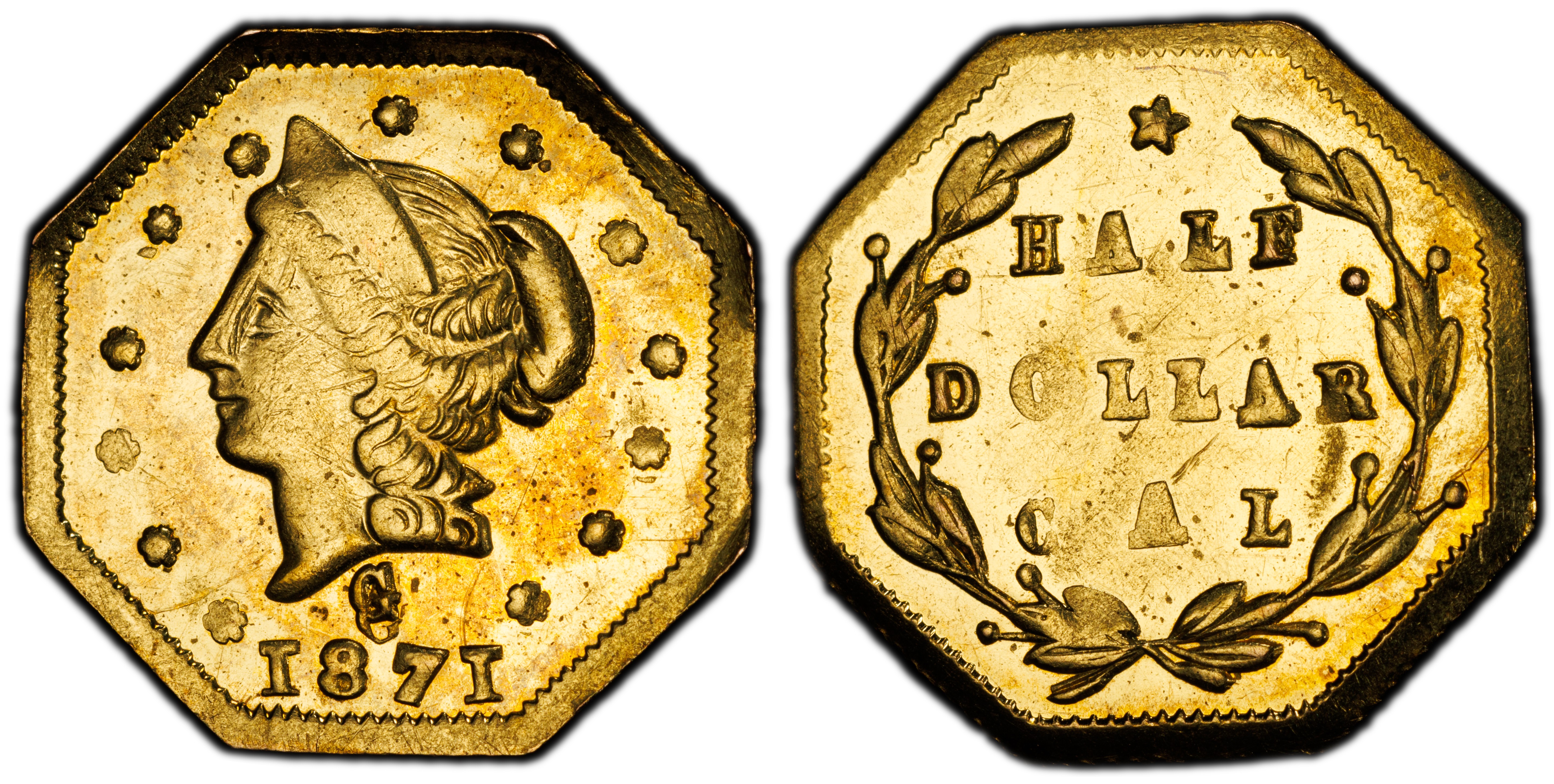
Obverse & Reverse
The 1871 Gold 50 Cents, cataloged as BG-924 (Breen-Gillio 924), is a product of the third and final period of California Fractional Gold production (1870-1882). By this era, the chaotic fervor of the initial Gold Rush had long subsided, but the economic landscape of the American West was still distinct. A persistent shortage of small-denomination federal coinage plagued California and the Pacific coast. The San Francisco Mint, established in 1854, primarily struck larger gold and silver coins, leaving a vacuum for cents, dimes, and quarters needed for daily commerce. This scarcity was a legacy issue from the Gold Rush itself, where gold dust and tiny nuggets initially served as the medium of exchange, making small transactions cumbersome and imprecise. Private jewelers and minters stepped into this void, first in the 1850s and again in the post-Civil War era. The BG-924 was not a pioneer 'slug' but a sophisticated, albeit unofficial, piece of currency intended to facilitate everyday trade. These later-period 'fractionals' were often machine-struck with professional dies, displaying a much higher quality than their cruder Period One counterparts. They were created by jewelers who saw a commercial opportunity, producing them for sale as souvenirs and, to a lesser extent, for local circulation. However, their legality was always ambiguous. The Coinage Act of 1864 had prohibited private coinage, and federal authorities, particularly Secret Service agents, became increasingly active in suppressing their manufacture and circulation in the 1870s and 1880s. This mounting legal pressure, combined with an eventual increase in the supply of federal small change, ultimately led to the demise of this fascinating and uniquely Western numismatic tradition. The BG-924, therefore, represents one of the last gasps of this private minting enterprise, a testament to the West's lingering economic independence and ingenuity in the face of federal inadequacy.
Associated EventPost-Civil War Economic Expansion in California
Reason For MintingTo alleviate a chronic shortage of official small-denomination federal coinage for daily commerce on the West Coast.
Minter HistoryWhile not definitively signed, the dies for BG-924 are widely attributed to the workshop of Robert B. Gray & Co. of San Francisco. Gray was a prominent diesinker and jeweler during this period, known for producing high-quality medals, tokens, and other fractional gold pieces. He was a key figure in the 'Period Three' (1870-1882) production of these miniature coins, creating dies for numerous issuers. His work is characterized by its professional quality and standardized designs, such as the Indian Head and Liberty Head motifs, which mimicked federal coinage to improve public acceptance. The legal crackdown by the Secret Service in the late 1870s and early 1880s effectively ended the operations of Gray and other fractional gold producers.
Historical SignificanceThe BG-924 is significant as a high-quality example from the final phase of private coinage in the United States. It embodies the persistent need for circulating small change in post-Gold Rush California and represents the craftsmanship of San Francisco jewelers who filled this economic niche before federal intervention permanently halted the practice.
N/A
Denomination50 Cents (Half Dollar)
Minting Period1871
Assayer/MinterAttributed to Robert B. Gray & Co. based on die similarities, though not definitively proven.
Geographic OriginSan Francisco, California
Obverse DescriptionA well-defined portrait of a Native American princess facing left, wearing a feathered headdress. Thirteen stars encircle the portrait along the rim.
Obverse InscriptionNo textual inscription, only the 13 stars.
Reverse DescriptionThe denomination '1/2' is located in the center, surrounded by an ornate wreath of leaves and berries tied with a bow at the bottom. The date '1871' is positioned directly below the bow. The word 'DOLLAR' is inscribed above the wreath along the upper rim.
Reverse Inscription1/2 DOLLAR 1871
CompositionGold
Stated Fineness Actual FinenessTypically ranges from .350 to .500 fine (9 to 12 karats), significantly below the .900 fineness of federal gold coins.
Weight0.25 grams
Diameter9.80 mm
EdgePlain
Unknown, but likely several thousand.
Survival Estimate500-750
Rarity ScaleR-4
The BG-924 is popular among collectors for its attractive Indian Head design, clear date and denomination, and its status as a relatively common and accessible entry point into the complex series of California Fractional Gold. Its well-executed design makes it a visually appealing representative of the 'Period Three' issues.
Key VarietiesThe BG-924 is a specific die marriage. While no major varieties are noted for the regular business strike, collectors should be aware of special strikings. A very small number of Proof examples of BG-924 were struck with mirror-like fields and sharp, frosted devices. These are exceptionally rare (R-8) and represent special presentation or collector pieces made at the time of minting. They are distinct from the regular business strikes and command a significant premium.
Authentication TipsAuthentic examples have a sharp, well-defined strike, especially in the details of the headdress feathers and the wreath leaves. The numbers in the date '1871' should be evenly spaced and properly aligned. Counterfeits, often made of brass or low-karat gold, will exhibit soft or mushy details, casting bubbles or seams, and incorrect weight. Genuine pieces often have a slightly brassy or reddish-gold hue due to their lower gold content, which can differ from the color of modern gold. Comparing the specific die characteristics (e.g., star placement, wreath details) to high-resolution images of certified examples is the best authentication method.
Shopping ConsiderationsA premium quality example for its grade will exhibit a sharp, full strike, particularly on the highest points like the Indian's cheek, the details of the feathers, and the bow on the reverse wreath. Look for clean, lustrous surfaces free of distracting marks, scratches, or evidence of harsh cleaning or polishing, which is common on these pieces. Coins that retain their original 'skin' and have not been dipped or brightened are highly desirable. Pay close attention for evidence of jewelry mounting, as many of these small pieces were used in adornments; look for solder marks, tooling, or smoothing on the rims and fields. A coin with superior eye appeal and a CAC sticker will always command a strong premium.
A coin's grade is its condition, rated on a 1-70 scale. For rare coins, this is the most critical factor in determining value, as a tiny difference in preservation can mean a huge difference in price.
Relevant Grade TypesOriginal BG-924 issues were business strikes intended for circulation or sale as souvenirs, and they are found in Circulated grades (AG-3 to AU-58) and Mint State grades (MS-60 to MS-70). A very small number of true Proof (PR/PF) examples were struck at the time of minting for collectors, featuring mirrored surfaces and frosted designs; these are extremely rare and are considered a separate category from the regular issues. There are no known later-date restrikes of this variety.
Mint State CharacteristicsAn uncirculated BG-924 will display full, unbroken mint luster, often with a slightly satiny texture. The strike can be variable, but high-end examples will show sharp detail on the feathers and the central strands of hair. The fields are susceptible to tiny planchet flaws or contact marks due to the softness of the low-karat gold alloy. A truly choice specimen is rare, as most were handled or kept with other coins, even if they did not circulate extensively.
Circulated Wear PatternsThe first signs of wear appear on the highest points of the design. On the obverse, friction will first dull the luster on the cheek, the eyebrow, and the tips of the feathers in the headdress. On the reverse, wear is first evident on the high points of the wreath's leaves and the knot of the bow. In lower grades (VF and below), the individual feathers will begin to merge, and the fine details of the wreath become indistinct.
Key Factors For ValueThe primary value drivers for BG-924 are grade and surface quality. An uncirculated piece is worth many times more than a circulated one. Beyond the numerical grade, 'eye appeal' is critical. Examples with a sharp strike, clean surfaces free of distracting marks or damage, and original, uncleaned 'skin' are most desirable. The presence of a CAC sticker, indicating premium quality for the grade, adds a significant premium, as it confirms the coin's quality in the eyes of discerning collectors.
PCGS Price Guide
| Grade | Price | Population |
|---|---|---|
| 45 | $190.00 | 2 |
| 45+ | $205.00 | N/A |
| 50 | $215.00 | 4 |
| 50+ | $225.00 | N/A |
| 53 | $245.00 | 8 |
| 53+ | $255.00 | N/A |
| 55 | $275.00 | 24 |
| 55+ | $300.00 | N/A |
| 58 | $315.00 | 50 |
| 58+ | $330.00 | N/A |
| 60 | $350.00 | 4 |
| 61 | $385.00 | 28 |
| 62 | $430.00 | 82 |
| 62+ | $475.00 | 1 |
| 63 | $525.00 | 42 |
| 63+ | $575.00 | N/A |
| 64 | $700.00 | 21 |
| 64+ | $850.00 | N/A |
| 65 | $1,250.00 | N/A |