1859 G50C BG-1002 (Regular Strike)
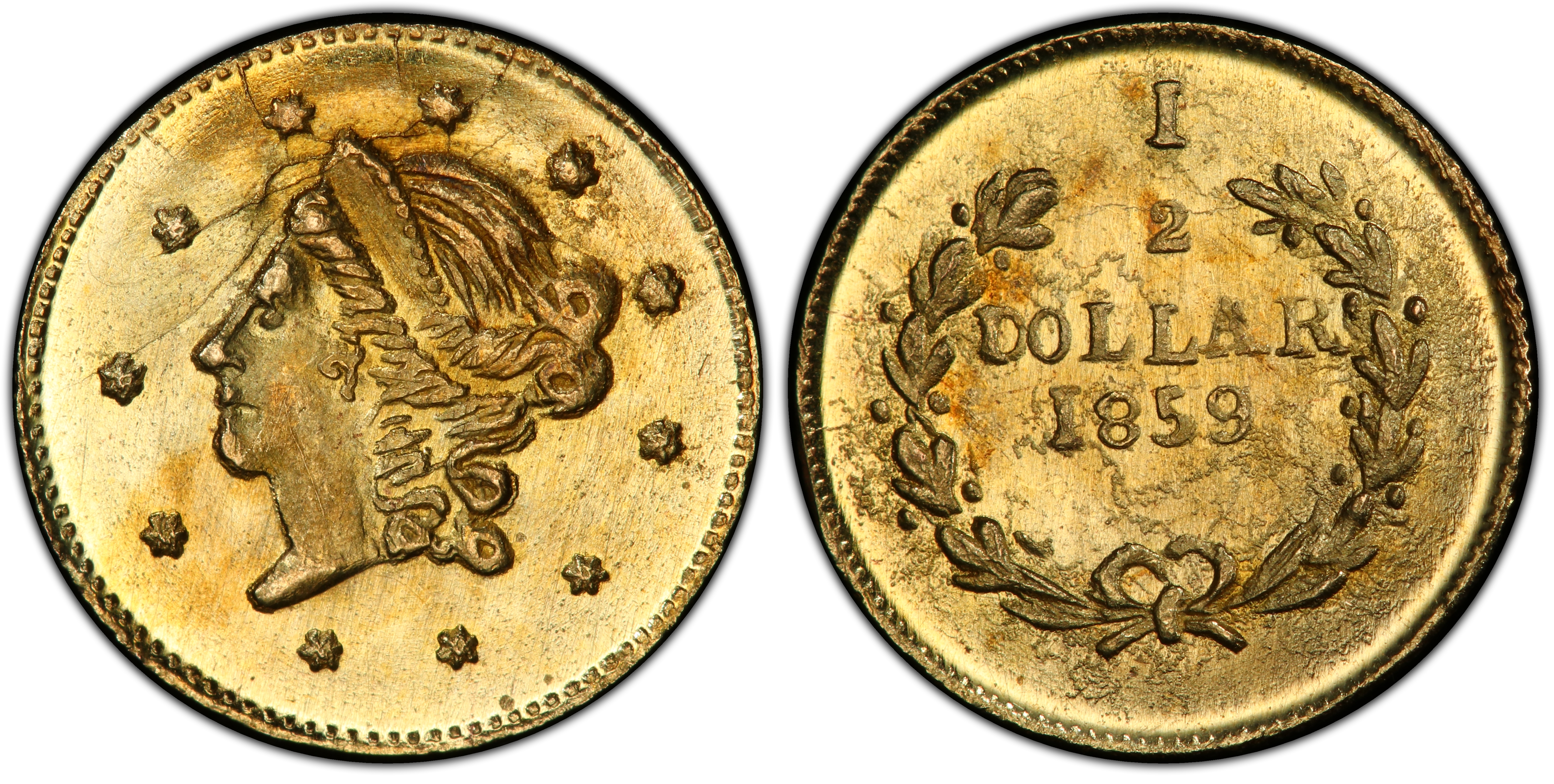
Obverse & Reverse
The 1859 BG-1002 50 Cents gold piece emerges from the chaotic and economically vibrant decade following the initial California Gold Rush. While the federal government established the San Francisco Mint in 1854 to convert the region's vast mineral wealth into official coinage, its production was initially focused on larger denominations like eagles and double eagles. This created a severe and persistent shortage of small change necessary for everyday transactions. A simple purchase of a newspaper or a drink could become a complicated barter affair. Into this numismatic vacuum stepped numerous private jewelers and metallurgists, particularly in San Francisco. These artisans, leveraging their skills in working with precious metals, began striking small-denomination gold coins—in quarter dollar, half dollar, and dollar sizes—to facilitate local commerce. Antoine Louis Nouizillet, a French immigrant and established jeweler at 138 Montgomery Street, was one of the most prolific and skilled of these private minters. His pieces, including the BG-1002, were not intended as official government money but as a practical, privately issued solution to a public need. They circulated freely, accepted at their intrinsic value, and served as a crucial lubricant for the region's booming economy. This period of unregulated private minting flourished until the Act of June 8, 1864, which prohibited the private issuance of coinage, effectively ending the era for these fascinating and historically significant pieces. The BG-1002 is a direct artifact of this unique chapter of American monetary history, representing a time when private enterprise directly addressed the failures of federal infrastructure.
Associated EventPost-California Gold Rush Economic Expansion
Reason For MintingTo alleviate a severe and persistent shortage of small-denomination federal coinage for daily commercial transactions in California.
Minter HistoryAntoine Louis Nouizillet was a French-born jeweler and watchmaker who operated a successful business in San Francisco during the 1850s. Located in the heart of the city's commercial district, he was well-positioned to observe the chronic lack of small change and had the metallurgical skills to address it. From approximately 1853 to 1859, he produced a significant quantity and variety of fractional gold pieces, distinguished by their relatively high quality of design and execution compared to some of his competitors. His work is characterized by several distinct styles of Liberty and Indian heads. After the Civil War and the federal prohibition on private coinage, Nouizillet's numismatic activities ceased, and he continued his primary trade as a respected local jeweler.
Historical SignificanceThe BG-1002 and its contemporaries are tangible relics of the unique economic conditions of mid-19th century California. They represent a period of de facto private coinage that was tolerated and even welcomed by the public. As a whole, California Fractional Gold pieces are a testament to the ingenuity and adaptability of frontier economies and serve as a critical field of study within the broader category of U.S. Pioneer and Territorial Gold.
N/A
Denomination50 Cents
Minting Period1859
Assayer/MinterAntoine Louis Nouizillet
Geographic OriginSan Francisco, California
Obverse DescriptionA small, finely detailed Indian Princess head facing left. The portrait features sharp facial contours and well-defined feathers in the headdress. The head is encircled by thirteen six-pointed stars, which are typically well-formed on this variety. The date '1859' is positioned below the bust truncation.
Obverse Inscription1859
Reverse DescriptionThe denomination '50 CENTS' is displayed in two lines at the center. This is surrounded by a wreath composed of two olive branches, tied together at the bottom with a simple bow. The legend 'CALIFORNIA GOLD' appears between the wreath and the upper rim. A small letter 'N' for Nouizillet is sometimes faintly visible below the bow, a key diagnostic.
Reverse InscriptionCALIFORNIA GOLD 50 CENTS
CompositionGold
Stated FinenessUnstated on the coin.
Actual FinenessApproximately .800 to .875 fine, though variations exist.
Weight0.26 grams
Diameter10.50 mm
EdgePlain
Unknown
Survival Estimate300-500
Rarity ScaleR-5 (Breen-Gillio Scale)
This issue is highly popular due to its classic 'Indian Head' design, direct connection to the post-Gold Rush era, and its status as a product of a known, prolific private minter. It offers a relatively accessible entry point into the world of California Fractional Gold while still being a genuine 19th-century gold piece.
Key VarietiesThe primary issue is the business strike (Regular Strike) intended for circulation. No original proof strikings are known or believed to exist for this variety. The BG-1002 is a specific die marriage within the broader series of Nouizillet's 1859 50 Cent pieces. Collectors of the series focus on collecting by BG number, as each represents a unique die pairing with subtle but important differences. No later-date restrikes of this specific variety were produced.
Authentication TipsAuthentication is paramount. Genuine BG-1002 examples exhibit sharp, high-relief details, especially in the feathers and facial features. The 'N' for Nouizillet below the wreath bow is a key diagnostic, though it can be weak. Look for die polish lines and a natural, slightly worn gold patina. Counterfeits are common and often have a 'soapy' or cast appearance with poor detail, incorrect weight, and often incorrect lettering style. Many fakes are made of brass or gold-plated base metals. Third-party certification from PCGS or NGC is strongly recommended for any potential purchase.
Shopping ConsiderationsA premium quality example for its grade will possess a sharp strike, especially on the highest points of the Indian's cheek and headdress, and on the leaves of the reverse wreath. Seek out specimens with smooth, lustrous surfaces that have not been harshly cleaned or polished; an original, unmolested 'skin' is very desirable and commands a significant premium. Avoid coins with scratches, rim bumps, or any evidence of having been mounted in jewelry. Because dies were often used until they failed, examples with minor, interesting die cracks can be desirable to specialists.
A coin's grade is its condition, rated on a 1-70 scale. For rare coins, this is the most critical factor in determining value, as a tiny difference in preservation can mean a huge difference in price.
Relevant Grade TypesOriginal period issues like the BG-1002 were business strikes, intended for circulation, and are found in Circulated (1-58) and Mint State (MS, 60-70) grades. No Proof (PR/PF) examples were struck during the original period of issue, nor are any later-date Proof restrikes known to exist. Any piece described as a 'Proof' would be highly suspect and require expert examination.
Mint State CharacteristicsAn uncirculated (MS) BG-1002 is defined by the absence of wear and the presence of original mint luster. The luster on these pieces is often satiny or semi-prooflike, a result of the polished dies used by jewelers. A high-quality Mint State example will exhibit a sharp strike with full details on the feathers and stars. Due to the small size and handling, even uncirculated specimens may show tiny planchet flaws or contact marks, but these should not be overly distracting.
Circulated Wear PatternsWear first appears on the highest points of the design. On the obverse, look for flattening on the Indian's cheek, the bridge of the nose, and the tips of the feathers. On the reverse, the high points of the leaves in the wreath and the bow's knot will show the first signs of friction and metal loss. In lower grades (below VF), the finer details of the feathers will merge and the stars will become faint.
Key Factors For ValueThe primary drivers of value are grade and surface quality. An example with original, uncleaned surfaces will always be worth significantly more than a cleaned or polished coin of the same grade. Strike sharpness is also critical; a fully struck piece is much more desirable than one with a weak center. Eye appeal, encompassing attractive natural toning and mark-free fields, plays a major role. For this specific issue, the presence of a CAC sticker, indicating premium quality for the assigned grade, adds a substantial premium.
PCGS Price Guide
| Grade | Price | Population |
|---|---|---|
| 50 | $260.00 | 2 |
| 50+ | $265.00 | N/A |
| 53 | $270.00 | 1 |
| 53+ | $275.00 | N/A |
| 55 | $280.00 | 1 |
| 55+ | $285.00 | N/A |
| 58 | $300.00 | 6 |
| 58+ | $315.00 | N/A |
| 60 | $330.00 | N/A |
| 61 | $350.00 | 2 |
| 62 | $375.00 | 11 |
| 62+ | $400.00 | N/A |
| 63 | $475.00 | 19 |
| 63+ | $550.00 | N/A |
| 64 | $725.00 | 13 |
| 64+ | $825.00 | N/A |
| 65 | $1,000.00 | 6 |
| 65+ | $1,200.00 | N/A |
| 66 | $1,450.00 | 8 |
| 66+ | $1,650.00 | N/A |
| 67 | $2,000.00 | N/A |