1876 25C BG-799C, PL (Regular Strike)
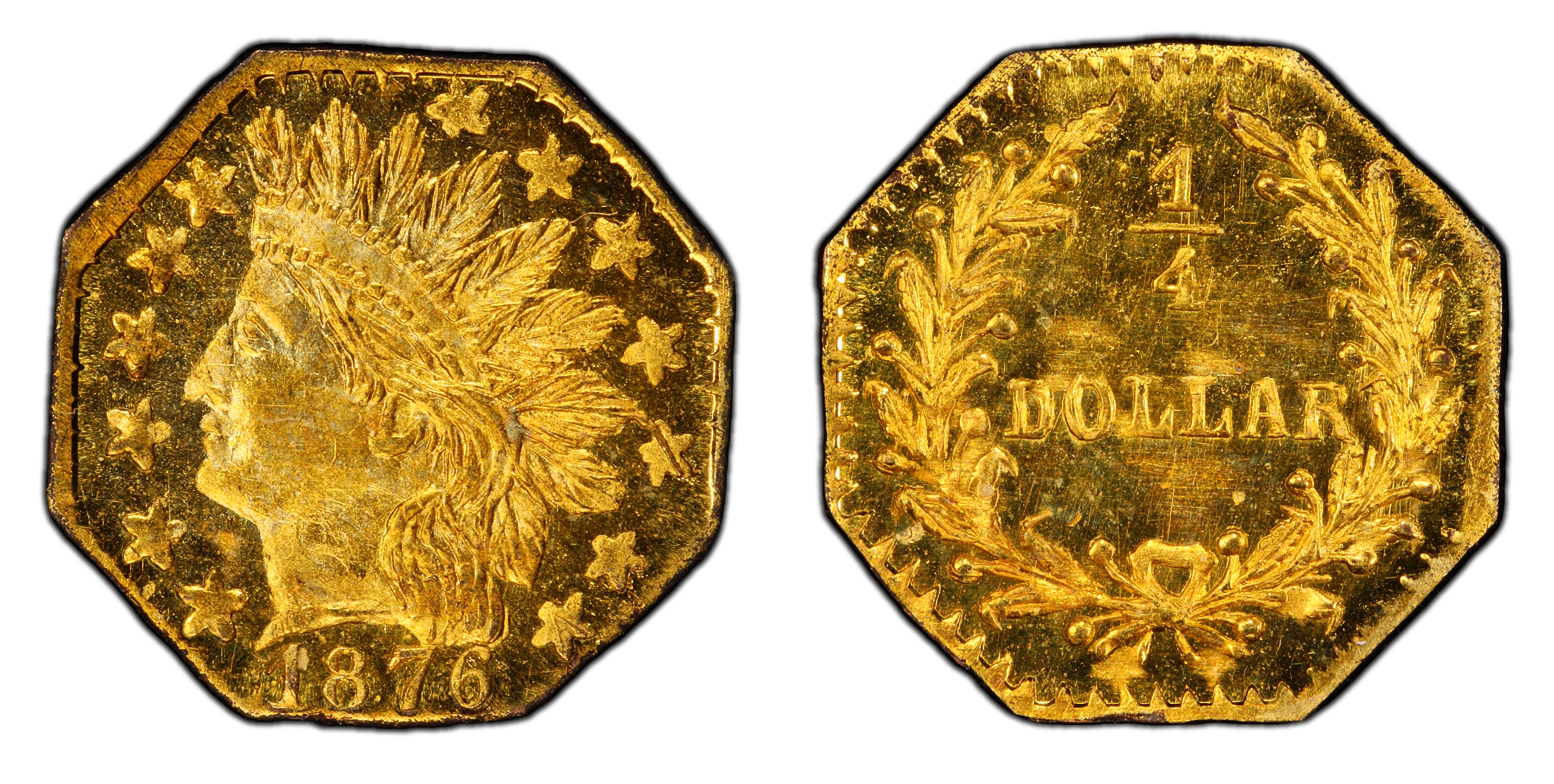
Obverse & Reverse
The 1876 BG-799C Quarter Dollar emerges from the third and final distinct era of California Fractional Gold production (1872-1882). By this time, the chaotic, unregulated days of the Gold Rush were long past, and the United States government had established a powerful mint in San Francisco. However, a persistent shortage of small denomination coinage continued to plague commerce on the West Coast. Federal silver coins were scarce, and the smallest circulating U.S. gold coin was the dollar. This created a niche for private minters to produce tiny gold coins, denominated as 25 cents, 50 cents, and one dollar, to facilitate everyday transactions. Unlike their Period One predecessors which served a vital monetary role, these later 'Period Three' pieces were primarily created to satisfy a burgeoning numismatic and souvenir market, capitalizing on the romantic allure of the Gold Rush. The Centennial Exposition in Philadelphia in 1876 spurred a nationwide interest in historical artifacts and novelties, and these miniature gold coins were perfect keepsakes. Jewelers and manufacturers, many of whom remain anonymous but are often associated with firms like Robert B. Gray & Co., struck these pieces with varying degrees of quality. The BG-799C variety is a product of this commercial environment. It was designed to look like a 'real' coin, with a Liberty head motif mimicking federal coinage, but it was understood to be a privately-issued token. These pieces circulated to some extent but were largely saved as mementos, which accounts for the relatively high proportion of survivors in Mint State grades compared to earlier issues. The legality of their production was always questionable, and the Secret Service eventually cracked down on private minting, viewing it as a usurpation of federal authority, leading to the permanent cessation of California Fractional Gold production in 1882.
Associated EventPost-Gold Rush Economic Expansion & Centennial Exposition Souvenir Demand
Reason For MintingPrimarily to serve the numismatic and souvenir trade, while also filling a lingering need for small-denomination coinage in local commerce.
Minter HistoryWhile not definitively attributed, the style of the BG-799C and other Period Three issues is strongly linked to the work of jewelers and die sinkers operating in San Francisco, with Robert B. Gray & Co. being one of the most prominent and likely manufacturers of many such pieces. These firms were not true 'minters' in the governmental sense but were skilled craftsmen who recognized and supplied a commercial demand for these popular gold tokens.
Historical SignificanceThe BG-799C represents the final phase of private gold coinage in the United States. It is a tangible link to the enduring legacy of the California Gold Rush and illustrates a unique chapter in American monetary history where private enterprise continued to fill a coinage gap long after the establishment of federal mints, ultimately transitioning from a utilitarian product to a commercial novelty.
BG-799C
Denomination25 Cents
Minting Period1876
Assayer/MinterRobert B. Gray & Co. (presumed)
Geographic OriginSan Francisco, California
Obverse DescriptionA simple, somewhat crude bust of Liberty facing right, wearing a plain coronet (headband) with no inscription. Thirteen stars encircle the portrait near the rim. The 'PL' in the coin's designation refers to this 'Plain Liberty' head type. The date '1876' is positioned below the bust.
Obverse Inscription1876
Reverse DescriptionThe denomination '1/4' is in the center, surrounded by a wreath of two olive branches. The wreath is tied with a bow at the bottom. The inscription 'DOLLAR' is located above the wreath, and the mintmark 'S' for San Francisco is below the bow. It's important to note this is a private 'S' mintmark and not that of the U.S. Mint.
Reverse Inscription1/4 DOLLAR S
CompositionGold
Stated Fineness Actual FinenessVaries, but typically between .500 and .750 fine (12-18 karat).
Weight0.25 grams
Diameter9.50 mm
EdgePlain
Unknown
Survival Estimate250-400
Rarity ScaleR-5
BG-799C is popular with collectors due to its affordability relative to earlier issues, its connection to the 1876 Centennial year, and its status as a representative of the final phase of California Fractional Gold. Its distinct, simple design makes it an interesting type coin.
Key VarietiesThe primary designation is BG-799C. There are no major varieties struck for circulation. Collectors should be aware that modern replicas and fantasy pieces exist in abundance for this series. No original proof or special restrike issues are known for this specific variety.
Authentication TipsGenuine examples have a specific die state. Look for a sharp, defined 'S' mintmark placed directly below the bow's knot. The stars on the obverse are often weakly struck and may appear somewhat malformed, which is a characteristic of genuine pieces, not a flaw. The surfaces should exhibit the soft, satiny luster of genuine gold, not the hard, brassy shine of modern fakes. Weight and diameter are key; counterfeits are often incorrect in these specifications. The overall fabric should feel 'right' for a 19th-century striking, not modern and mechanical.
Shopping ConsiderationsA premium quality example for its grade will possess a sharp strike, particularly on Liberty's portrait and the numbers in the denomination. Many examples are weakly struck, so a bold strike commands a significant premium. Look for clean, original surfaces that have not been harshly cleaned, polished, or used in jewelry. A hint of original reddish-gold toning is highly desirable. Check carefully for minute rim bumps or evidence of jewelry mounting, as these tiny coins were frequently used in this manner. Avoid examples with excessive spotting or surface impairments.
A coin's grade is its condition, rated on a 1-70 scale. For rare coins, this is the most critical factor in determining value, as a tiny difference in preservation can mean a huge difference in price.
Relevant Grade TypesOriginal BG-799C coins were struck as business strikes intended for potential circulation or sale as souvenirs. They are found in Circulated grades (AG-3 to AU-58) and, more commonly, in Mint State grades (MS-60 to MS-70) due to their popularity as keepsakes. No proofs were struck during the original period of issue, and there are no known later-date presentation strikings or restrikes for this specific Breen-Gillio number.
Mint State CharacteristicsIn uncirculated condition, BG-799C typically displays a soft, slightly satiny luster. The strike is a key variable; many are softly struck, especially on the stars and the highest points of Liberty's hair. A well-struck example with full detail is rare and commands a premium. Due to the softness of the gold and small size, even high-grade Mint State examples will often show tiny contact marks or 'ticks' from handling over the decades. These are generally accepted if they do not detract from the overall eye appeal.
Circulated Wear PatternsWear first appears on the high points of Liberty's hair, cheek, and coronet. The stars will quickly become indistinct. On the reverse, the highest points of the wreath's leaves and the numbers '1/4' will show initial friction. In lower grades (VF and below), the date and legends will show significant weakness and begin to merge with the fields.
Key Factors For ValueThe primary value drivers for this coin are grade and surface quality. An example with original, uncleaned surfaces and attractive luster will always be worth more than a cleaned or polished coin of the same grade. Strike sharpness is the next most important factor; a fully struck piece can be worth multiples of a weakly struck one. Eye appeal, which encompasses toning and the absence of distracting marks, is crucial. Finally, certification by a top-tier grading service (PCGS or NGC) is standard, and a CAC sticker signifying premium quality for the grade adds a significant premium.
PCGS Price Guide
| Grade | Price | Population |
|---|---|---|
| 63 | N/A | 1 |
| 64 | $700.00 | 1 |
| 64+ | $800.00 | N/A |
| 65 | $1,000.00 | 2 |
| 67 | N/A | N/A |