1874 G25C BG-876, PL (Regular Strike)
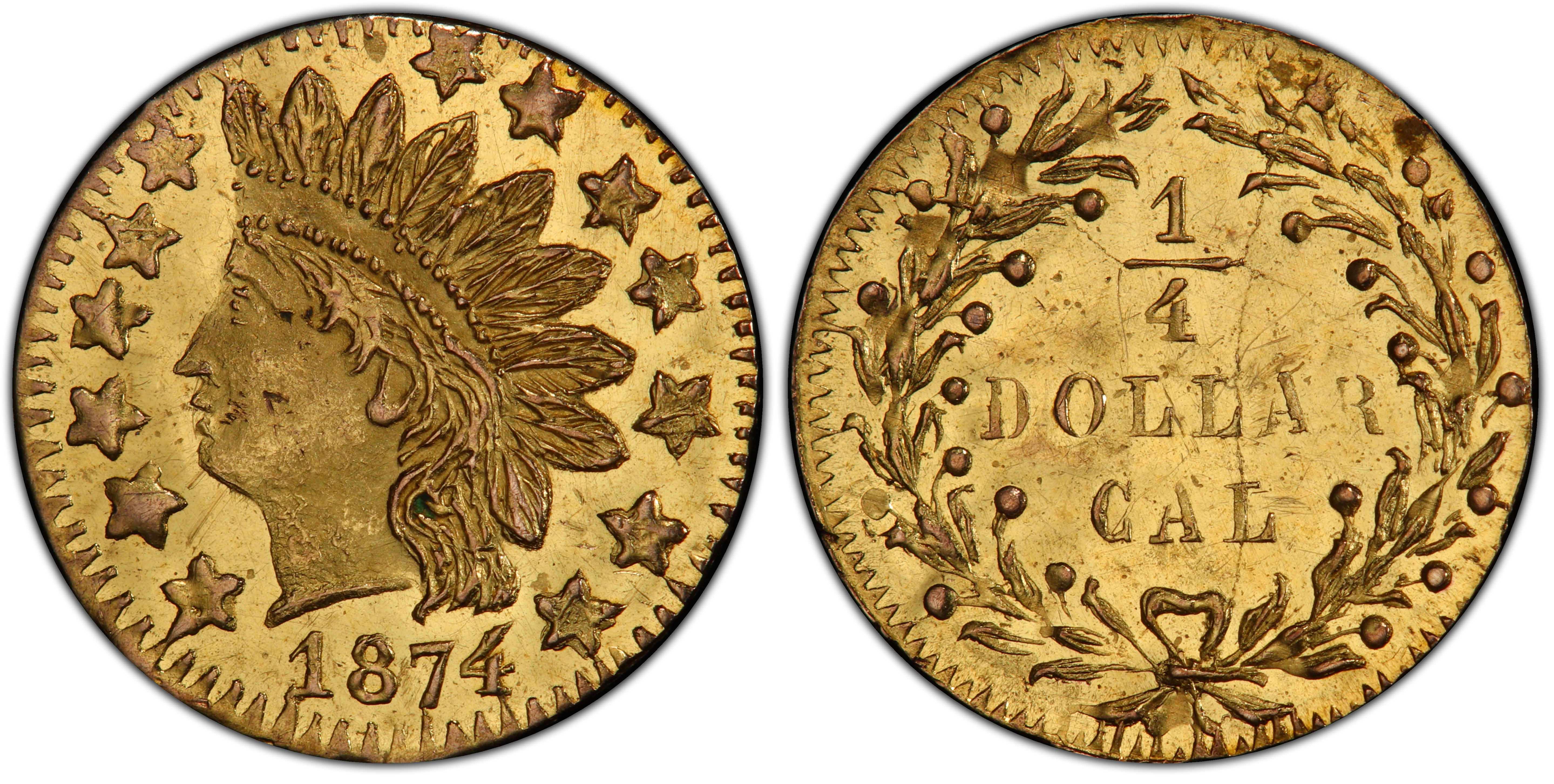
Obverse & Reverse
The 1874 25 Cents, cataloged as Breen-Gillio 876, is a product of the fascinating 'Period Three' (1872-1882) of California Fractional Gold production. By this era, the frantic energy of the initial Gold Rush had long subsided, but California's economy remained dynamic and distinct from the rest of the nation. The Coinage Act of 1864 had explicitly outlawed private currency, a measure aimed squarely at the diverse private and territorial gold coins that had once dominated western commerce. However, the law was interpreted by some to apply only to coins intended as legal tender currency. San Francisco jewelers, responding to a persistent local demand for small-denomination gold pieces for use as gifts, souvenirs, and in minor transactions, found a lucrative niche. They ingeniously circumvented the law by producing pieces that were technically tokens, often omitting the word 'DOLLAR' or 'CENTS' to avoid direct conflict with federal statutes. The BG-876 is a quintessential example of this phenomenon. It was struck not as a circulating coin in the traditional sense, but as a popular commercial item that satisfied a cultural desire for tangible gold, emblematic of California's identity. These tiny gold pieces were affordable keepsakes for tourists and locals alike, serving as mementos of the Golden State. Their production was not a formal minting operation but rather the work of skilled craftsmen in small, private workshops, who used hand-operated presses. This resulted in significant variation in strike quality and planchet characteristics, even within the same die marriage. The public reception was positive, as they filled a void for small, beautiful gold objects in an economy still lacking sufficient small change. Their eventual demise came with the Secret Service crackdown of 1883, which effectively ended the half-century-long tradition of private gold coinage in the United States, rendering pieces like the BG-876 historical artifacts of a unique chapter in American economic history.
Associated EventPost-Gold Rush California Economic Expansion
Reason For MintingTo serve as popular souvenirs and gift items, satisfying a commercial demand for small-denomination gold pieces while circumventing federal private coinage laws.
Minter HistoryThe specific minter of BG-876 is unknown, which is typical for Period Three California Fractional Gold. These pieces were generally produced by manufacturing jewelers in San Francisco, such as Herman J. Brand or Robert B. Gray & Co., who had the equipment and expertise for die sinking and striking. They operated outside the purview of the U.S. Mint, creating these tokens as part of their broader business of jewelry and precious metal work. Their primary business was not coinage, but they capitalized on the public's affinity for gold.
Historical SignificanceThe BG-876 is significant as a representative of the final phase of private gold issuance in the U.S. It illustrates the creative adaptation of private enterprise to federal regulations and highlights the persistent cultural and economic importance of gold in 19th-century California, long after the initial rush had ended. These pieces are tangible links to the souvenir and jewelry trade of the era.
N/A
Denomination25 Cents (Quarter Dollar)
Minting Period1874
Assayer/MinterUnknown private minter, likely a manufacturing jeweler in San Francisco.
Geographic OriginSan Francisco, California
Obverse DescriptionA depiction of a Liberty head facing left, often described as an 'Indian Head' due to the feathered headdress. The portrait is somewhat crude in execution compared to federal coinage. Thirteen stars encircle the bust, representing the original colonies.
Obverse InscriptionNo textual inscription; only the portrait and 13 surrounding stars.
Reverse DescriptionThe denomination '1/4' is located in the center, surrounded by an open wreath of leaves and berries. The date '1874' is positioned below the wreath.
Reverse Inscription1/4
CompositionGold
Stated FinenessNot explicitly stated on the coin.
Actual FinenessVaries by manufacturer, but typically ranges from .500 to .900 fine gold, often around 14-21 karats.
Weight0.25 grams
Diameter9.70 mm
EdgePlain
Unknown, but likely several thousand.
Survival Estimate500-750
Rarity ScaleR-5 (High)
This variety appeals to collectors for its classic 'Indian Head' design, its status as a dated, denominated piece from the popular Period Three series, and its relative affordability compared to earlier California territorial gold. It represents a tangible piece of post-Gold Rush history and the souvenir trade of San Francisco.
Key VarietiesThe primary variety is the regular business strike (BG-876). While no original proof strikings are known, this variety is sometimes found with prooflike (PL) surfaces, which are not special strikings but rather the result of being struck from freshly polished dies. These PL examples are highly sought after and command a significant premium. There are no known major die varieties or official restrikes for this specific catalog number.
Authentication TipsAuthentic examples often exhibit a slightly soft or uneven strike, particularly on the high points of the feathers and the wreath. The gold color should be consistent with 19th-century alloys, often with a slightly brassy or reddish tint. Counterfeits are common and may appear overly sharp, have incorrect weight or diameter, or display a soapy, cast-like surface texture. The style of the numerals in the date and fraction is a key diagnostic; compare any potential purchase to high-resolution images of certified examples.
Shopping ConsiderationsA premium quality example for its grade will possess a sharp, well-centered strike, especially on the central devices of the head and the '1/4' on the reverse. Seek out coins with clean, original surfaces that retain some measure of mint luster. Prooflike (PL) designated examples are particularly desirable. Common problems to avoid include harsh cleaning, which dulls the surfaces and imparts fine hairline scratches, and jewelry mounting or removal damage, which often appears as rim filing or solder marks. An even, attractive original color adds significantly to eye appeal and value.
A coin's grade is its condition, rated on a 1-70 scale. For rare coins, this is the most critical factor in determining value, as a tiny difference in preservation can mean a huge difference in price.
Relevant Grade TypesOriginal issues were business strikes intended for commercial sale, not circulation in the traditional sense, and are found in Circulated (1-58) and Mint State (MS, 60-70) grades. No true Proofs were struck during the original period of issue. However, some coins were struck using highly polished dies, resulting in Prooflike (PL) surfaces. These are designated as MS-PL by grading services and are considered a special category of business strike, not a separate issue like a Proof restrike.
Mint State CharacteristicsUncirculated examples of BG-876 often show weakness in the strike on the highest points of the feathers in the headdress and the tips of the wreath leaves. Luster can range from dull and satiny to bright and prooflike. Due to the small size and production methods, planchet quality can be inconsistent, and small, as-made flaws or adjustment marks are not uncommon. Contact marks, even on high-grade pieces, can be prominent relative to the coin's tiny size.
Circulated Wear PatternsWear first appears on the high points of the cheek, the hair just above the ear, and the upper feathers of the headdress. On the reverse, the highest points of the wreath and the edges of the numerals in '1/4' will show the first signs of friction. In lower circulated grades (VF and below), the finer details of the feathers and wreath will merge, and the stars may become indistinct.
Key Factors For ValueThe primary drivers of value are grade and surface quality. An example with original, uncleaned surfaces and minimal contact marks will always be prized. Strike sharpness is critical; a fully struck piece is much more desirable than a typically weak one. Eye appeal, driven by attractive original color and any prooflike contrast, can add a substantial premium. For this issue, a CAC sticker confirming quality for the grade is highly valued by discerning collectors and can significantly increase market price.
PCGS Price Guide
| Grade | Price | Population |
|---|---|---|
| 64 | $850.00 | 1 |
| 64+ | N/A | N/A |