1876 G25C BG-855 (Regular Strike)
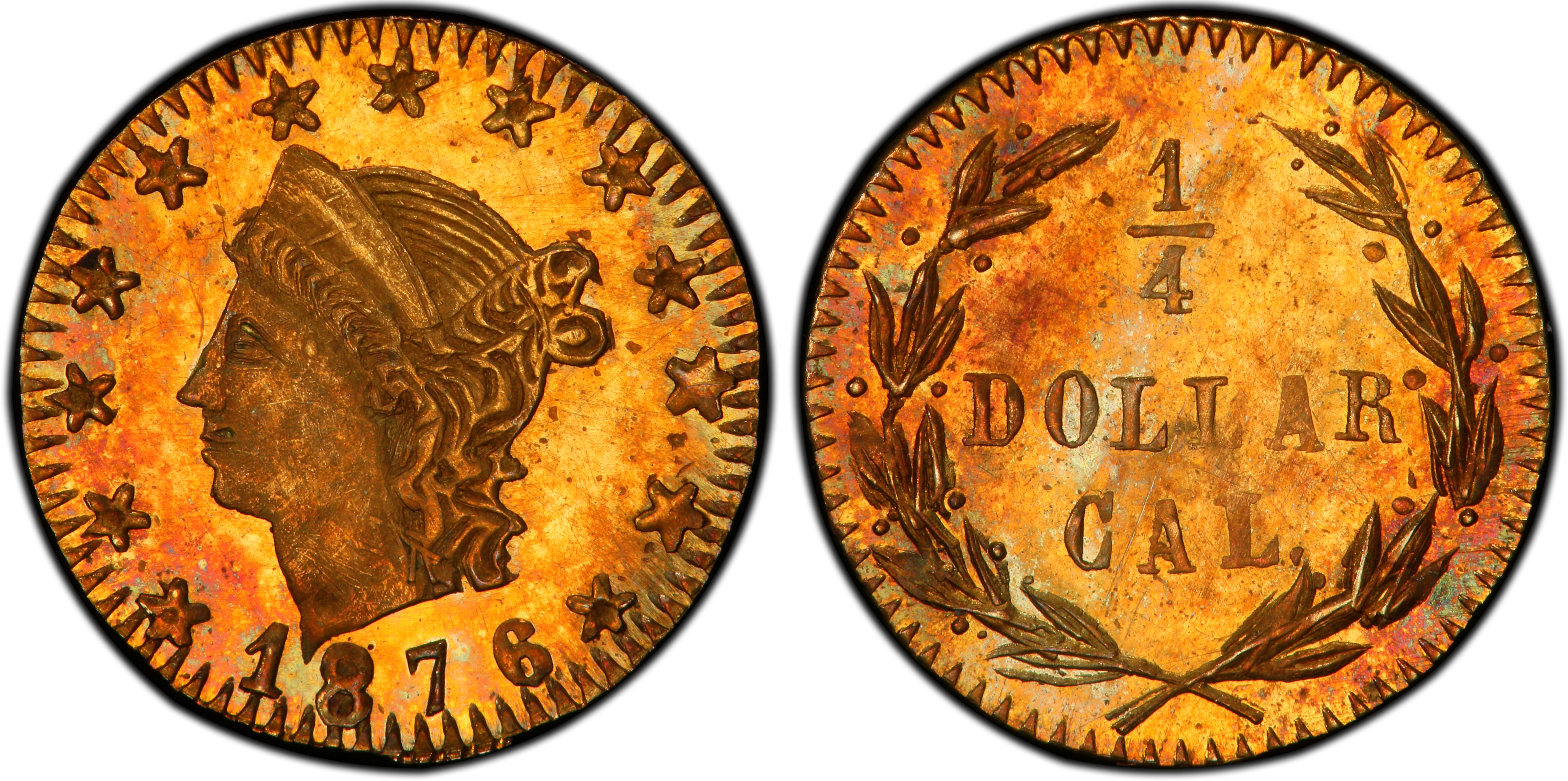
Obverse & Reverse
The 1876 G25C BG-855 is a product of the second period of California Fractional Gold production (1858-1882), a fascinating era where the purpose of these miniature gold coins had fundamentally shifted. The initial wave of fractional gold (1852-1857) arose from a genuine and severe shortage of small change in the gold fields, serving as a necessary medium of exchange. However, by the mid-1850s, the newly established San Francisco Mint was producing a steady supply of official U.S. silver and gold coinage, rendering the private issues obsolete for daily commerce. Enterprising jewelers, recognizing a new market, began producing a second wave of fractional gold pieces intended not for circulation, but as souvenirs and keepsakes. These 'jeweler's issues' were popular with tourists and locals alike, who wished to send a memento of the California Gold Rush back east or to Europe. The BG-855 was struck in this environment. The 'G' initial on the obverse is the hallmark of Robert B. Gray & Co., a prominent San Francisco jeweler who had purchased the coining equipment of an earlier minter, Antoine Nouizillet, around 1859-60. Gray's operation was one of the more prolific during this period. The year 1876 was significant in the United States as it marked the nation's Centennial, an event celebrated with great patriotic fervor, most notably at the Centennial Exposition in Philadelphia. While produced in San Francisco, this coin was part of a larger national context of celebrating American history and enterprise. These tiny gold pieces were tangible, affordable symbols of the nation's mineral wealth and the romanticism of the West. Unlike their Period One predecessors, which were made to approximate their stated value, Period Two issues were notoriously underweight, containing far less gold than their face value implied. This was not considered fraudulent at the time, as their role as tokens was well understood by the public. Production of all private coinage was eventually suppressed by the U.S. Secret Service, who saw the potential for deception, and by 1883 the era of California Fractional Gold had come to an end. Today, the BG-855 is prized not as a coin that saw circulation, but as an artifact of a unique transitional period in American numismatics, representing extreme rarity and a direct link to the souvenir trade that grew from the ashes of the Gold Rush.
Associated EventPost-Gold Rush Souvenir & Jewelry Trade
Reason For MintingTo serve the robust market for curios, jewelry, and souvenirs of the California Gold Rush, rather than to circulate as money.
Minter HistoryRobert B. Gray & Co. was a San Francisco-based jewelry firm that became a significant producer of 'Period Two' California Fractional Gold. Around 1859-60, Gray acquired the dies, hubs, and punches of Antoine Louis Nouizillet, one of the primary minters from the earlier 'Period One.' Gray continued to produce fractional gold for over a decade, distinguishing his own issues with a prominent 'G' initial on the obverse dies. His firm's products are generally noted for being of slightly higher weight and quality compared to some other contemporary jeweler's issues, though still underweight relative to their face value.
Historical SignificanceThe BG-855 is historically significant as a quintessential example of a 'jeweler's issue' of California Fractional Gold. It represents the shift in the purpose of these private coins from a necessary medium of exchange to a commercial souvenir product. Its extreme rarity today underscores the limited production and ephemeral nature of these privately struck gold tokens from the post-Gold Rush era.
BG-855
Denomination25 Cents
Minting Period1876
Assayer/MinterRobert B. Gray & Co.
Geographic OriginSan Francisco, California
Obverse DescriptionA small, simplified bust of Liberty facing left, her hair tied in a bun. The portrait is surrounded by thirteen six-pointed stars. The date, 1876, is below the bust. This is the Liberty Head design common to Period Two issues.
Obverse Inscription1876
Reverse DescriptionThe reverse features a simple wreath composed of two branches tied together at the bottom with a bow. Within the wreath, the denomination is expressed as '1/4 DOLLAR'. The 'CAL.' abbreviation for California appears below the denomination.
Reverse Inscription1/4 DOLLAR CAL.
CompositionGold
Stated Fineness Actual FinenessVariable, but typically less pure than federal coinage, often around 14 to 21 karats.
Weight0.24 grams
Diameter9.60 mm
EdgePlain
Unknown
Survival Estimate4 to 12 known
Rarity ScaleR-7
The BG-855 is highly sought after due to its extreme rarity (R-7) and its status as a dated Liberty Head type from the popular California Fractional Gold series. As a 'Period Two' issue, it appeals to specialists who appreciate the history of the Gold Rush souvenir trade. The tiny size and delicate nature present a unique collecting challenge.
Key VarietiesThere are no known major varieties for the BG-855 die marriage. Given its rarity, the entire issue is considered a single variety. No later restrikes or special collector issues are known to exist for this specific variety; all known examples are original business strikes from the period.
Authentication TipsAuthentication is paramount for California Fractionals. Buyers should insist on third-party certification from PCGS or NGC. Genuine pieces often exhibit a somewhat crude strike, with softness in the details of Liberty's hair and the wreath. Counterfeits often have a mushy or soapy appearance from being cast, or sharp, modern-looking details if struck from new dies. The surfaces of genuine pieces should show original, age-appropriate luster and patina; any signs of recent cleaning or artificial toning are suspect. Check for precise die markers if available in specialized reference works, as fakes will not replicate these perfectly.
Shopping ConsiderationsFor an R-7 issue, any example is a major acquisition. A 'premium quality' specimen would be one that is well-centered and sharply struck for the issue, particularly on the stars and the date. Look for original, undisturbed surfaces with a pleasing golden-orange patina. Luster can range from satiny to semi-prooflike. Avoid examples that have been harshly cleaned, polished, or show evidence of being removed from jewelry (solder marks, rim damage, or tooling). Even on certified examples, carefully examine for hidden flaws under magnification. A CAC sticker on a coin of this rarity would denote superior quality and command a significant premium.
A coin's grade is its condition, rated on a 1-70 scale. For rare coins, this is the most critical factor in determining value, as a tiny difference in preservation can mean a huge difference in price.
Relevant Grade TypesAll original 1876 BG-855 pieces were struck as business strikes. Since they were intended as souvenirs and not for commerce, they are most often encountered in high grades, from About Uncirculated (AU) to Mint State (MS, 60-70). Circulated examples (1-58) are rare and may indicate a piece was used as a pocket piece. No proofs were struck during the original period of issue, and no later-date Proof restrikes are known.
Mint State CharacteristicsUncirculated examples of BG-855 typically exhibit a soft, satiny luster. The strike is often uneven, with some weakness common on the stars opposite the highest point of Liberty's head. The extremely small planchets are prone to handling marks, even on Mint State examples. Look for a bold date and clear denomination. The overall eye appeal, combining luster, strike, and surface preservation, is critical for determining quality within the MS grades.
Circulated Wear PatternsOn this small Liberty Head design, wear first appears on the highest points of the obverse: Liberty's cheek, the hair bun, and the strand of hair over the ear. On the reverse, the highest points of the wreath's leaves and the bow will show the first signs of friction. In lower grades (VF and below), the stars will begin to merge with the fields and the date digits will lose their sharpness.
Key Factors For ValueFor the BG-855, value is driven by three main factors. First and foremost is rarity; as an R-7 issue, any appearance on the market is a significant event. Second is the certified grade; a move from MS62 to MS64 can double the coin's value. Third is eye appeal, which encompasses the quality of the strike, the originality of the surfaces, and the richness of any natural toning. Cleaned, damaged, or repaired coins will be worth substantially less than problem-free examples in the same grade. A CAC sticker provides a strong endorsement of quality and significantly increases market value.
PCGS Price Guide
| Grade | Price | Population |
|---|---|---|
| 58 | N/A | N/A |
| 62 | $1,850.00 | 2 |
| 62+ | $2,250.00 | N/A |
| 63 | $3,000.00 | 2 |
| 63+ | $3,500.00 | N/A |
| 64 | $4,250.00 | 3 |
| 64+ | $5,000.00 | N/A |
| 65 | $6,500.00 | 1 |