1872 G25C BG-818, Washington Head (Regular Strike)
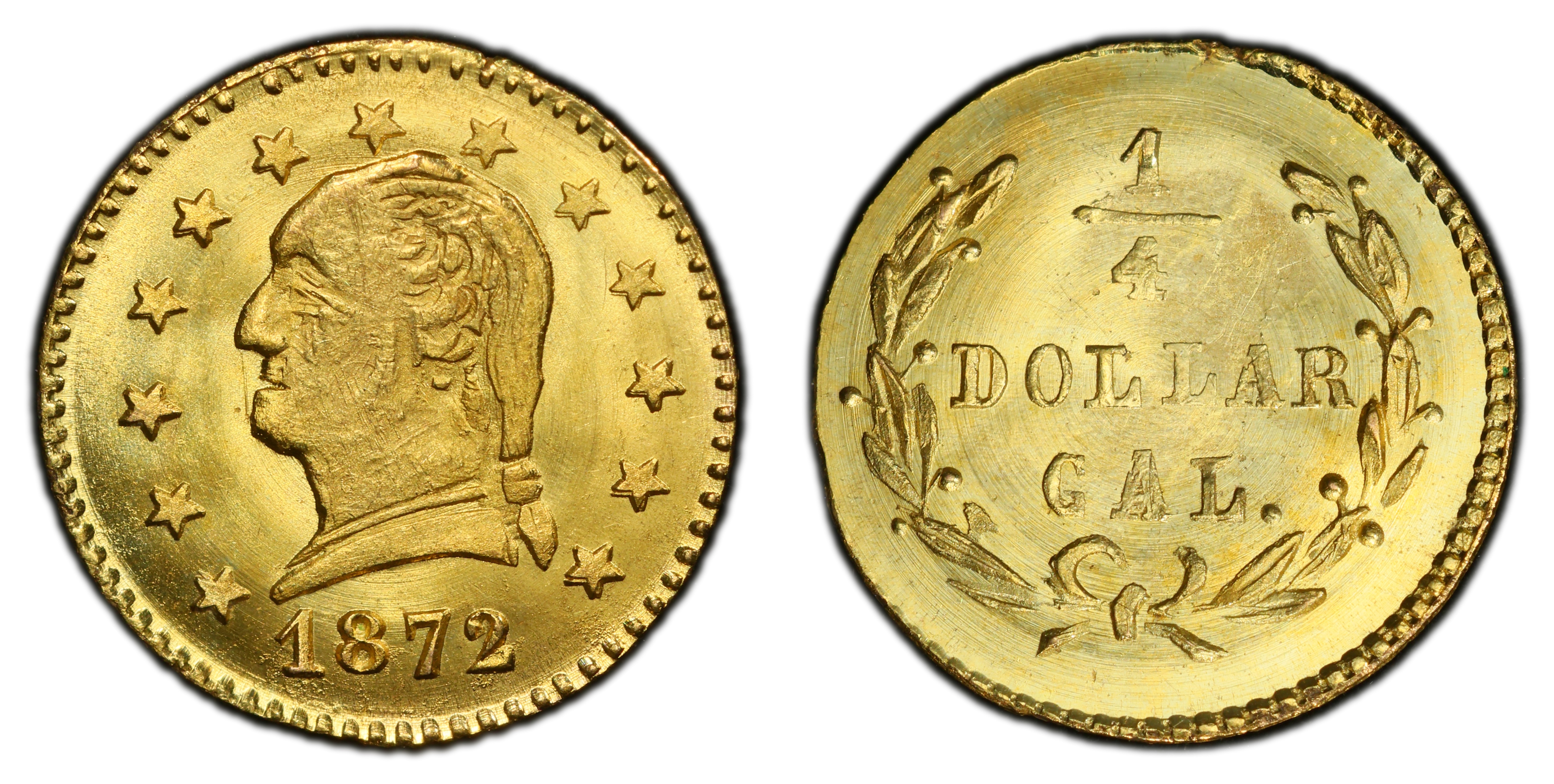
Obverse & Reverse
The 1872 BG-818 Washington Head quarter dollar emerges from the second major phase of California fractional gold production, often termed 'Period Two' (1859-1882) by numismatists following the Breen-Gillio classification. By this era, the acute shortage of small change that characterized the initial Gold Rush had largely subsided with the efficient operation of the San Francisco Mint. The purpose of these tiny gold pieces had shifted dramatically from utilitarian currency to charming souvenirs and jewelry items. Unlike the 'Period One' issues, which were struck with at least a pretense of conforming to federal weight standards, these later 'jeweler's issues' were notoriously underweight for their stated denomination and exhibited a wide variety of novel designs, breaking from the ubiquitous Liberty Head motif. The introduction of a Washington Head design in 1872 was a significant departure, predating George Washington's appearance on a regular-issue federal coin by sixty years. This patriotic theme was likely a marketing decision by the unattributed private minter, intended to appeal to tourists and citizens celebrating American heritage. These pieces were typically struck in small, back-room operations run by jewelers or metalsmiths in San Francisco, often using hand-operated screw presses or even simple hammer striking, which resulted in inconsistent strike quality. The Coinage Act of 1864 had made the private issuance of coinage illegal, but enforcement was lax, and production continued until a Secret Service crackdown in the early 1880s finally suppressed the industry. The BG-818, therefore, represents a fascinating product of this legally grey period—a commercial venture that catered to a collector and tourist market, a miniature gold memento of a trip to the romanticized West, rather than a coin intended to buy a loaf of bread. Its numismatic significance lies in its unique design, its status as a scarce 'jeweler's issue,' and the window it provides into the post-Gold Rush economy of California.
Associated EventCalifornia Gold Rush Aftermath & Souvenir Trade
Reason For MintingPrimarily created to serve a growing market for souvenirs and jewelry rather than to alleviate a coinage shortage.
Minter HistoryThe specific minter of the BG-818 variety is unknown, a common characteristic for many 'Period Two' issues. The era was dominated by numerous small-scale jewelers and artisans, primarily in San Francisco, who produced these fractional pieces. Unlike the earlier, more prominent assayers, these minters rarely signed their work with identifiable initials or marks. Research by Breen and Gillio suggests that many of these producers were French jewelers who brought their metalworking skills to California. They operated outside the formal banking system, creating these tokens on demand for a public enchanted by their novelty and connection to California's gold identity.
Historical SignificanceThe BG-818 is significant for being one of the earliest coin-like items in American history to feature George Washington's portrait, foreshadowing his eventual place on federal coinage in 1932. It exemplifies the evolution of California fractional gold from a necessity of commerce to a product of tourism and nostalgia, capturing the entrepreneurial spirit of post-Gold Rush California's artisans.
BG-818
Denomination25 Cents
Minting Period1872
Assayer/MinterUnknown/Unattributed
Geographic OriginSan Francisco, California
Obverse DescriptionA right-facing bust of George Washington, modeled in a classical style. The portrait is relatively high-relief for the size of the planchet. The field is plain, without any surrounding inscription or stars.
Obverse Inscription Reverse DescriptionThe denomination '1/4' appears in the center, with 'DOLLAR' inscribed below it. This is enclosed within a wreath of two olive branches, tied at the bottom with a simple bow. The date '1872' is positioned inside the wreath, just below the bow.
Reverse Inscription1/4 DOLLAR 1872
CompositionGold
Stated Fineness Actual FinenessVariable, typically between .500 and .750 fine (12-18 karat), consistent with underweight Period Two 'jeweler's issues'.
Weight0.25 grams
Diameter9.70 mm
EdgePlain
Unknown, but presumed to be very small, likely numbering in the low thousands at most.
Survival EstimateFewer than 75 pieces are believed to exist in all grades.
Rarity ScaleR-4 (Scarce)
This variety is highly sought after for its iconic Washington Head design, which stands out dramatically from the common Liberty and Indian Head motifs of the series. Its status as a scarce, dated Period Two issue adds to its desirability among specialists.
Key VarietiesNo major, widely recognized die varieties from the original 1872 minting period are cataloged for BG-818. No official restrikes, patterns, or trial pieces are known to exist. Collectors should be aware of contemporary counterfeits and modern replicas which are common for the series.
Authentication TipsGenuine examples are very thin and struck on solid gold planchets, not plated. The strike is often uneven, with some softness in Washington's hair or the wreath's leaves, a result of hammer or early screw press production. Fakes are often thicker, have a soapy or cast-like texture, and may show a coppery core where the gold plating has worn. The details on genuine pieces, even if soft, will be characteristically sharp in the recesses, unlike the rounded details of a casting. Pay close attention to the style of the numerals in the date and the fraction, comparing them to known genuine examples.
Shopping ConsiderationsA premium quality example for its grade will exhibit a sharp strike on the high points of Washington's portrait (cheek and hair) and clear definition in the wreath and bow. Original, uncleaned surfaces with some remaining mint luster are highly prized and command significant premiums. Look for attractive, deep reddish-gold or orange-gold toning. Common problems to avoid are cleaning (indicated by hairlines), tooling, evidence of jewelry mounting (solder or rim filing), and bending. Due to their thinness, many examples are bent or damaged; a perfectly flat planchet is a significant plus. Third-party certification by PCGS or NGC is highly recommended for this issue.
A coin's grade is its condition, rated on a 1-70 scale. For rare coins, this is the most critical factor in determining value, as a tiny difference in preservation can mean a huge difference in price.
Relevant Grade TypesOriginal 1872 BG-818 issues were business strikes intended for sale as souvenirs, not general circulation. They are found in Circulated grades (AU-58 and below), though this is less common, and Mint State (MS, 60-70) grades. No Proofs were struck during the original period of issue. Any piece described as a 'Proof' would be a modern creation or a misattribution of a prooflike business strike. There are no known later-date, authorized Proof restrikes.
Mint State CharacteristicsUncirculated examples of BG-818 often display a soft, satiny luster rather than a hard, frosty one. The strike is a key determinant of quality; many pieces are weakly struck on Washington's hair above the ear and on the reverse bow. A well-struck example with full detail is rare and desirable. Planchets were often unpolished, so minor, as-made striations or imperfections in the fields are common and should not be confused with cleaning or damage. Small, scattered contact marks are typical due to the softness of the low-karat gold.
Circulated Wear PatternsOn circulated examples, wear first appears on the highest points: Washington's cheekbone, the hair curls above his ear, and the knot of the bow on the reverse. As wear progresses, the finer details of the hair and the individual leaves of the wreath will become flat and indistinct. In lower grades (Fine and below), the date and denomination may begin to weaken.
Key Factors For ValueThe primary value drivers for BG-818 are grade and surface quality. An example with original, lustrous surfaces free of cleaning, scratches, or damage will always command a premium. Strike quality is the next most important factor; a sharp, well-centered strike can make a coin far more valuable than a poorly struck example of the same grade. Eye appeal, driven by attractive toning and a lack of distracting marks, plays a major role. Given the prevalence of fakes, certification by a top-tier service like PCGS or NGC is nearly essential for market acceptance and value realization. A CAC sticker on a certified coin indicates premium quality for the grade and often results in a significant price jump.
PCGS Price Guide
| Grade | Price | Population |
|---|---|---|
| 55 | $800.00 | 4 |
| 55+ | $850.00 | N/A |
| 58 | $900.00 | 2 |
| 58+ | $1,000.00 | N/A |
| 60 | $1,300.00 | 1 |
| 61 | $1,450.00 | 3 |
| 62 | $1,600.00 | 14 |
| 62+ | $1,650.00 | N/A |
| 63 | $1,700.00 | 26 |
| 63+ | $1,750.00 | N/A |
| 64 | $1,800.00 | 38 |
| 64+ | $2,250.00 | N/A |
| 65 | $2,750.00 | 27 |
| 65+ | $3,250.00 | N/A |
| 66 | $4,500.00 | 9 |
| 67 | N/A | N/A |