1873 G25C BG-842 (Regular Strike)
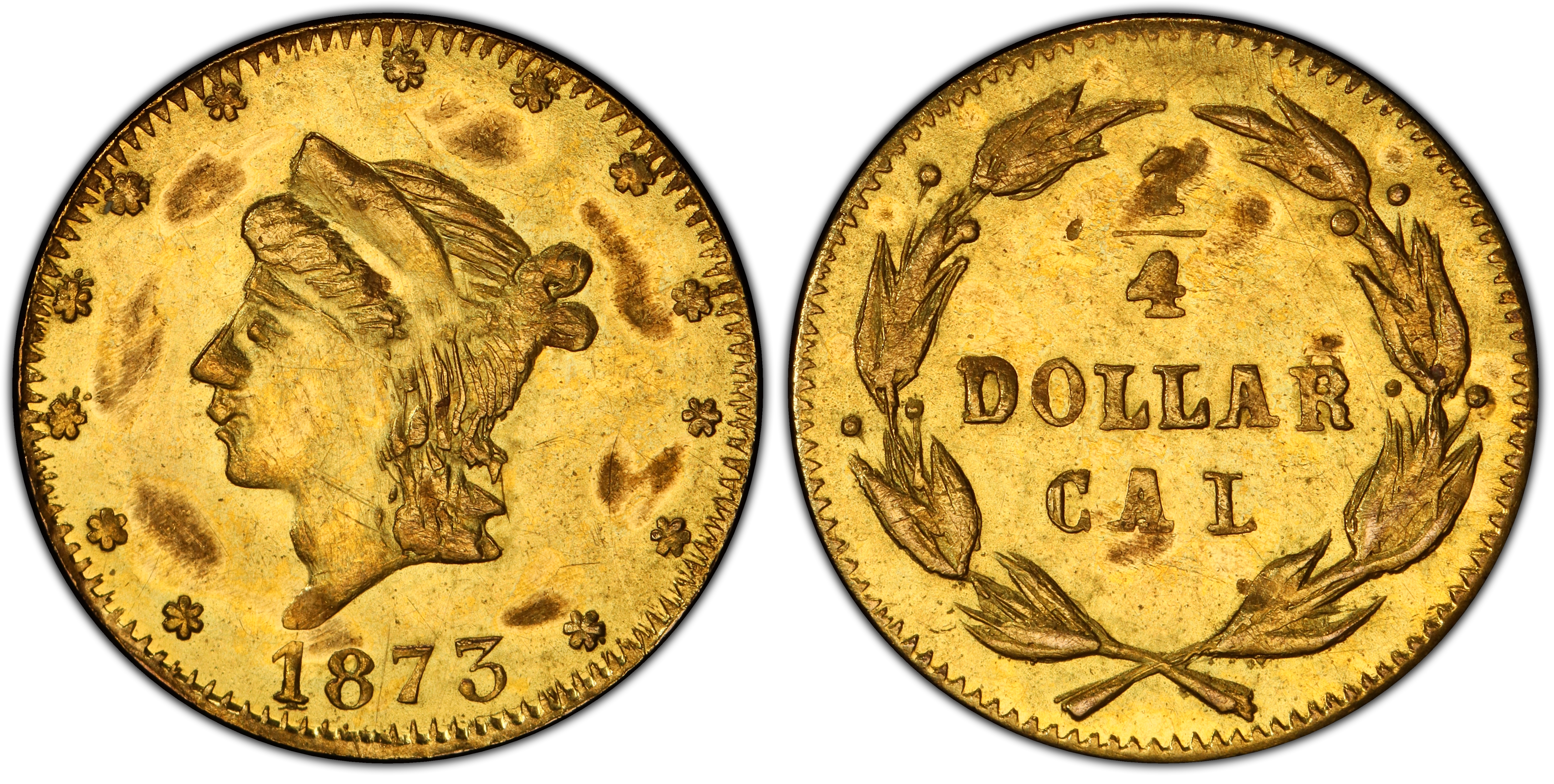
Obverse & Reverse
The 1873 BG-842 25 Cents piece emerges from the second major period of private Californian coinage, a fascinating era that followed the initial chaos of the Gold Rush. By the 1870s, the acute shortage of small change that had plagued California in the early 1850s had largely been resolved by the output of the San Francisco Mint, which opened in 1854. Consequently, the private 'fractional gold' coins of this 'Period Two' (1858-1882) served a different purpose. They were no longer essential instruments of commerce but were instead produced as popular souvenirs, keepsakes, and jewelry items, capitalizing on the romantic allure of the Gold Rush. These miniature gold coins were tangible mementos of California's unique economic identity. The Coinage Act of 1864 had prohibited private coinage, but the law was not aggressively enforced against these small, privately issued tokens until the early 1880s. This legal gray area allowed a number of manufacturing jewelers in San Francisco to continue their production. The BG-842 is a product of this environment, struck by a prominent local jeweler not for circulation in the mines, but for sale to tourists and residents. Its existence speaks to a California that was no longer a frontier but a maturing society with a powerful founding myth—a myth that could be purchased in the form of a tiny, glittering gold coin. The attribution of this piece is tied to the history of its manufacturers. While many earlier issues were anonymous, research points to the prolific jewelry firms of San Francisco. Robert B. Gray & Co. was a major producer, but he sold his interests to the California Jewelry Company, owned by the Levison Brothers, in 1871. Given the 1873 date of BG-842, it is almost certainly a product of the Levisons, likely using dies and equipment acquired from Gray, continuing a profitable and popular product line.
Associated EventPost-Gold Rush California Economic Development
Reason For MintingPrimarily struck as souvenirs and for use in the jewelry trade rather than to alleviate a currency shortage.
Minter HistoryThe California Jewelry Company, operated by the Levison Brothers, was a leading jewelry manufacturer and importer in San Francisco. Founded around 1859, they expanded significantly, and by 1871 had a large, well-equipped facility on Sutter Street. They took over the fractional gold business of Robert B. Gray & Co. in 1871, becoming a primary producer of these souvenir coins. Their pieces are part of the 'Period Two' issues, which are generally well-made and designed to appeal to the public's fascination with the Gold Rush.
Historical SignificanceThe BG-842 represents the commercialization of the Gold Rush legacy. As a 'Period Two' issue, it is a numismatic artifact that bridges the gap between utilitarian private coinage and modern souvenir tokens. It highlights a time when private minters operated in a legal twilight, meeting a commercial demand for keepsakes that recalled the state's dramatic founding, and showcases the high level of skill among San Francisco's private manufacturing jewelers.
BG-842
Denomination25 Cents
Minting Period1873
Assayer/MinterCalifornia Jewelry Company (Levison Brothers)
Geographic OriginSan Francisco, California
Obverse DescriptionA head of Liberty, facing left, with a coronet inscribed LIBERTY. She is surrounded by thirteen stars representing the original colonies. The date '1873' is positioned below the bust.
Obverse InscriptionLIBERTY / 1873
Reverse DescriptionThe denomination '1/4 DOLLAR' is enclosed within a simple wreath composed of two branches tied with a ribbon at the bottom. The legend 'CALIFORNIA GOLD' would typically encircle the wreath, however this variety is known for a simplified reverse.
Reverse Inscription1/4 DOLLAR
CompositionGold
Stated Fineness Actual FinenessVariable, typically between .500 and .800 fine.
Weight0.24 grams
Diameter9.50 mm
EdgePlain
Unknown
Survival Estimate13-30 pieces
Rarity ScaleR-6
The BG-842 is sought after due to its high rarity (R-6) and its connection to the romantic history of California. As a dated 'Period Two' piece, it is more affordable than the earlier, circulating issues, yet still represents a genuine artifact from the era of private gold coinage. Its small size and intricate design make it a fascinating miniature work of art.
Key VarietiesThe primary variety is the regular business strike. No proof strikings from the original minting period are known to exist, as these were commercial products. No later-date restrikes or patterns are known for this specific Breen-Gillio number.
Authentication TipsAuthentic pieces must have a denomination (e.g., '1/4 DOLLAR'). Many contemporary fakes and modern replicas omit the word 'DOLLAR' to evade counterfeiting laws. Genuine pieces often exhibit a somewhat crude, handmade quality, with slightly uneven surfaces or weak strikes in areas due to the high-pressure, low-tonnage minting process on thin planchets. The lettering style and the shape of Liberty's features should be compared to known genuine examples. Be wary of pieces that appear too perfect, have porous or cast-looking surfaces, or exhibit a coppery color, indicating a plated counterfeit.
Shopping ConsiderationsFor a premium quality BG-842, a buyer should look for a sharp strike, particularly on the highest points of Liberty's hair and the details of the wreath. Luster is a key factor; original, vibrant, prooflike or satiny luster is highly desirable. Due to the softness of the gold and their use in jewelry, many specimens are found with scratches, rim bumps, or evidence of having been mounted. A 'no-problem' coin with clean surfaces and minimal contact marks will command a significant premium. Eye appeal is paramount; coins with a pleasing, original reddish-gold hue are preferred over those that have been cleaned or dipped, which often appear unnaturally bright and lifeless. Given the prevalence of fakes, purchasing a specimen certified by a top-tier grading service like PCGS or NGC is strongly recommended.
A coin's grade is its condition, rated on a 1-70 scale. For rare coins, this is the most critical factor in determining value, as a tiny difference in preservation can mean a huge difference in price.
Relevant Grade TypesOriginal issues were business strikes produced for commercial sale, not circulation in the traditional sense, and are found in Circulated (AU-50 to AU-58 are most common for survivors) and Mint State (MS, 60-70) grades. No original Proof (PR/PF) strikings are known for this variety. Any piece described as a 'Proof' would be a later-made item or a misattribution of a prooflike business strike.
Mint State CharacteristicsUncirculated examples of BG-842 often display a surprisingly prooflike or deeply reflective luster, a byproduct of the polished dies used by jewelers. However, the strike can be inconsistent. The central devices, particularly Liberty's hair detail and the wreath, may be softly struck even on a high-grade piece. The fields are prone to tiny planchet striations or handling marks, which are common for the series and should be expected. A truly exceptional MS example will combine strong luster with a better-than-average strike and relatively clean surfaces.
Circulated Wear PatternsWear first appears on the highest points of the design. On the obverse, this includes Liberty's cheek, the hair above her eye, and the coronet. On the reverse, the leaves and bow of the wreath will show the first signs of friction. In lower grades (e.g., AU), the luster will be diminished in the fields, and the fine details will become flattened and indistinct.
Key Factors For ValueThe primary value drivers for BG-842 are rarity and grade. Surface quality is critical; an example with original, undisturbed luster and minimal marks is far more valuable than a cleaned or damaged piece of the same grade. Strike sharpness is the next factor; specimens with bold details on the portrait and wreath are prized. Eye appeal, including attractive original toning and reflectivity, significantly enhances value. A CAC sticker for this issue provides a strong premium, as it confirms both the accuracy of the grade and the quality of the surfaces for that grade.
PCGS Price Guide
| Grade | Price | Population |
|---|---|---|
| 53 | $550.00 | 1 |
| 53+ | $575.00 | N/A |
| 55 | $600.00 | 1 |
| 55+ | $625.00 | N/A |
| 58 | $700.00 | 3 |
| 58+ | $750.00 | N/A |
| 60 | $800.00 | 2 |
| 61 | $925.00 | 1 |
| 62 | $1,150.00 | 5 |
| 62+ | $1,275.00 | N/A |
| 63 | $1,750.00 | 5 |
| 63+ | $2,000.00 | N/A |
| 64 | $2,750.00 | 2 |